Every summer, sea turtles return to South Walton's beaches to nest, with the 2025 season showing promising progress - 4,975 hatchlings emerged from 66 nests. However, these turtles face numerous challenges, including artificial lighting, beach obstacles, and pollution. Local efforts, like the South Walton Turtle Watch and Friends of South Walton Sea Turtles, play a key role in monitoring nests, rescuing turtles, and educating the community. Simple actions, like following the #CleanDarkFlat rules (clean up beach gear, reduce lighting, and level sand), can make a big difference in protecting these vulnerable species. By working together, residents and visitors can help ensure the survival of sea turtles and the health of South Walton's beaches.
Sea Turtle Conservation in Florida is Hard
Sea Turtle Species in South Walton
South Walton's beaches serve as a nesting ground for four sea turtle species, with Loggerheads (Caretta caretta) and Green turtles (Chelonia mydas) being the most frequent visitors. Loggerheads are the predominant species, while Green turtles are slightly less common. Leatherback and Kemp's ridley turtles, on the other hand, are rare sights along Northwest Florida's coastline.
Each species has its own distinct characteristics and habits. Loggerheads are easily recognized by their large, blocky heads and powerful jaws, which are perfect for crushing hard-shelled prey like clams and crabs. In contrast, Green turtles have a more streamlined, oval-shaped shell and smaller heads. Unlike Loggerheads, adult Green turtles primarily eat seagrass and algae, favoring a vegetarian diet over hard-shelled creatures. These differences play a role in how each species interacts with their environment and the specific threats they face.
Loggerhead Turtles: The Most Common Species
Loggerheads are the most frequent nesters in South Walton. These turtles typically weigh around 275 pounds as adults and have shells that measure about 3 feet in length. Their appearance features a ruddy brown carapace paired with a creamy yellow underside.
"Loggerheads are the most abundant sea turtle species nesting in Florida." - Dr. Robbin Trindell, Sea Turtle Management Program Leader at the Florida Fish and Wildlife Conservation Commission
The Loggerheads that nest in Walton County belong to a unique Northwest Florida subpopulation. Conservationists closely monitor this group to ensure their survival.
Nesting Season: May 1 to October 31
Sea turtle nesting season officially spans from May 1 to October 31 each year. During this time, female turtles return to the beaches where they were born to lay their eggs. A single female can deposit over 100 eggs per nest.
To protect these nests, South Walton Turtle Watch conducts daily surveys at sunrise throughout the season. Their team identifies crawl markings, locates nests, and marks them off with yellow tape and signs. They continue to monitor these nests during the incubation period. Volunteers also document "false crawls", which occur when a turtle returns to the water without laying eggs. In 2025, there were 22 false crawls by Loggerheads and 13 by Green turtles.
Sea turtles typically nest and hatch at night. Hatchlings rely on the natural light of the moon and stars to guide them toward the ocean. This makes artificial lighting a significant hazard, as it can disorient the hatchlings during this critical journey. These nesting behaviors provide valuable context for understanding the challenges these turtles face in their fight for survival.
Threats to Sea Turtles in South Walton
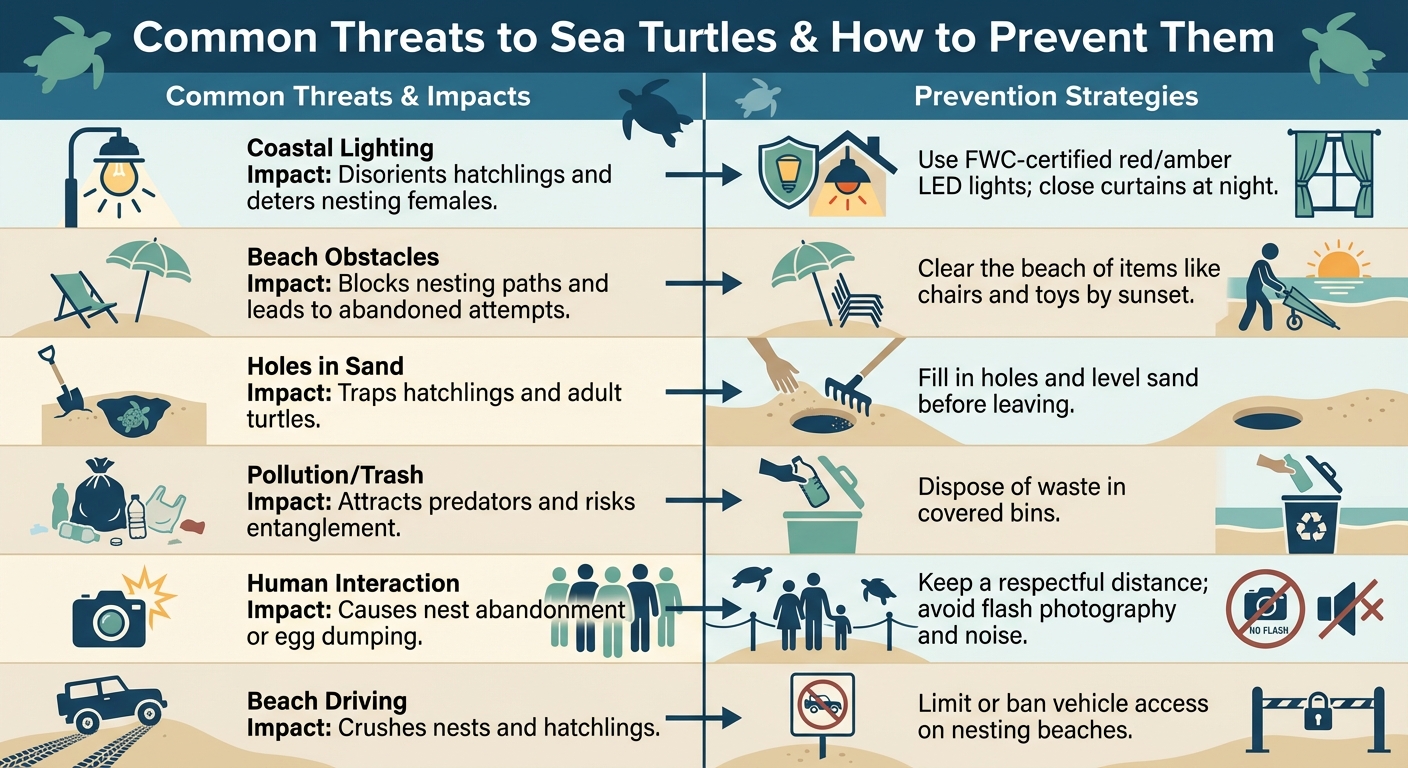
Common Threats to Sea Turtles and Prevention Strategies in South Walton
South Walton's stunning coastline is home to sea turtles, but human activity poses serious risks to their survival. The challenges these turtles face are especially dire during nesting and hatching, times when they are most vulnerable.
Artificial lighting is a major issue. Bright lights from beachfront properties, flashlights, and even cell phones can confuse both nesting females and hatchlings. Instead of heading toward the ocean, hatchlings often crawl inland toward these artificial lights, putting them at risk of dehydration, exhaustion, or predators.
"Noise, lights and movement can cause a turtle to abandon her nesting attempt and sometimes forces her to dump her egg clutch in the water to peril." – South Walton Turtle Watch Group
Beach obstacles and sand disturbances also create significant problems. Items left on the beach - like chairs, umbrellas, and toys - can block turtles or even entangle them during nesting attempts. Deep holes dug in the sand can trap both hatchlings and adult turtles, while large sandcastles may obstruct the path of hatchlings trying to reach the sea.
Pollution and human interference add another layer of danger. Trash and leftover food attract predators such as raccoons and coyotes, which can dig up nests and destroy eggs. Other human activities, like using flash photography, driving on the beach, or hosting bonfires, can disturb turtles, sometimes causing them to abandon their nests or harming eggs and hatchlings.
"In order to keep sea turtles and our beaches and oceans healthy, it's important for all of us to be good neighbors and do our part." – Dr. Robbin Trindell, Sea Turtle Management Program Leader at the Florida Fish and Wildlife Conservation Commission
Here's a quick look at the key threats sea turtles face and simple ways we can help:
Common Threats and How to Prevent Them
| Threat | Impact on Turtles | Prevention Strategy |
|---|---|---|
| Coastal Lighting | Disorients hatchlings and deters nesting females | Use FWC-certified red/amber LED lights; close curtains at night |
| Beach Obstacles | Blocks nesting paths and leads to abandoned attempts | Clear the beach of items like chairs and toys by sunset |
| Holes in Sand | Traps hatchlings and adult turtles | Fill in holes and level sand before leaving |
| Pollution/Trash | Attracts predators and risks entanglement | Dispose of waste in covered bins |
| Human Interaction | Causes nest abandonment or egg dumping | Keep a respectful distance; avoid flash photography and noise |
| Beach Driving | Crushes nests and hatchlings | Limit or ban vehicle access on nesting beaches |
sbb-itb-d06eda6
Conservation Programs in South Walton
Sea turtle conservation in South Walton thrives thanks to the dedication of two key organizations.
South Walton Turtle Watch

The South Walton Turtle Watch (SWTW) is a non-profit group working under the authorization of the Florida Fish & Wildlife Conservation Commission. From May 1 to October 31, its trained volunteers patrol the beaches at sunrise, searching for turtle crawls, marking nests with stakes and flagging tape, and keeping a close eye on them throughout their 60-day incubation period. All findings are meticulously reported to the FWC.
This season, SWTW's efforts confirmed strong nesting activity, reinforcing earlier data. Beyond nest monitoring, the organization also plays a critical role in responding to emergencies involving stranded, sick, or injured sea turtles, facilitating their swift rehabilitation. SWTW further engages the community through events promoting the #CleanDarkFlat initiative, which emphasizes keeping beaches clean, dark, and level to protect turtle habitats.
"We strive to protect them and their nesting habitats so they can continue to thrive and increase healthy populations." – South Walton Turtle Watch
While SWTW focuses on fieldwork, another local group takes the lead in public education and awareness.
Friends of South Walton Sea Turtles
Friends of South Walton Sea Turtles (FSWST) is a volunteer-driven organization dedicated to educating the community about sea turtle conservation. Through school programs, public meetings, and active social media campaigns, FSWST spreads awareness and encourages participation in conservation efforts. They also support these initiatives financially through fundraising and merchandise sales.
"The original group's primary mission is to locate turtles and their nests in order to protect them." – Friends of South Walton Sea Turtles
Together, SWTW and FSWST create a well-rounded approach to conservation in South Walton, combining hands-on protection of sea turtles and their nests with efforts to educate and involve the local community in preserving these remarkable creatures.
How to Help: Keep Beaches Clean, Dark, and Flat
In South Walton, everyone - whether a visitor or a resident - has an important role in protecting sea turtles during nesting season. The #CleanDarkFlat initiative lays out three straightforward rules that can make a life-saving difference for both nesting mothers and their hatchlings.
The #CleanDarkFlat Rules
These simple steps take just a few minutes but have a massive impact, helping to create safe pathways for countless sea turtles each season. Beyond protecting turtle pathways, these actions also complement the work of volunteer monitoring teams.
| Rule | Specific Actions | Why It Protects Sea Turtles |
|---|---|---|
| Clean | Remove all beach gear (chairs, tents, toys) and dispose of trash in covered bins. | Prevents entanglement and ensures nesting mothers can reach the dunes without obstacles. |
| Dark | Turn off outdoor lights, close blinds, and use red/amber flashlights. | Avoids disorienting hatchlings, who use the natural horizon glow to find their way to the sea. |
| Flat | Fill in holes and level sand structures before sunset. | Prevents nesting mothers and hatchlings from falling into holes or being blocked on their journey. |
When using flashlights, make sure they are FWC-certified red/amber LED models with low, shielded, long-wavelength output.
Holes deeper than 2 feet are especially dangerous for hatchlings and can even delay emergency responders. Walton County Ordinance requires that holes no larger than 3 feet by 3 feet and no deeper than 2 feet be filled before leaving the beach. Want to do more? Join the "Hole Patrol" volunteer program to help keep beaches safe for turtles and people alike.
As Dr. Robbin Trindell emphasized earlier, we all share the responsibility of keeping sea turtles and beaches safe and healthy.
Volunteer and Report Turtle Activity
Protecting sea turtles goes beyond following the #CleanDarkFlat rules - active volunteer participation can make an even bigger difference. If you encounter a sick, injured, or stranded turtle, do not touch or push it back into the water - this is not only harmful but also illegal. Instead, report it immediately by calling the South Walton Turtle Watch Hotline at 850‑865‑4503 or texting #FWC. Local survey teams are also available to assist.
For those who want to get involved, volunteers can commit to at least two days per week from May 1 to October 31. Volunteers must be 18 or older and live locally.
Another way to learn and contribute is by attending Wild Sea Turtle Wednesdays at The Big Chill in Watersound. These events, held from 9:00 AM to 11:00 AM during May, June, and July, provide a chance to hear from conservationists directly. Additionally, property owners can help spread awareness by purchasing weatherproof #CleanDarkFlat posters to educate rental guests throughout the season.
Conclusion
South Walton's beaches play a crucial role in the marine ecosystem, and the conservation of sea turtles here depends on everyone who visits. The 4,975 hatchlings that made it to the water during the 2025 season stand as a testament to the dedication of volunteers, residents, and visitors alike.
As Dr. Robbin Trindell from the Florida Fish and Wildlife Conservation Commission puts it:
"In order to keep sea turtles and our beaches and oceans healthy, it's important for all of us to be good neighbors and do our part."
This statement highlights how even small, mindful actions can make a big difference for nesting turtles. Sea turtles are a keystone species, meaning their well-being reflects the overall health of South Walton's beaches and marine ecosystems. By protecting them, we safeguard the entire coastal environment for all who rely on it.
Whether you're new to the area or have called it home for years, you can contribute in meaningful ways. Report stranded turtles to the South Walton Turtle Watch Hotline at 850-865-4503, educate others about turtle safety, or volunteer during the nesting season from May 1 to October 31. The steps you take today help ensure a thriving future for South Walton's beaches.
These beaches are shared by everyone. By acting responsibly, we can preserve their beauty and ensure that generations to come will continue to marvel at these incredible creatures.
FAQs
What are the #CleanDarkFlat guidelines, and why do they matter for sea turtles?
The #CleanDarkFlat guidelines are designed to safeguard sea turtles during their nesting season, which lasts from May 1 to October 31. These rules focus on maintaining beaches in three key ways: clean, dark, and flat. Each of these actions helps create a safe space for nesting females and their hatchlings.
- Clean: Clear the beach of trash and debris to remove obstacles that could block or harm turtles.
- Dark: Turn off unnecessary lights at night or switch to long-wavelength amber LED bulbs to avoid confusing turtles, as artificial lights can disorient them.
- Flat: Smooth out the sand by filling in holes and leveling sandcastles, ensuring hatchlings have an unobstructed path to the ocean.
These efforts are crucial because artificial lighting and beach clutter can lead to dehydration, injuries, or increased vulnerability to predators for turtles. By following these straightforward steps, you can actively contribute to the survival of these endangered creatures in South Walton.
How does artificial lighting harm sea turtles during nesting season?
Artificial lighting poses a serious threat to sea turtles, particularly during nesting season. When hatchlings emerge from their nests, their instinct is to move toward the brightest light, which would naturally be the moonlit ocean. Unfortunately, artificial lights from buildings, streetlights, and other human-made sources can disorient them, leading them away from the water. This confusion can result in dehydration, exhaustion, predation, or even death for these vulnerable creatures.
To combat this issue, South Walton has implemented local regulations requiring beachfront properties to reduce light pollution. Measures include using turtle-friendly lighting, such as long-wavelength amber LEDs, shielding light fixtures, and turning off unnecessary lights at night. Additionally, residents and visitors can play a role by keeping beaches clean, dark, and flat. These simple actions are crucial for ensuring hatchlings safely make their way to the ocean during nesting season, which spans from May 1 to October 31.
How can I volunteer to help with sea turtle conservation in South Walton?
Getting involved in sea turtle conservation in South Walton is a fulfilling way to help protect these amazing animals. If you're interested, you can join the South Walton Turtle Watch (SWTW) for daily beach patrols during nesting season, which runs from May 1 to October 31. Volunteers help monitor nests, track hatchlings, and ensure they make it safely to the ocean. There's also an opportunity to assist with public education and report any distressed or stranded turtles by calling 850-865-4503.
Another great way to contribute is through the Volunteer Beach Ambassador (VBA) program, organized by the Friends of South Walton Sea Turtles. Ambassadors focus on teaching visitors how to adopt turtle-friendly habits, like minimizing artificial light, filling in holes on the beach, and keeping the area clean. You can also join outreach campaigns such as #CleanDarkFlat, which aim to raise awareness and protect nesting sites. Every small effort counts when it comes to safeguarding South Walton’s sea turtles for the future.