- Fines & Stop-Work Orders: Unpermitted projects often result in hefty fines and immediate halts to construction. Retroactive permits may cost 3-5x the standard fee.
- Demolition Risks: In some cases, unapproved work must be removed entirely or exposed for inspection.
- Property Value Impact: Appraisers may assign $0 value to unpermitted improvements, reducing overall property worth.
- Insurance Issues: Claims can be denied, and liability coverage may not apply to unpermitted areas.
- Selling Challenges: Florida law requires sellers to disclose unpermitted work, which can deter buyers or complicate financing.
Key Takeaway:
Proper permits ensure compliance with Florida Building Code, protect property value, and avoid legal and financial headaches. Always consult Walton County's guidelines before starting renovations.
Legal Consequences of Unpermitted Renovations in 30A
Fines, Stop-Work Orders, and Legal Actions
When unpermitted renovations are discovered in Walton County, enforcement kicks in right away. The first step is often a stop-work order, which halts all construction until the issue is resolved. Property owners must then apply for retroactive, or "after-the-fact", permits. These come with the original permit fee plus additional penalty fines.
Sometimes, the situation gets even more complicated. Owners may be required to expose parts of the structure for inspection or, in extreme cases, demolish the unpermitted work entirely. As Sovanic, Inc., a general contractor, explains:
"When a local building department discovers unpermitted work, they may issue a 'stop work order' and impose fines that can be substantial."
Florida law also requires sellers to disclose any unpermitted work when selling their property. Failing to do so can open the door to lawsuits. According to Loshak Law PLLC:
"Florida sellers are legally obligated to disclose unpermitted work at the time of the sale. If the seller fails to do so, you are free to file a lawsuit against them in state court."
In most cases, contracts from the Florida Realtors Association mandate that sellers address unpermitted work before closing. Adding to the complexity, there’s no time limit for enforcement on unpermitted work in Florida. Violations can still be addressed years - or even decades - later. These legal and financial consequences can be both immediate and long-lasting.
Effects on Property Value and Insurance Claims
Unpermitted renovations can take a serious toll on property value and insurance. Appraisers often assign a value of $0 to unpermitted improvements since there’s no assurance the work complies with building codes. This means that even a beautifully updated kitchen or a new addition might not contribute to the home's official value.
Insurance claims tied to unpermitted work are another major headache. Edgar DeJesus, a mortgage professional at Treasure Coast Home Loans, explains:
"If you file a claim related to unpermitted work, your insurance company may deny coverage entirely."
Insurance companies often reject claims for damage caused by unpermitted electrical or plumbing work. Liability coverage can also be denied if someone is injured in an unpermitted area, such as a deck or addition. Beyond that, unpermitted work can lead to higher premiums or force homeowners into high-risk insurance pools.
Selling a property with unpermitted work is no easy task. A 2023 study in Tampa revealed that of approximately 850,000 home remodels, only about 9% had proper permits pulled. If unpermitted work is discovered during a sale, buyers might walk away or demand steep price reductions. Additionally, government-backed lenders like FHA and VA may refuse financing for homes with unpermitted structural or safety-related renovations.
Additional Regulations for Flood Zones and Coastal Properties
For coastal properties in 30A, the stakes are even higher. Walton County enforces stricter rules for violations involving land clearing, wetland disturbances, or unpermitted coastal construction. Erika Phelan from Buyers Broker of Florida notes:
"If municipalities discover unpermitted work they could require the home improvement to be demolished, bring the improvement up to code or face fines or liens."
Unapproved clearing in protected areas, such as coastal dune lake zones or wetland buffers, can trigger hefty fines and restoration requirements. Removing vegetation in these zones without permission can lead to even higher penalties and fees.
In cases where violations threaten habitats or sensitive resources, code inspectors are authorized to bypass standard procedures and take immediate action. Properties located seaward of the Coastal Construction Control Line (CCCL) face additional state regulations under Section 161.053 of Florida Statutes. Unpermitted structural changes in these areas can result in the denial of a Certificate of Occupancy, effectively barring legal use of the property.
How to Obtain Renovation Permits in 30A
Step 1: Determine Which Permits Your Project Needs
Before starting your renovation, figure out which approvals are required. Walton County follows a two-step review process: the Planning and Development Services Department evaluates site plans, zoning, flood zones, and stormwater management, while the Building Department checks for structural integrity and code compliance.
To get started, use the Walton County Interactive Map to find your Parcel ID, Zoning District, and FEMA Flood Zone designation. If your property is near sensitive coastal areas, you may need additional environmental reviews. Properties along CR 30A, 393, 395, and parts of 83 and 283 fall under the Route 30A Scenic Corridor Overlay District, which requires Design Review Board approval.
It’s a good idea to consult the Planner on Call before buying materials or beginning your project. They can clarify requirements for setbacks, stormwater management, and neighborhood-specific plans. As the Walton County Planning Department advises:
"Confirm requirements in advance. There are many protected areas in South Walton including but not limited to: native vegetative communities; coastal dune lake protection zones; a 25-foot buffer from any wetland area".
Once you’ve identified the permits you need, gather the necessary documentation.
Step 2: Complete and Submit Permit Applications
Prepare all required documents, which typically include engineering plans, architectural drawings, and a site plan showing setbacks and property layout. If your project costs more than $5,000 - or $15,000 for HVAC replacements - you’ll also need to file a Notice of Commencement with the Clerk of Court.
Submit your paperwork, along with applicable fees, to the Walton County Building Division. Keep in mind that the Planning review process usually takes about 2 to 3 weeks. Additionally, land clearing in sensitive areas requires a separate permit, with a $25 application fee for parcels north of the bay.
Once your application is in, the next step is to prepare for inspections.
Step 3: Pass Inspections and Receive Final Approval
During construction, several inspections will be conducted. The Planning Department will check foundation surveys, finish floor elevation, final grading, and stormwater systems. Meanwhile, the Building Department will inspect foundations, framing, plumbing, and electrical systems.
The Walton County Planning Department stresses:
"The key here is to make sure you build according to your approved plans! Deviations can result in delays".
If any issues are found, you’ll need to address them and pay re-inspection fees before scheduling the next inspection. Once all inspections are cleared, you’ll receive final approval or a Certificate of Occupancy.
Keep in mind that building permits are valid for 180 days from the date of issuance. If you’re unable to schedule an inspection within this period, you’ll need to request a permit extension to prevent expiration.
Can Unpermitted Renovations Lead to Demolition Orders?
sbb-itb-d06eda6
Permitted vs. Unpermitted Renovations: A Direct Comparison
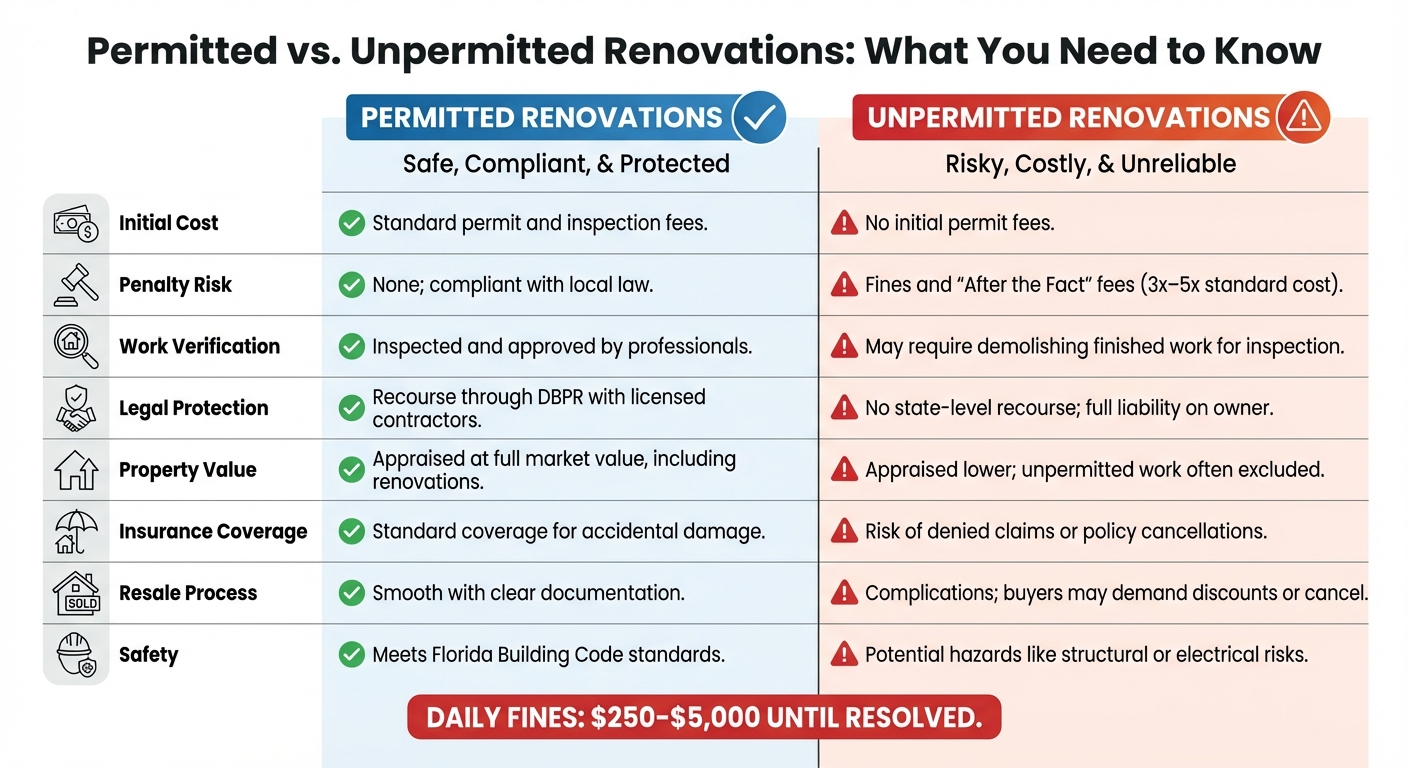
Permitted vs Unpermitted Renovations in 30A Florida
When deciding on renovations, it's tempting to skip permits to save time and money upfront. But this choice often leads to far greater expenses and risks down the line. Comparing permitted and unpermitted work side by side highlights the critical differences and helps you make smarter decisions for your 30A renovation project.
Let’s start with costs. Unpermitted work seems cheaper initially because there are no permit fees. However, if discovered, you’ll face steep "After the Fact" fees that are 3 to 5 times the standard permit cost. Worse, you may need to tear out finished walls or floors to allow inspections, adding even more to the expense.
Legal protections also set permitted work apart. When you hire licensed contractors and secure permits, you gain legal recourse through Florida's Department of Business and Professional Regulation (DBPR). With unpermitted work, you’re on your own. If something goes wrong, you assume full liability for meeting Florida Building Code standards.
Property value and insurance are other key considerations. Unpermitted renovations can reduce your home’s appraised value and even make it harder to secure financing. Insurance companies may deny claims for damage caused by unpermitted electrical or plumbing work, leaving you to cover the costs out of pocket.
Here’s a quick breakdown of these differences:
Table: Permitted vs. Unpermitted Renovations
| Feature | Permitted Renovation | Unpermitted Renovation |
|---|---|---|
| Initial Cost | Standard permit and inspection fees | No initial permit fees |
| Penalty Risk | None; compliant with local law | Fines and "After the Fact" fees (3x–5x standard cost) |
| Work Verification | Inspected and approved by professionals | May require demolishing finished work for inspection |
| Legal Protection | Recourse through DBPR with licensed contractors | No state-level recourse; full liability on owner |
| Property Value | Appraised at full market value, including renovations | Appraised lower; unpermitted work often excluded |
| Insurance Coverage | Standard coverage for accidental damage | Risk of denied claims or policy cancellations |
| Resale Process | Smooth with clear documentation | Complications; buyers may demand discounts or cancel |
| Safety | Meets Florida Building Code standards | Potential hazards like structural or electrical risks |
This comparison highlights the long-term benefits of sticking to permitted renovations. While the upfront costs might seem higher, the peace of mind, legal protection, and financial security make it well worth the investment.
Conclusion: Follow Permit Requirements to Avoid Legal and Financial Problems
Skipping permits might seem like a shortcut, but the risks far outweigh any initial time savings. If code enforcement gets involved, your project can come to an abrupt halt, and fines quickly pile up. In fact, after-the-fact fees can inflate permit costs by 2 to 5 times, with daily fines ranging from $250 to $5,000 until the issue is resolved.
Beyond fines, unpermitted work can create a cascade of problems. It can void property insurance, complicate sales or refinancing due to flagged title issues, and, in extreme cases, unpaid fines may turn into liens that could lead to foreclosure.
"Ignoring the permitting requirements can lead to severe financial penalties, mandated demolition, and long-term legal issues that far outweigh the time and cost of proper planning."
To avoid these headaches, it's crucial to follow the permit process. As outlined earlier, proper permits are key to both compliance and maintaining your property’s value. Before starting any project, reach out to the Walton County Building Department to confirm permit requirements, work with licensed contractors, and ensure you file a Notice of Commencement for projects exceeding $5,000.
Permits are more than just a legal requirement - they’re a safeguard against financial pitfalls, legal troubles, and potential property devaluation. By investing time and effort upfront, you protect your 30A property and ensure its long-term integrity.
FAQs
What happens if I try to sell a home with unpermitted renovations in Florida?
Selling a home in Florida that includes unpermitted renovations can be a tricky process. Buyers and their inspectors often identify unpermitted work, which can lead to delays, renegotiations, or even a canceled deal. Florida law also requires sellers to disclose any such renovations, which may cause potential buyers to hesitate or lose confidence in the property.
In some cases, the unpermitted work might need to be corrected or retroactively permitted before the sale can proceed. This process can take time and may come with significant costs. Tackling these issues ahead of listing your home can help streamline the sale and reduce the risk of complications.
What are the risks to your property insurance if you renovate without permits?
Renovating without the right permits can lead to big headaches with your property insurance. If damage happens because of unpermitted work, your insurer might deny your claim, cut back on coverage, or even cancel your policy altogether. Why? Unpermitted work often skips inspections and may not meet building codes, which increases the chances of problems down the line.
To safeguard your home and steer clear of unexpected costs, make sure all renovations follow local permit rules. It’s a small step that can save you from major trouble later.
How can I make sure my renovation project meets Walton County regulations?
Before diving into your renovation project in Walton County, it's crucial to determine whether you need a permit. Generally, permits are required for most structural, electrical, plumbing, or mechanical work. However, smaller projects, such as detached buildings under 400 square feet or minor additions outside the Coastal Building Zone, might not require one.
Once you've established the need for a permit, the next step is submitting the appropriate application. This process ensures your project meets local building and environmental standards. After approval, proceed with construction as outlined in your plans. Remember to schedule inspections at key stages to confirm everything complies with the regulations. Following these steps can help you steer clear of legal troubles or fines for unpermitted work.