
Zoning Laws for Short-Term Rentals on 30A
Essential rules for 30A short-term rentals: state license and $300 Walton County VRC, zoning/HOA limits, taxes, occupancy, safety, coastal protections, and permit freezes.

If you're renting out property on 30A for short-term stays, here’s what you need to know:
- Registration is mandatory: You must obtain a Walton County Vacation Rental Certificate (VRC) for $300/year and a state license from Florida's Department of Business and Professional Regulation.
- Rules vary by area: Zoning laws, environmental protections, and HOA restrictions can significantly impact what’s allowed. Some areas ban new rental permits altogether.
- Tax obligations: Rentals in South Walton are subject to a 5% Tourist Development Tax, while North Walton properties pay 3%.
- Occupancy and safety: Limits on guest numbers, parking requirements, and fire safety codes are strictly enforced. Violations can result in fines up to $500/day.
- Stay compliant: Display your VRC number on all ads and signage, follow local quiet hours, and ensure your property meets all county and HOA guidelines.
Failing to follow these rules can lead to hefty fines and legal complications. Always verify zoning and HOA restrictions before listing or buying property.
30A & DESTIN Things You Need to Know Before Moving!
How Zoning Works in 30A Communities
Walton County is divided into four planning areas, with 30A located in South Walton County. Every property in this area falls into a specific zoning district, which dictates its permissible uses. These zoning classifications are critical for determining whether short-term rentals are allowed. Essentially, these districts lay the foundation for the unique regulations that shape each community.
One notable zoning category in the area is Traditional Neighborhood Developments (TNDs). Communities like Alys Beach and Rosemary Beach are prime examples of TNDs, operating under carefully designed master plans. Unlike standard residential zones, TNDs often mix residential and commercial spaces in distinct ways and enforce stricter architectural guidelines.
Zoning Categories and Short-Term Rental Rules
In most of 30A’s standard residential zones, short-term rentals are generally allowed, though specific restrictions apply. For example, Accessory Dwelling Units (ADUs) must be no larger than 800 square feet of conditioned space and cannot exceed 75% of the size of the primary dwelling. Meanwhile, Recreational Vehicles (RVs) are prohibited from being used as short-term vacation rentals, even if they’re on private property with a temporary living permit.
For home-based businesses in residential zones, the rules limit operations to 25% of the property’s floor area and allow no more than two employees who don’t live on-site.
Community-Specific Rules
In addition to county-wide zoning laws, individual communities often enforce their own set of rules. For instance, Grayton Beach, the oldest community on 30A, adheres to county zoning while maintaining its historic charm. Similarly, Blue Mountain Beach follows county regulations without significant deviations. However, private planned communities like Seaside and WaterColor introduce additional restrictions. These often require homeowners to navigate separate approval processes through their homeowners associations before listing properties for rent.
Rosemary Beach takes it a step further by mandating that all rentals receive approval from its HOA Design Review Board. This community operates under a neo-traditional master plan featuring iconic design elements such as white picket fences and brick-lined streets, with strict standards that leave little room for flexibility. Likewise, Alys Beach, which spans 158 acres along the Gulf, enforces a luxury-focused aesthetic with an emphasis on clean, simple architectural forms.
As of February 2023, Walton County reported over 14,000 active short-term vacation rentals, with nearly 90% of them being single-family homes. However, certain parts of Santa Rosa Beach, including areas like Blue Mountain Beach, are currently subject to a freeze on new applications for non-hosted short-term rentals. If you’re considering purchasing property in these areas, it’s crucial to check with the Walton County Planning Department to confirm whether a new certificate is even an option, especially in zones with restricted permit availability.
Understanding these zoning details is an important step before diving into the licensing and compliance process, which will be covered later.
Problems Short-Term Rental Owners Face
Even with a solid understanding of zoning laws, short-term rental owners often encounter a maze of additional restrictions. These go beyond county rules and touch on issues like homeowners' association (HOA) regulations, coastal protections, and parking requirements. Here's a closer look at these challenges.
HOA and Neighborhood Restrictions
In many planned communities, HOAs enforce stricter rental rules that can override county permissions. For instance, Walton County might grant a Vacation Rental Certificate (VRC), but that doesn’t exempt owners from following HOA-specific guidelines. Some HOAs outright ban short-term rentals or require separate approvals, leaving owners to navigate multiple layers of compliance. It’s crucial to remember that a VRC doesn’t trump HOA or neighborhood rules, so verifying all local requirements is a must.
Coastal and Environmental Protection Rules
For properties near the Gulf, environmental regulations add another layer of complexity. Coastal construction control lines, dune protection ordinances, and sea turtle lighting rules can directly impact how owners operate or modify their rentals. For example, during sea turtle nesting season, outdoor lighting must meet strict standards to avoid disturbing wildlife. Additionally, any changes to beachfront structures or landscaping may require special permits. While these measures are in place to protect the natural environment, they can create seasonal and operational challenges for rental owners.
Parking and Property Setback Rules
Parking often becomes a headache, especially in older neighborhoods that weren’t designed for multiple guest vehicles. Zoning laws typically require a minimum number of parking spaces based on the size of the property and the number of bedrooms. Falling short of these requirements can lead to enforcement actions. On top of that, street parking bans and property setback rules can limit where owners can add parking spaces, outdoor amenities, or accessory structures, making compliance even trickier.
How to Meet Zoning Requirements
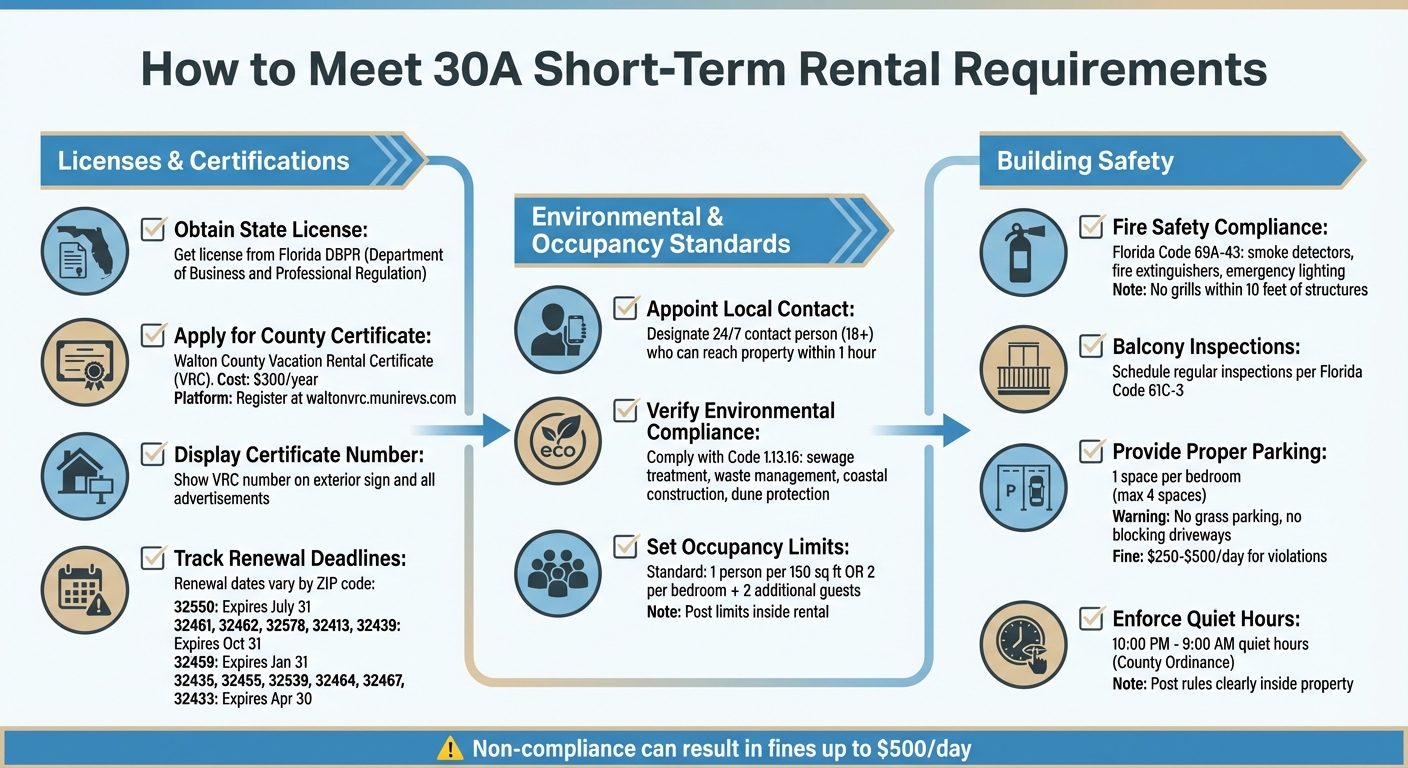
30A Short-Term Rental Compliance Checklist: Licenses, Certifications, and Safety Requirements
Navigating zoning requirements for short-term rentals on 30A involves a detailed approval process. Property owners must secure state and county certifications, adhere to coastal regulations, and follow building safety codes. Here’s a breakdown of how to handle each step.
Getting Licenses and Certifications
Obtain a state license. Before operating legally, all short-term rental owners must secure a license from the Florida Department of Business and Professional Regulation (DBPR). This is a statewide requirement and separate from county-specific certifications.
Apply for the Walton County Vacation Rental Certificate (VRC). This certificate costs $300 annually and is required before advertising or renting your property. You can register online using the GovOS/MuniRevs platform (waltonvrc.munirevs.com). Either property owners or their managing agents (with a signed Agent Affidavit) can complete the application process. Once approved, you must display your VRC number on a visible exterior sign at the property and include it in all your advertisements.
Keep track of renewal deadlines. Certificates expire based on your property’s ZIP code. Missing the renewal date can lead to late fees and fines. Here’s a quick reference for the renewal schedule:
| ZIP Code | Issuance Date | Expiration Date |
|---|---|---|
| 32550 | Aug 1 | July 31 |
| 32461, 32462, 32578, 32413, 32439 | Nov 1 | Oct 31 |
| 32459 | Feb 1 | Jan 31 |
| 32435, 32455, 32539, 32464, 32467, 32433 | May 1 | Apr 30 |
If you decide to stop renting, deactivate all listings and close your GovOS account. Otherwise, your property will still fall under short-term rental regulations.
Meeting Coastal and Environmental Standards
Once your certifications are in place, shift your focus to compliance with environmental and occupancy standards.
Appoint a local responsible party. Walton County requires you to designate a contact person over 18 who is available 24/7 and can reach the property within an hour to address inspections or guest issues.
Follow environmental codes. Your VRC application includes an affidavit verifying that your property complies with Walton County Florida Code 1.13.16. This covers requirements for on-site sewage treatment and solid waste management. For beachfront properties, you’ll also need to adhere to coastal construction control lines and dune protection ordinances.
Understand occupancy rules. Walton County typically limits occupancy to one person per 150 square feet of heated and cooled living space, or two people per bedroom plus two additional guests. Some communities enforce stricter limits. For example, 30A Townhomes restricts occupancy to 11 people for 3-story units (2,349 sq. ft.) and 7 people for 2-story units (1,522 sq. ft.). These rules should be posted inside the rental, often as a window cling near the front door.
Building Safety Requirements
Comply with fire safety codes. Short-term rentals must meet Florida Administrative Code 69A-43, which requires working smoke detectors, fire extinguishers, and emergency lighting. Additionally, some communities prohibit grills near balconies or within 10 feet of structures.
Schedule balcony inspections. Florida Administrative Code 61C-3 mandates regular inspections for balconies to ensure safety.
Provide proper parking. You’ll need a parking plan showing off-street spaces - typically one space per bedroom, up to a maximum of four. Parking on grass or blocking driveways is against county rules and can result in daily fines ranging from $250 to $500. Most 30A communities ban street parking, as well as trailers, boats, and oversized vehicles.
Enforce quiet hours. Walton County Ordinance requires quiet hours from 10:00 p.m. to 9:00 a.m.. Repeated violations can put your rental certificate at risk. Make sure to post these rules clearly inside the property to keep guests informed.
Choosing a Property That Meets Zoning Rules
Checking Zoning and HOA Rules Before Buying
Before purchasing a property, it's crucial to confirm it qualifies as a short-term rental. In Walton County, any property rented out more than three times a year for stays shorter than 30 days is considered a short-term vacation rental.
Make sure the property is eligible for a Walton County Vacation Rental Certificate (VRC) and a business license from the Department of Business and Professional Regulation (DBPR). You can check the licensing status of the property or similar units in the area through the DBPR online portal. Skipping this step could result in hefty fines for noncompliance.
Carefully review any community-specific restrictions. Many properties along 30A are in planned developments or gated communities, such as Calypso Point or Cypress Dunes, which often have HOA rules governing rentals. Some communities may outright ban short-term rentals, while others might impose limits on occupancy or how often the property can be rented. Request and review the HOA covenants, conditions, and restrictions (CC&Rs) before committing to a purchase.
Additionally, check Walton County's GovOS system for any active violations or enforcement actions tied to the property. Ensure that any existing rental listings comply with current regulations to avoid future complications.
Once you've confirmed the property meets all legal requirements, you can shift your focus to evaluating market conditions and potential investment opportunities.
Researching Competition and Future Development
After confirming zoning and legal compliance, it's time to dive into market research. Start by analyzing the rental landscape based on guest capacity. Along 30A, rental options range from cozy carriage houses for two guests to sprawling "reunion houses" that can accommodate up to 40. Nightly rates vary widely, with carriage houses typically priced between $105 and $505, while luxury estates can fetch between $475 and $6,115 per night. Look for opportunities in underserved segments, such as mid-size rentals for 10–16 guests or properties catering to large groups of 30 or more.
Consider the amenities that can make your property stand out. Features like private pools, golf carts, EV chargers, and private beach access are often associated with high-performing rentals. Evaluate whether the property includes these amenities or if you can add them while staying within zoning and HOA guidelines.
Keep an eye on vacant land listings and review setback or build-to-line requirements in the Land Development Code to gauge future competition. Properties near Coastal Dune Lakes or in Coastal High Hazard Areas are subject to stricter regulations, which may limit new developments in the area but could also impact your own expansion plans.
Lastly, think about the character of the community and the type of guests it attracts. Different neighborhoods along 30A cater to varied audiences. For instance, Rosemary Beach is known for its upscale, walkable charm, appealing to high-end travelers, while Inlet Beach offers larger lots and newer homes, making it ideal for family gatherings. Choose a location that aligns with your business goals and the guest experience you want to offer.
Conclusion: Following Zoning Laws on 30A
Staying compliant with 30A short-term rental regulations is simpler when you stick to the required steps. First and foremost, every property must secure both a Vacation Rental Certificate and a state license from the Florida Department of Business and Professional Regulation (DBPR) before being listed. Skipping this step - or renting and advertising without the certificate - can lead to hefty daily fines of $500, along with other penalties. Additionally, the certificate number needs to be displayed on all online advertisements and on exterior signage.
Pay close attention to renewal deadlines, as they vary by ZIP code. For example, certificates for properties in ZIP code 32461 expire on October 31, while those in 32459 expire on January 31. If you decide to stop renting your property, make sure to deactivate all listings; otherwise, enforcement actions may still apply. It's important to note that compliance is entirely the owner's responsibility - platforms like Airbnb and Vrbo won’t handle local certifications for you.
If you’re ever unsure about requirements, reach out to local professionals or contact Walton County's Planning Department for assistance. Following these rules not only helps you avoid fines but also ensures your property aligns with community standards and protects your investment.
FAQs
What zoning rules apply to short-term rentals on 30A?
Walton County’s zoning rules significantly influence where short-term rentals can operate along the 30A corridor. Although the regulations don’t explicitly outline specific zoning categories, they aim to strike a balance between supporting tourism and maintaining the unique character of the local communities. For property owners, it’s crucial to carefully review the county’s zoning codes and check with local authorities to stay compliant.
Familiarity with these zoning laws is key to avoiding fines or restrictions, particularly in areas with stringent residential or environmental protections. If you’re considering buying or renting out a property in the area, working with a local expert can provide valuable guidance and help you navigate these regulations with ease.
How do HOA rules affect short-term rentals in 30A communities?
Homeowners’ Associations (HOAs) wield considerable influence over short-term rentals along 30A. Many beachfront neighborhoods have HOA covenants that either allow, restrict, or outright ban vacation rentals. Even in cases where short-term rentals are permitted, HOAs often impose additional rules. These might include occupancy limits, mandatory insurance coverage, or obtaining a county rental certificate. Communities like Seacrest Beach or Rosemary Beach, for instance, may enforce stricter guidelines, such as banning rentals shorter than 30 days or requiring the property owner to occupy the home.
HOA rules don’t stop at rental policies - they can also affect everyday operations. Think parking restrictions, noise curfews, or pet policies. Violating these rules could result in fines or even the loss of rental privileges. To avoid complications, it’s crucial to thoroughly review your HOA’s governing documents, such as covenants and bylaws, before diving into a short-term rental plan. Familiarizing yourself with these rules can help ensure a hassle-free experience for both you and your guests.
What environmental rules should short-term rental owners near the Gulf follow?
Short-term rental owners along 30A need to follow specific rules designed to protect the Gulf's delicate ecosystem. A key regulation is Walton County’s Beach Code, which emphasizes "Leave No Trace" practices. This means personal belongings must be removed from the beach between one hour after sunset and one hour before sunrise unless you have special permission. Additionally, any sightings of nesting or hatching sea turtles should be reported to Florida Fish and Wildlife Conservation.
From May through October, during sea turtle nesting season, extra precautions are required. Exterior lights, such as those on balconies or porches, must either be turned off or fitted with red filters to prevent disorienting the turtles. Rental owners are also responsible for properly managing trash, avoiding any interference with turtle nests, and filling in holes in the sand to ensure a safe environment. By adhering to these rules, you’re not only complying with local laws but also playing a part in preserving this unique coastal habitat.


