Local paddleboarding and kayaking rules on 30A are designed to keep you safe and protect the area’s waters and wildlife. From mandatory safety gear to restrictions on motorized vessels in certain areas, following these guidelines ensures a hassle-free and enjoyable experience. Here’s what you need to know:
- Safety Gear: Always have a USCG-approved life jacket, a whistle or horn, and a white light for night paddling. In coastal waters at night, carry distress signals.
- Registration: Nonmotorized paddlecraft don’t need registration. Motorized ones must be registered within 30 days of purchase.
- Navigation Rules: Yield to larger boats, stay visible, and follow right-of-way rules.
- Local Restrictions: Only non-motorized watercraft are allowed on coastal dune lakes. Launch only from designated areas. Avoid disturbing dunes, sea oats, or wildlife.
- Beach Rules: Maintain a 15-foot setback from dunes and water. Remove all gear one hour after sunset to comply with local ordinances.
- Flag System: Double red flags mean waters are closed. Fines for violations can reach $500.
Text "SAFETY" to 31279 for real-time updates on Gulf conditions, and always check local signage before heading out.
Paddle Boarding PFD Laws, Access Permits and How to Stay Safe!
Florida State Laws for Paddleboarding and Kayaking
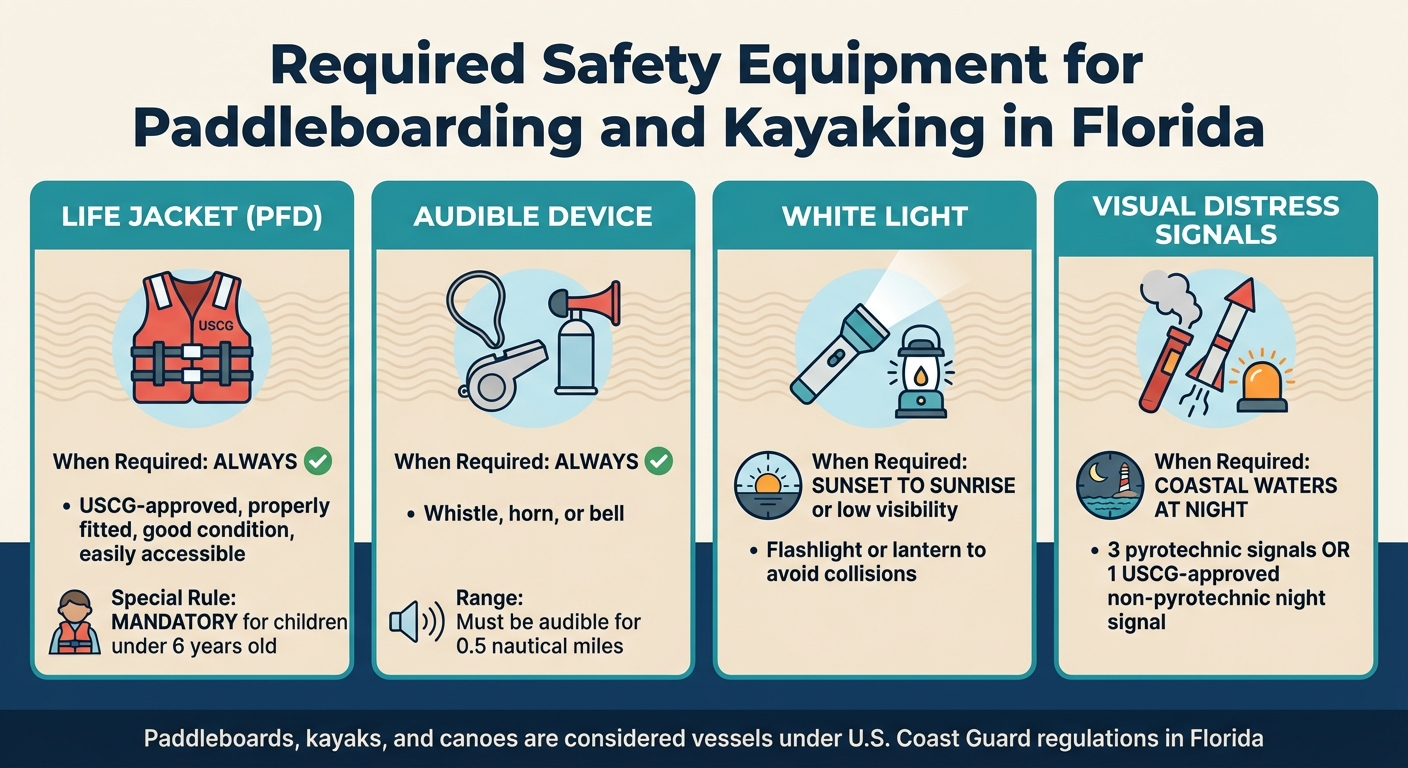
Required Safety Equipment for Paddleboarding and Kayaking in Florida
In Florida, paddleboards, kayaks, and canoes are considered vessels under U.S. Coast Guard (USCG) regulations, unless paddleboards are used exclusively in designated swimming, surfing, or bathing areas. This classification means paddlers must follow the same safety rules that apply to other watercraft in the state.
Every person on board must have a USCG-approved life jacket that fits properly, is in good condition, and is easy to access. For children under 6 years old, wearing a life jacket at all times while the vessel is in motion is mandatory. Additionally, you’ll need an audible signaling device, like a whistle or horn, capable of being heard from at least half a nautical mile away.
If you're paddling at night (from sunset to sunrise) or in low-visibility conditions, you're required to have a white light source, such as a flashlight or lantern, to avoid collisions. For those venturing into coastal waters like the Gulf of Mexico at night, carrying three pyrotechnic visual distress signals or one USCG-approved non-pyrotechnic night signal is also required. These safety measures are non-negotiable for paddleboarding and kayaking in Florida.
Required Safety Equipment
The safety equipment you need depends on the time and location of your paddling activities.
| Equipment Item | When Required | Specific Details |
|---|---|---|
| Life Jacket (PFD) | Always | USCG-approved; mandatory for children under 6 |
| Audible Device | Always | Whistle, horn, or bell audible for 0.5 nautical miles |
| White Light | Sunset to sunrise or low visibility | Flashlight or lantern |
| Visual Distress Signals | Coastal waters at night | 3 pyrotechnic or 1 non-pyrotechnic night signal |
Registration and Titling Requirements
Rules for registration and titling differ based on whether your paddlecraft is motorized or not.
Nonmotorized vessels under 16 feet, such as standard kayaks and paddleboards, do not require registration or titling in Florida as long as they are powered solely by human effort.
However, if you add a motor - whether gas or electric - you must register and title the vessel through your county tax collector's office. This process must be completed within 30 days of purchase, and you’ll need to carry proof of purchase during the grace period. Operating a motorized vessel without registration after 30 days is considered a misdemeanor. Registration fees range from $5.50 for vessels under 12 feet to $28.75 for those between 16 and 26 feet, with titling fees ranging from $5.25 to $11.00, depending on processing speed.
Navigation Rules and Safety Practices
Right-of-Way Rules
Paddleboards and kayaks are considered vessels under Florida law, so the same rules that apply to motorized watercraft also apply to them. When approaching another watercraft head-on, always turn to the right (starboard) to pass on the left (port) side. If a larger boat overtakes you from behind, maintain a steady course and speed to avoid any sudden surprises for the other vessel.
"When navigating in restricted water areas (docks, bridges, etc.), give way to less maneuverable watercraft, usually larger boats." - MyFWC Florida Fish and Wildlife
In tighter spaces like docks, bridges, or channels, paddlecraft should yield to larger boats that are less maneuverable. Always stick to the starboard side in narrow channels and cross quickly without disrupting other vessels. Keep in mind, powerboat operators may not always see you, so wearing brightly colored life jackets - especially in challenging conditions like fog, glare, or rough waters - can make a big difference in your visibility.
Once you've mastered these navigation basics, it’s equally important to familiarize yourself with essential safety gear, like paddleboard leashes, and understand how to handle rip currents for a safer outing.
Paddleboard Leashes and Safety Tips
Proper navigation goes hand-in-hand with securing your board and following key safety practices. Always use a leash to keep your paddleboard from drifting away if you fall off. Additionally, check the South Walton beach flag system daily to stay informed about ocean conditions.
If you find yourself caught in a rip current, resist the urge to fight against it. Instead, swim parallel to the shore until you’re free of the current, then make your way back to land. Be on the lookout for warning signs of rip currents, such as darker-colored water (indicating deeper areas), murky brown water caused by stirred-up sand, or noticeable gaps in the usual wave patterns.
sbb-itb-d06eda6
30A and South Walton Local Rules
Coastal Dune Lake Rules
South Walton is home to 19 coastal dune lakes, which require careful attention when enjoying activities like paddleboarding or kayaking. Only non-motorized watercraft - such as kayaks and paddleboards - are allowed. Personal watercraft, like jet skis, are strictly prohibited. To protect the delicate environment, make sure to launch only from official public access points, designated park areas, or neighborhood accesses. This helps prevent trespassing and avoids damaging the fragile dunes.
These lakes are brackish, meaning they host a mix of freshwater and saltwater species. If you're fishing here, you'll need both a freshwater and saltwater fishing license. When paddling through shallow areas, be mindful of the seagrasses - lift your paddle and fins to avoid harming these vital plants. Restoration zones, like the cordoned-off areas in Western Lake at Grayton Beach State Park, are strictly off-limits to all watercraft. If you’re bringing a dog along for the adventure, keep them leashed and always pack out their waste to avoid contributing to nutrient pollution, which can lead to harmful algae blooms.
"The lakes are quiet, photogenic, and perfect for easy paddling - provided we all treat them gently." - Destin Dreamers
Additionally, remember that state parks near these lakes may have their own paddling rules in place.
State Park Policies
Each state park along 30A has unique rules to follow. For example, Topsail Hill Preserve State Park prohibits all paddlecraft - including kayaks and paddleboards - on its three coastal dune lakes. Fishing is allowed, but only from the shoreline. On the other hand, Grayton Beach State Park offers a boat ramp for accessing Western Lake, where paddling is encouraged. If you're paddling in the Gulf from state or county properties, you must maintain idle speed within 750 feet of the shoreline. However, launching personal watercraft from Gulf-side parks is not allowed.
Beach and Dune Protection Rules
Local rules also aim to protect the delicate beach and dune ecosystems. Always maintain a 15-foot setback from dunes and the water's edge to ensure emergency corridors remain clear. Walking on dunes or disturbing sea oats is prohibited. Additionally, any paddlecraft left unattended on the beach between one hour after sunset and one hour before sunrise will be removed by authorities.
At Inlet Beach, there’s a 66-foot-wide zone east of the west boundary of Lakeshore Drive that’s designated exclusively for launching vessels. Parking or driving in this area is strictly prohibited. For property owners with permitted storage racks, a maximum of two paddlecraft can be stored, provided they are kept at least three feet above the sand and display a visible permit number.
Restricted Areas and Environmental Protections
Swimming Zones and Diver-Down Flag Rules
If you're paddling in the Gulf of Mexico, it's essential to keep a safe distance from diver-down flags. Stay at least 300 feet away from these flags (red with a white diagonal stripe) in open waters, and 100 feet in rivers, inlets, or navigation channels. If you need to get closer, slow down and maintain control of your vessel.
Pay attention to double red flags, which signal that Gulf waters are closed. Entering these restricted waters could lead to a $500 fine and even criminal charges. For the latest updates on flag conditions, you can text "SAFETY" to 31279. Additionally, remember to leave a 15-foot clearance from the water’s edge to ensure emergency vehicles have access.
While navigation rules are vital, protecting the local environment is just as important.
Wildlife and Habitat Protection Zones
South Walton prioritizes the preservation of its natural habitats, and there are specific guidelines to follow in these areas. Sea turtle nesting season runs from May 1 to October 31. During this period, nests are marked with wooden stakes. Be sure to keep your distance from these protected areas. If you're visiting the beach at night near nesting zones, use red-filtered flashlights, which you can find at the TDC Visitor Information Center.
If you dig holes in the sand, ensure they are no larger than 3 feet by 3 feet in width and no deeper than 2 feet. Always fill them in before leaving to prevent hazards for nesting turtles. When paddling near wildlife, maintain a respectful distance to avoid disturbing sea turtles or shorebirds. Also, refrain from picking up live sand dollars - if they are brown, they are still alive.
Walking on dunes or removing sea oats is strictly off-limits. These plants are protected by state law because they play a key role in preventing erosion.
"By being environmental stewards and ensuring that each of us 'Leave No Trace' when enjoying recreational activities along the area's beaches, waterways and natural lands, we help to protect and preserve this destination." - Visit South Walton
Conclusion
Paddleboarding and kayaking along 30A offer an incredible way to explore South Walton's unspoiled waters. However, these privileges come with responsibilities. Following local regulations isn't just about avoiding a hefty $500 fine for entering the Gulf during double red flag conditions; it's about ensuring your safety, respecting the environment, and safeguarding this destination for future visitors. These rules help protect both you and the delicate ecosystems of 30A.
For Gulf updates, text "SAFETY" to 31279, and always maintain a 15-foot distance from dunes and the water's edge. To comply with Leave No Trace ordinances and protect nesting sea turtles, make sure to remove all gear - paddleboards, kayaks, and personal items - no later than one hour after dusk.
During nesting season (May 1 to October 31), avoid marked sea turtle nests, stay off dunes, and fill in any holes you dig. These small actions play a big role in preserving the ecological harmony that makes South Walton so special.
"By being environmental stewards and ensuring that each of us 'Leave No Trace' when enjoying recreational activities along the area's beaches, waterways and natural lands, we help to protect and preserve this destination while ensuring everyone is afforded the same pristine experience." – SoWal Staff
Whether you're new to paddleboarding or a seasoned pro, following these simple rules ensures a safe and enjoyable experience for everyone. Your efforts not only protect fragile ecosystems but also support emergency responders and keep this coastal paradise vibrant for generations to come.
FAQs
What safety gear do I need for paddleboarding or kayaking at night on 30A?
When heading out paddleboarding or kayaking at night on 30A, it's essential to have a white light that can be seen from all directions (360 degrees). This isn't just a good idea - it’s required by Florida law for nighttime paddling to ensure you're visible to others on the water.
You’ll also need a U.S. Coast Guard-approved personal flotation device (PFD) within reach at all times. For children under 6 years old, wearing the PFD is not optional - it’s mandatory while on a paddleboard or kayak. On top of that, having a whistle or another sound-producing device is strongly recommended. It can be a lifesaver for signaling for help or communicating during emergencies.
By following these rules, you’ll stay safe and meet local requirements while enjoying your nighttime water adventure.
Do I need to register a non-motorized paddleboard or kayak in South Walton?
No, you don’t need to register a non-motorized paddleboard or kayak in Florida. However, you’re still required to follow safety rules. This includes having a U.S. Coast Guard–approved life jacket and a sound-producing device (like a whistle) on board.
If you’re heading to the beaches in South Walton, keep in mind that permits are needed for certain activities, like bringing vehicles, dogs, or having fires on the beach. Always review local regulations beforehand to make sure your trip is both safe and hassle-free.
What happens if you break the double red flag rule in the Gulf of Mexico?
Breaking the double red flag rule in the Gulf of Mexico isn’t just risky - it’s also a serious offense. If you ignore this rule, you could face a $500 fine and even criminal charges.
So, what does the double red flag mean? It signals that the water is off-limits to everyone due to hazardous conditions like strong rip currents or severe weather. These flags are there for your protection, and entering the water during these times is strictly forbidden.
To avoid trouble - and keep yourself safe - always pay attention to the beach safety flags and follow their guidance.