Exploring 30A by golf cart is a fun and practical way to navigate Florida's scenic Emerald Coast. Golf carts, specifically Low-Speed Vehicles (LSVs), are compact, street-legal, and ideal for short trips between beach towns like Seaside, WaterColor, and Alys Beach. Here's a quick rundown of what you need to know:
- Rules & Regulations: LSVs can be driven on roads with speed limits of 35 MPH or less. A valid driver’s license, insurance, and seat belts are mandatory. DUI laws apply, and child car seat rules must be followed.
- Community Restrictions: Some neighborhoods, like Seaside and Rosemary Beach, prohibit visitor rentals, while others, like WaterColor, allow golf carts only with specific rental homes.
- Rental Costs: Expect daily rates between $115–$200 and weekly rates from $390–$835, depending on the cart size and season.
- Top Rental Companies: Popular options include 30A Gulf Carts, The Rental Shop 30A, and Street Legal Golf Cart Rentals, offering a range of electric and gas-powered carts with delivery services.
- Safety Tips: Charge electric carts nightly, park only in designated spaces, and avoid driving on sidewalks or bike paths.
Renting a golf cart on 30A is a convenient way to explore the area’s beaches and communities, but understanding the rules and planning ahead ensures a smooth experience.
5 Golf Cart Rentals in 30A, Florida
Golf Cart Rules and Regulations on 30A
Understanding the rules for golf carts and Low-Speed Vehicles (LSVs) is essential to avoid fines and ensure safety while driving along 30A. Florida law makes a clear distinction between these two types of vehicles, and knowing the difference is crucial.
Florida Laws for Golf Carts and LSVs
Under Florida Statute 320.01, a Low-Speed Vehicle (LSV) is defined as a four-wheeled vehicle with a top speed between 20 mph and 25 mph. Standard golf carts, on the other hand, are limited to a maximum speed of 20 mph and can only operate on neighborhood streets. LSVs, being street-legal, are allowed on roads with speed limits of 35 mph or less, which is why most rental companies on 30A offer LSVs to meet local road requirements.
If you’re driving an LSV, you’ll need a valid driver’s license, registration, titling, and insurance that includes Personal Injury Protection (PIP) and Property Damage Liability. Insurance providers often require drivers to be at least 18 or 21 years old. Lt. Scott Hogeboom from the Walton County Sheriff's Office explains the reasoning behind speed limits:
"Golf carts would impede on traffic if they drove on higher speed roads. The cart would not be able to keep up and any higher speed would be unsafe".
Keep in mind that Highway 98 and its shoulders are strictly off-limits for both golf carts and LSVs. Additionally, you cannot drive these vehicles on sidewalks, pedestrian pathways, bike paths, or the beach. Seat belts are mandatory for all passengers, and open containers of alcohol are prohibited. Florida’s DUI laws also apply to LSVs, so driving under the influence can result in arrest and the vehicle being repossessed.
For families, child safety rules are particularly important. Children aged 3 or younger must be secured in a federally approved car seat. If your child typically uses a booster seat or a 5-point harness in a regular car, the same applies to an LSV. Look for signs to understand road regulations: green signs indicate county-maintained roads, while blue ones denote private road rules.
Next, let’s explore how specific 30A communities handle golf cart use.
Rules for Specific 30A Communities
In addition to state laws, individual communities along 30A have their own policies regarding golf carts and LSVs. For example, Seaside prohibits all visitor and rental golf carts. Rosemary Beach limits golf cart use to homeowners only, meaning visitors cannot bring or rent carts in the area. WaterColor strikes a balance by allowing only certain rental homes to include a golf cart as part of the package, while banning guests from renting carts from outside vendors.
Before booking accommodations, check with your rental manager about the specific rules for your community. Policies vary - Prominence, Alys Beach, and NatureWalk each have unique guidelines. Some neighborhoods also enforce additional restrictions, such as NatureWalk’s rule against underage drivers.
Required Safety Equipment
To legally drive an LSV on 30A, your vehicle must meet federal safety standards. This includes having the following equipment:
- Headlamps and tail lamps
- Front and rear turn signals
- Brake lights (stop lamps)
- Red reflex reflectors (one on each side and one on the rear)
- A driver-side exterior mirror and either an interior rear-view mirror or a passenger-side exterior mirror
- Parking brake
- DOT-approved windshield
- Seat belts for all designated seats
- Vehicle Identification Number (VIN)
- Horn and windshield wipers
| Required Safety Equipment |
|---|
| Headlamps and tail lamps |
| Front and rear turn signals |
| Brake lights (stop lamps) |
| Red reflex reflectors (one on each side and one on the rear) |
| Driver-side exterior mirror |
| Interior rear-view or passenger-side exterior mirror |
| Parking brake |
| DOT-approved windshield |
| Seat belts for all designated seats |
| Vehicle Identification Number (VIN) |
| Horn and windshield wipers |
Most rental companies take care of registration and insurance, but it’s a good idea to double-check before driving off. If you’re renting an electric LSV, note that they typically have a range of 20–25 miles per charge. Be sure to recharge the battery overnight to avoid interruptions during your trip.
Golf Cart Rental Companies on 30A
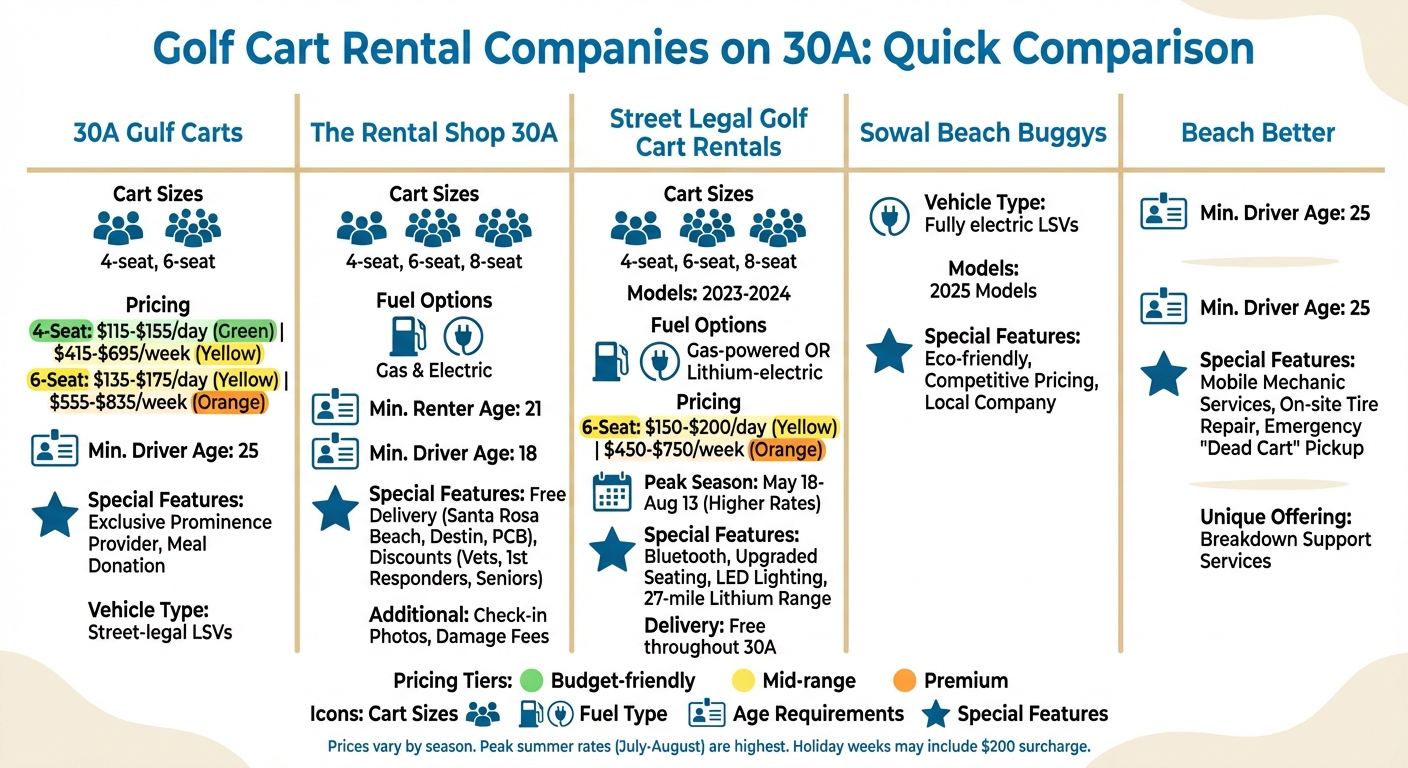
Golf Cart Rental Costs and Company Comparison on 30A Florida
Looking to rent a golf cart on 30A? Here are some top providers, each offering distinct options to match your travel plans.
30A Gulf Carts
Specializing in 4- and 6-passenger street-legal LSVs, 30A Gulf Carts offers flexible rental terms, including daily, weekly, and even annual options. They’re the exclusive rental provider for the Prominence community, which has strict cart policies. Rates for 4-seat carts range from $115 to $155 per day or $415 to $695 per week, while 6-seat models cost $135 to $175 per day or $555 to $835 per week. Plus, for every customer review, they donate a meal to Feeding America. Keep in mind, drivers must be at least 25 years old.
The Rental Shop 30A
South Walton Golf Cart Rentals, part of The Rental Shop 30A, is a trusted name on the 30A corridor. They provide both gas and electric carts in 4-, 6-, and 8-passenger configurations. Free delivery is available to Santa Rosa Beach, Destin, and Panama City Beach, and they offer discounts for veterans, first responders, and seniors. Renters must be at least 21 years old, with drivers needing to be 18 or older. To protect your deposit, they take check-in photos upon delivery, and damage fees apply for misuse.
Street Legal Golf Cart Rentals
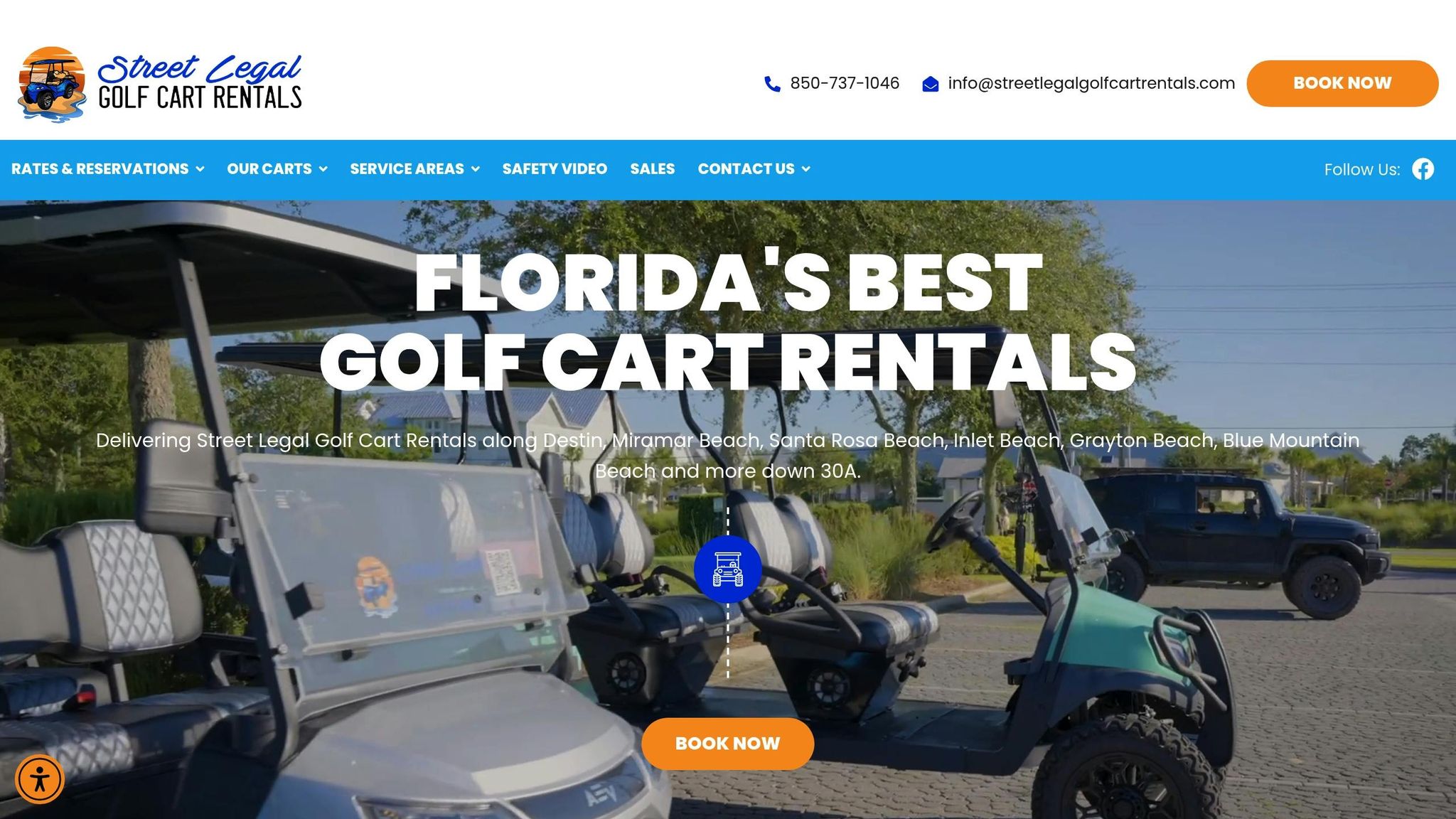
Street Legal Golf Cart Rentals, also known as Best 30A Golf Cart Rentals, features the latest 2023–2024 models in 4-, 6-, and 8-passenger options. Choose between gas-powered or lithium-electric carts, which include Bluetooth audio, upgraded seating, and LED lighting. The lithium-electric models boast an extended range of up to 27 miles per charge. Rates for 6-seat carts range from $150 to $200 per day or $450 to $750 per week, with higher prices during peak season (May 18–August 13). Free delivery is available throughout the 30A area.
Sowal Beach Buggys
Sowal Beach Buggys takes a fully electric approach, offering eco-friendly LSVs with 2025 models in their fleet. As a local company, they keep costs competitive by avoiding high-overhead storefronts.
Beach Better
Beach Better goes beyond rentals, providing mobile mechanic services, on-site tire repair, and emergency "dead cart" pickup if your golf cart breaks down. They require all drivers to be at least 25 years old.
Explore these options to find the golf cart rental that aligns with your needs and travel plans on 30A.
sbb-itb-d06eda6
Rental Costs and How to Book
Typical Rental Costs
Rental rates along 30A vary depending on the season. For instance, a 6-passenger golf cart typically costs between $390 and $555 per week during the winter, while summer prices jump to $750–$835 per week during peak months like July and August.
If you're considering upgrading from a 4-passenger to a 6-passenger cart, expect to pay an additional $20–$40 per day or $100–$150 per week. Keep in mind, most companies require a minimum rental of two days, and holiday weeks - like the Fourth of July - often come with a $200 surcharge.
When comparing prices, make sure you know what’s included. Some companies bundle fees, taxes, refundable deposits, and delivery into their rates, while others may not. Additionally, many providers offer discounts for groups like military personnel, first responders, healthcare workers, and seniors, so it’s worth asking about these perks.
How to Reserve Your Golf Cart
Reserving your golf cart is a simple process. You can book either online or by phone, depending on the rental company. During the reservation, you'll select the cart size - options often include 4-, 6-, or 8-passenger models - and decide between gas-powered or electric carts. Be sure to provide your delivery address and book early. Many companies increase their rates for bookings made within seven days of the rental start date. If you’re lucky, you might find promo codes like "Early10" to save a bit on the total cost.
To complete the booking, you’ll need a valid driver’s license, proof of auto insurance, and you’ll sign a rental agreement. Age requirements vary, but most companies require renters to be 21 or 25+, while drivers must be at least 18 years old. Before finalizing, check whether your vacation rental community allows outside golf cart rentals. For example, places like Rosemary Beach, WaterColor, and Seaside often have specific rules or restrictions. Don’t forget to provide gate codes for delivery access and inspect the cart for any damage upon arrival.
Safe and Responsible Golf Cart Use
Driving Safely on 30A Roads
Golf carts and Low-Speed Vehicles (LSVs) are permitted only on roads with speed limits of 35 MPH or lower. For safety reasons, LSVs may cross Highway 98, but only at designated intersections with traffic lights.
If traffic starts piling up behind you, it’s courteous - and safer - to pull over and let others pass. Stick to the rules: avoid driving on sidewalks, bike paths, or multi-use paths. Make sure all passengers are properly restrained, and remember that driving under the influence or having open containers of alcohol is strictly illegal for both drivers and passengers.
Pay attention to street sign colors to know where you can legally drive. Green signs indicate county-maintained roads where standard LSV regulations apply, while blue signs mark private roads with their own specific rules. To avoid being stranded, charge your electric cart every night. Be mindful when transporting items - improperly securing loads, like strapping items to the roof, could lead to repair costs of $650 or more.
Safe driving isn’t just about how you operate the cart; proper parking is just as important to avoid fines and keep traffic moving smoothly.
Where to Park Your Golf Cart
Street-legal golf carts can park in any car-designated legal parking space across most of 30A - about 90% of it, to be exact. However, some areas have stricter rules. For example, Alys Beach and Rosemary Beach don’t allow golf cart parking for visitors, and violations can result in fines or towing. In WaterColor, only carts provided with specific rental homes are allowed - outside rentals are prohibited.
"On about 90% of 30A wherever you can park a car, you can park a Street Legal Golf Cart." - Street Legal Golf Cart Rentals
For beachgoers, there are dedicated parking options. Eastern Lake Access has 18 spaces reserved for LSVs, while the CR 393 Transit Hub, located north of Gulf Place, offers 74 parking spots, including spaces specifically for LSVs. In Seaside, you’ll find two large golf cart lots in the Town Center - one on the West End near the Vin Scully portrait and another on the East End across from Cocina Cubana. Always avoid parking on sidewalks, bike paths, or near fire hydrants. If you’re heading to popular beach spots, plan to arrive early - before 8:30 a.m. - or later in the day, after 4:00 p.m., to secure a spot.
Conclusion
We've gone through the rules, rental options, and safe driving practices to help you make the most of your golf cart experience while staying safe and within the law.
Renting a golf cart along 30A is a fun and convenient way to explore the area - but only if you do so responsibly. Most rentals are Low-Speed Vehicles (LSVs) that meet Florida's street-legal standards. This means they’re treated just like motor vehicles, so traffic laws and DUI regulations apply.
Before you book, double-check the local community rules to avoid surprises. For example, visitor rentals are off-limits in Rosemary Beach and Seaside, and WaterColor only allows carts provided with approved rental homes. Ignoring these rules could lead to fines, towing, or even repossession of your cart.
Stick to roads with speed limits of 35 mph or lower, ensure everyone is buckled up (including using car seats for kids when needed), and charge your electric cart nightly - most models can only cover 20–25 miles per charge. Rental rates fluctuate with the seasons, but a well-planned rental can make it easy to explore everything from hidden beach paths to charming coastal towns at your own pace.
FAQs
What are the community rules for using golf carts on 30A?
Golf cart rules along Scenic Highway 30A are shaped by a mix of state low-speed vehicle (LSV) laws and specific guidelines set by each beach community’s homeowners’ association (HOA).
In some neighborhoods, golf carts are off-limits altogether. For example, Alys Beach and Rosemary Beach don’t allow golf cart rentals for visitors, as these areas are built to encourage walking. In Seaside and Seacrest, carts are restricted to guests with verified mobility disabilities, and even then, HOA approval is required. Over in Watersound, carts must be pre-registered to the property, while WaterColor mandates that visitors rent carts from an approved provider within the community.
Other communities, such as Dune Allen, Grayton Beach, Gulf Place, Seagrove, and Inlet Beach, don’t impose additional HOA restrictions. In these areas, standard county LSV laws apply. These rules include bans on carts using Highway 98, sidewalks, bike paths, or roads with speed limits over 35 mph. Drivers must also be at least 16 years old and possess a valid driver’s license. Breaking either HOA or county regulations can lead to fines, towing, or even losing the rental.
How can I make sure my rented golf cart is street-legal and safe to drive on 30A?
To use a rented golf cart safely and legally on 30A, it must comply with Florida’s low-speed vehicle (LSV) regulations. This means the cart should reach speeds between 20–25 mph, be properly registered, insured, and display a visible license plate. Additionally, it must include essential safety features like headlights, taillights, brake lights, turn signals, mirrors, a DOT-approved windshield, and seat belts for every passenger.
Before hitting the road, double-check that the cart has all required paperwork, such as registration and proof of insurance. Inspect the safety equipment - like seat belts and lights - to ensure everything is in working order. For electric carts, make sure they’re fully charged to avoid any mid-ride inconveniences. Keep in mind that LSVs are only allowed on roads where the speed limit is 35 mph or lower. They’re strictly prohibited from sidewalks, Highway 98, and pedestrian paths. It’s also important to adhere to neighborhood-specific rules, which might include restrictions on cart use in certain zones or limits on the number of passengers.
By sticking to these rules, you can enjoy a smooth and enjoyable ride along the scenic 30A coastline.
Are there extra costs to consider when renting a golf cart during busy seasons?
Renting a golf cart during busy seasons typically means higher prices. On top of that, you might encounter extra charges like taxes, short-term rental fees (for rentals lasting less than a week), or refundable damage deposits. To avoid surprises, it’s smart to check with the rental company directly about the costs for your specific dates.