The 30A region in South Walton, Florida, is facing rapid growth that threatens its charm and natural surroundings. With a population increase of 20,000 between 2010 and 2019 and over 4.5 million visitors annually, residents are concerned about traffic, rezoning, and preserving the area's beauty. Community forums have become a key tool for locals to voice concerns, share updates, and influence development policies.
Key issues include:
- Zoning changes: Rezoning conservation land for residential use risks losing natural flood defenses and wildlife habitats.
- Traffic congestion: Infrastructure struggles to keep up with visitor numbers, despite a $767 million mobility plan.
- Environmental preservation: Wetlands, mature trees, and rare coastal dune lakes are at risk from overdevelopment.
Forums like sowal.co help residents stay informed, organize opposition to unsuitable projects, and push for sustainable growth. Success stories include scaling back large developments, improving traffic solutions, and preserving protected areas. These platforms empower the community to shape 30A's future while protecting its character and resources.
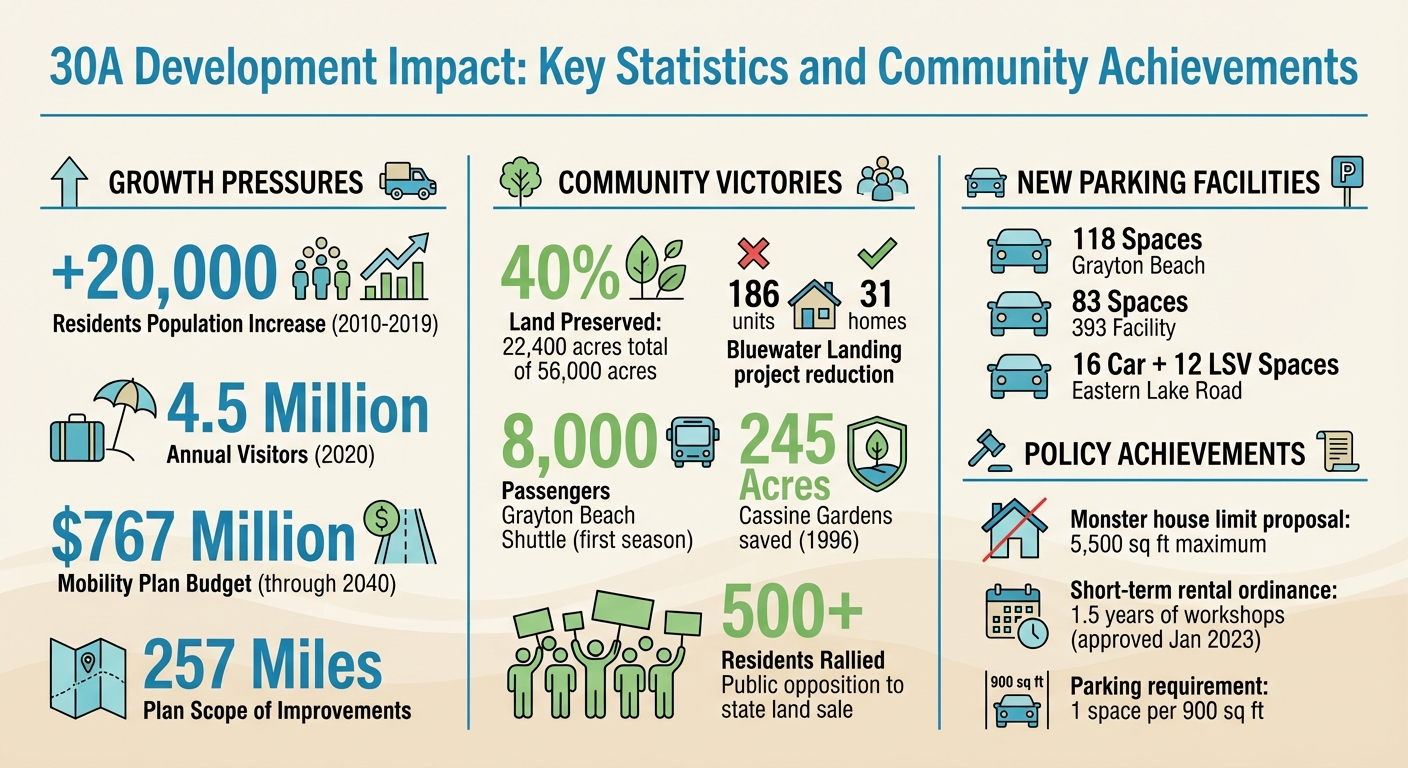
30A Development Impact: Key Statistics and Community Achievements
Main Development Issues Discussed in 30A Forums
Zoning and Community Character
Discussions in the 30A forums often revolve around zoning changes and their potential impact on the area's unique identity. A key issue is the proposal to rezone "Conservation Residential" land to "Low Density Residential", which residents fear could undermine important natural protections. In March 2021, Mandy Cooper and Margaret Landry led opposition to a 40-acre D.R. Horton project on Joy Lane and Nellie Road, citing concerns about losing crucial flood defenses.
Another hot topic is the rise of "monster houses." In May 2025, the Walton County Planning Commission backed a proposal to limit homes larger than 5,500 square feet in parts of South Walton. This move aims to address worries about oversized short-term rentals turning peaceful neighborhoods into high-density rental zones. The proposed Sunliner Diner in Blue Mountain Beach also sparked debate in June 2025. Residents from seven homeowners' associations opposed the 10,086-square-foot restaurant, arguing that its "Rockin' 50s" theme clashed with the area's character. Technical Review Committee Chair Stephen Schoen reclassified the project as a "major development", questioning whether it aligned with the "scale" and "character" of Small Neighborhood zoning.
Representative Leigh Moore of Scenic Walton captured the community's concerns, stating:
"It is a gem, that is why people are desperate to be there. And for a lot of different reasons, and it has been coming on for years, it is 'death by a thousand cuts' if we are not careful."
In addition to zoning issues, residents are grappling with pressing traffic and infrastructure challenges.
Traffic and Infrastructure Problems
Traffic congestion, especially during peak tourist seasons, is an ongoing frustration for residents. With 4.5 million visitors recorded in 2020, many feel that the area's infrastructure hasn't kept up with the rapid growth. Lacy, a forum participant, summed up the sentiment:
"The cart always goes before the horse; residents ask, why not limit growth?"
To address these concerns, the county has laid out a 20-year mobility plan through 2040, which includes nearly 257 miles of improvements at an estimated cost of $767 million. Some progress has already been made, such as the completion of the Grayton Beach Municipal Parking Facility (118 spaces) and the 393 Municipal Parking Facility (83 spaces) by summer 2023, which aim to ease congestion. Safety concerns are also a recurring theme. Barbara Morano highlighted one such issue:
"The (nine-unit) density creates a life safety issue for a firetruck to enter."
These infrastructure challenges are closely tied to concerns about coastal preservation and environmental sustainability.
Coastal and Environmental Issues
Protecting the natural environment remains a central focus in forum discussions. Residents frequently stress the importance of wetlands and mature trees as vital defenses against floods and strong winds. The area's rare coastal dune lakes and its location along the Atlantic Flyway for migratory birds further highlight the need for careful consideration of new developments.
Community efforts have shown that collective action can influence development outcomes. For example, in May 2021, D.R. Horton scaled back its Bluewater Landing project at Draper Lake after strong opposition from residents, led by Barbara Morano and the South Walton Community Council. The original plan for 186 residential units and a 6,000-square-foot commercial structure was reduced to just 31 single-family homes, with the lake and surrounding land placed in a permanent land trust. Reflecting on the risks of unchecked growth, forum member SUP Boarder commented:
"SoWal promotes its natural resources (beach, forest, parks, trails, etc) but these natural resources are at risk of compromise by over-development."
How Forums Create Solutions
Community forums have become instrumental in tackling traffic, zoning, and environmental challenges along 30A. By gathering resident input, encouraging collaboration, and influencing policy decisions, these platforms play a key role in shaping development in ways that align with community priorities.
Gathering and Organizing Community Feedback
Online hubs like sowal.co serve as spaces where locals discuss development projects and voice concerns about issues such as infrastructure gaps and sign clutter. These forums often highlight recurring themes like density exceptions and the preservation of rural clusters, which are crucial for maintaining the area's character.
Local government also uses these platforms to engage with residents. For example, the Plan for Walton 2040 Team utilizes forums to distribute surveys and share conceptual maps, collecting broad public input on growth strategies. Housing and market concerns frequently surface in these discussions, providing valuable data for residents advocating against projects that don’t align with the community's needs.
The South Walton Community Council (SWCC), active since 1995, acts as a nonpartisan coalition gathering input from residents, business owners, and neighborhood groups. Dave Rauschkolb, founder of Hands Across the Sand, praised the SWCC's efforts, saying:
"SWCC is the most effective advocacy organization in our county working to preserve the unique character of our area and its environment".
This organized feedback becomes the foundation for collaborative problem-solving.
Building Collaborative Solutions
Forums encourage collaboration by combining in-person and virtual meetings. Tools like Zoom now complement traditional gatherings, ensuring that seasonal residents and those unable to attend in person can still participate. This hybrid approach was particularly effective during the creation of the county's long-term mobility plan.
Draft ordinances are often presented to the community for feedback, allowing policymakers to refine legislation based on public input. The short-term vacation rental ordinance, for example, underwent 1.5 years of workshops and data collection before its approval in January 2023. Digital surveys played a key role in gathering data on public health and infrastructure concerns during this process.
Public workshops organized by the Planning Department further enhance collaboration. Consultants present "Sector Maps" and "Place Types" for review, and residents can access these materials via forum-linked websites like PlanForWalton2040.com. This allows for detailed suggestions on land-use designations before public hearings.
Through these collaborative efforts, forums have influenced tangible policy changes.
Influencing Policy and Project Changes
Feedback from community forums has directly shaped policy. On January 24, 2023, the Walton County Board of County Commissioners approved a new Short-Term Vacation Rental Ordinance after extensive public input. The ordinance introduced a registration system, mandatory safety inspections, and a parking requirement of one space per 900 square feet of living area for new homes south of the bay.
In February 2023, the SWCC submitted a proposal to the Planning Commission to amend the Land Development Code's definition of a Planned Unit Development (PUD). The proposal aimed to require a five-acre minimum and ensure that projects demonstrate "unique design" and "public benefit" beyond standard zoning. As the SWCC stated:
"PUD must result in a design that could not be accomplished with standard zoning (cookie-cutter developments do not qualify for a PUD)".
Community input has also influenced design decisions. When the Tourist Development Council installed large blue wayfinding signs, over 150 citizens opposed the design during a public workshop, compared to just two in favor. This overwhelming feedback led to a redesign that better reflects the area’s artistic and eclectic character.
These examples show how organized community action through forums helps preserve 30A’s distinctive charm and natural beauty while steering development in a sustainable direction.
sbb-itb-d06eda6
Case Studies: Forum Results in 30A
These examples highlight how community forums have brought about meaningful changes in 30A, particularly in traffic management and environmental preservation.
Better Traffic and Parking Solutions
Community forums have played a key role in reshaping how 30A handles traffic. Between 2020 and 2021, public workshops helped develop a 20-year Mobility Plan for Walton County. This plan focuses on multimodal solutions like public transit, bike paths, and pedestrian-friendly pathways.
One standout achievement was the Grayton Beach Shuttle Pilot, launched by the Walton County Tourist Development Council. During its first season, the shuttle transported 8,000 people along County Road 30A, significantly reducing car traffic in busy beach areas. Commissioner Tony Anderson praised the program, saying it proved that transit solutions can succeed not just in theory but in real-world applications.
Forum discussions also spurred the development of five municipal parking projects aimed at easing congestion by redirecting cars to peripheral lots served by shuttles. For example, in December 2022, Walton County awarded a contract to Gum Creek Farms, Inc. to construct the Eastern Lake Road Municipal Parking Facility, which began in February 2023. This facility offers 16 car spaces and 12 low-speed vehicle spaces, helping to alleviate congestion in the Seagrove neighborhood. Other projects include the 393 Municipal Parking Facility, which features 83 spaces and a 1,300-square-foot transit building, and the Grayton Beach Municipal Parking Facility, offering 118 spaces, including spots for electric and low-speed vehicles. These initiatives not only address traffic but also help preserve the area’s charm and balance.
Beyond traffic, forum efforts have also made a lasting impact on protecting the region’s natural environment.
Stronger Coastal and Environmental Protections
Community forums have also been instrumental in advancing environmental protections along 30A. One of the most notable moments came in August 1996, when the conservation group Beach to Bay Connection rallied over 500 residents at a public hearing at Bay Elementary. The goal? To oppose the sale of state-owned preservation land. This overwhelming turnout successfully convinced the state to reduce the amount of "surplus" land for sale, ultimately saving the 245-acre Cassine Gardens Cypress Swamp Nature Trail from private development. Bonnie McQuiston, a founding member of Beach to Bay Connection, summed up the community’s stance:
"The message to the state was loud and clear: Do not develop preservation land".
Another victory came when forums united residents against a proposed 1,650-linear-foot private boardwalk through Topsail Hill Preserve State Park. The community highlighted the park’s mission to protect natural habitats and rare species, leading to the rejection of the proposal. Today, roughly 40% of South Walton's 56,000 acres remains under conservation, safeguarding the area from future development. These efforts ensure that 30A’s natural beauty and ecosystems remain intact for generations to come.
Conclusion: Forums and the Future of 30A
Community forums have played a pivotal role in shaping the direction of 30A's growth. From the founding of the South Walton Community Council in 1995 to today's online platforms, these spaces have empowered residents to influence policies before irreversible changes take hold. Thanks to organized community efforts, approximately 40% of South Walton's 56,000 acres are now safeguarded from development.
The key to continued progress lies in active participation. Susan Lucas, a dedicated resident advocate, stresses that planning must be driven by citizens. Forums serve as a crucial bridge, connecting residents with officials, especially as the area faces the pressures of ongoing growth. Without this engagement, development decisions often lean toward those with more resources. Digital platforms have further amplified the collective voice of the community, making it easier to stay informed and take action.
Platforms like sowal.co have extended the reach of forums by centralizing information on development updates and fostering resident involvement. The site archives conservation successes and provides clarity on complex Land Development Code proposals, breaking down intricate planning documents into accessible information for residents. This digital infrastructure enables rapid information sharing and collective action on pressing issues like increased development density and infrastructure challenges.
A prime example of forum-driven success is the "Bluewater Landing" compromise at Draper Lake. Community advocacy reduced the project size from 186 residential units to 31 single-family homes. Additionally, D.R. Horton agreed to dedicate the lake and surrounding property for county preservation. As South Walton advocate Barbara Morano reflected:
"The evolution of the Draper Lake project... showed the results of time, negotiation, compromise, sensitivity to the community and caring".
Looking ahead, forums will remain essential as the county implements its $767 million mobility plan through 2040, while continuing to manage growth pressures. These platforms have already driven zoning victories, environmental protections, and traffic solutions, transforming residents from passive observers into active planners. The challenge now extends beyond preserving what exists - it’s about ensuring that new residents understand and value the efforts of past generations to protect this coastline. By participating in forums, the community can help safeguard the unique character of 30A for generations to come.
FAQs
How do community forums help shape development policies along 30A?
Community forums on sowal.co serve as a vital hub for shaping development policies in the 30A region. They bring together residents, developers, and county officials to exchange ideas, discuss proposals, and share feedback on initiatives like the Walton 2040 growth plan. These forums give locals the chance to voice their opinions on key issues such as zoning adjustments, housing density, and preserving natural resources.
The impact of these discussions is tangible. For instance, community feedback on short-term rental regulations led to revisions in proposed ordinances, while debates about tree protection policies resulted in strengthened measures to safeguard local greenery. By elevating public input, these forums ensure that growth and development along 30A align with the community’s values and priorities.
What are the key environmental challenges caused by 30A's rapid development?
The rapid expansion along the 30A corridor has sparked serious concerns about its impact on the environment. New housing and commercial projects are steadily encroaching on wetlands and natural buffers - key defenses against flooding and storm damage. By removing mature trees and altering natural water systems, this development increases the risk of flooding and wind damage, particularly during hurricane season.
Wildlife habitats and the area’s distinctive ecological features, which draw countless visitors, are also under threat. On top of that, the influx of traffic from short-term rentals and new residential areas is leading to congestion, longer commutes, and higher vehicle emissions. Overcrowding is putting a strain on essential infrastructure, from utilities to stormwater management systems.
As a low-lying coastal region, 30A faces additional challenges like rising sea levels, stronger hurricanes, and the instability that comes with heavy construction on sandy soil. These combined pressures underscore the urgent need for thoughtful planning to ensure growth doesn’t come at the expense of the environment.
How does the 30A community address concerns about large development projects?
The 30A community has shown remarkable determination in opposing large-scale development projects, blending grassroots activism with formal legal and planning strategies. Residents rally together through petitions, attend public hearings, and work closely with organizations like the South Walton Community Council (SWCC) to make sure their concerns are taken seriously. Their efforts have paid off with notable successes, such as preventing a proposed Hampton Inn and pushing for changes to the Cypress Lake development to address traffic and environmental challenges.
Locals also take an active role in technical review meetings, raising concerns about safety and overdevelopment. For example, public feedback has shaped decisions on projects like the 30A Surf Club and other developments near Draper Lake. This steadfast dedication underscores the community’s commitment to preserving the natural beauty and unique character that define the 30A region.