30A, a scenic stretch along Florida's Gulf Coast, is not just about beaches - it’s also home to highly-rated schools. Families moving here can choose from public schools under the Walton County School District, charter schools like Seaside Neighborhood School, private institutions such as Ohana Institute, or homeschool and virtual learning options. Public schools, including Dune Lakes Elementary, Emerald Coast Middle, and South Walton High, are zoned by address and offer strong academics, extracurriculars, and bus services. Charter and private schools provide smaller classes and specialized programs, often requiring applications or lotteries. Virtual learning and homeschool co-ops add flexibility for seasonal or full-time residents.
Key details:
- Public schools: Free, zoned by address, bus service available.
- Charter schools: Free but limited spots (lottery-based).
- Private schools: Tuition required; smaller, personalized settings.
- Homeschool/Virtual: Flexible schedules with co-op options.
Plan ahead by checking zoning maps, enrollment deadlines, and school calendars. For more insights, visit the Walton County School District website or local resources like sowal.co.
Best School District in Northwest Florida
School Options in 30A
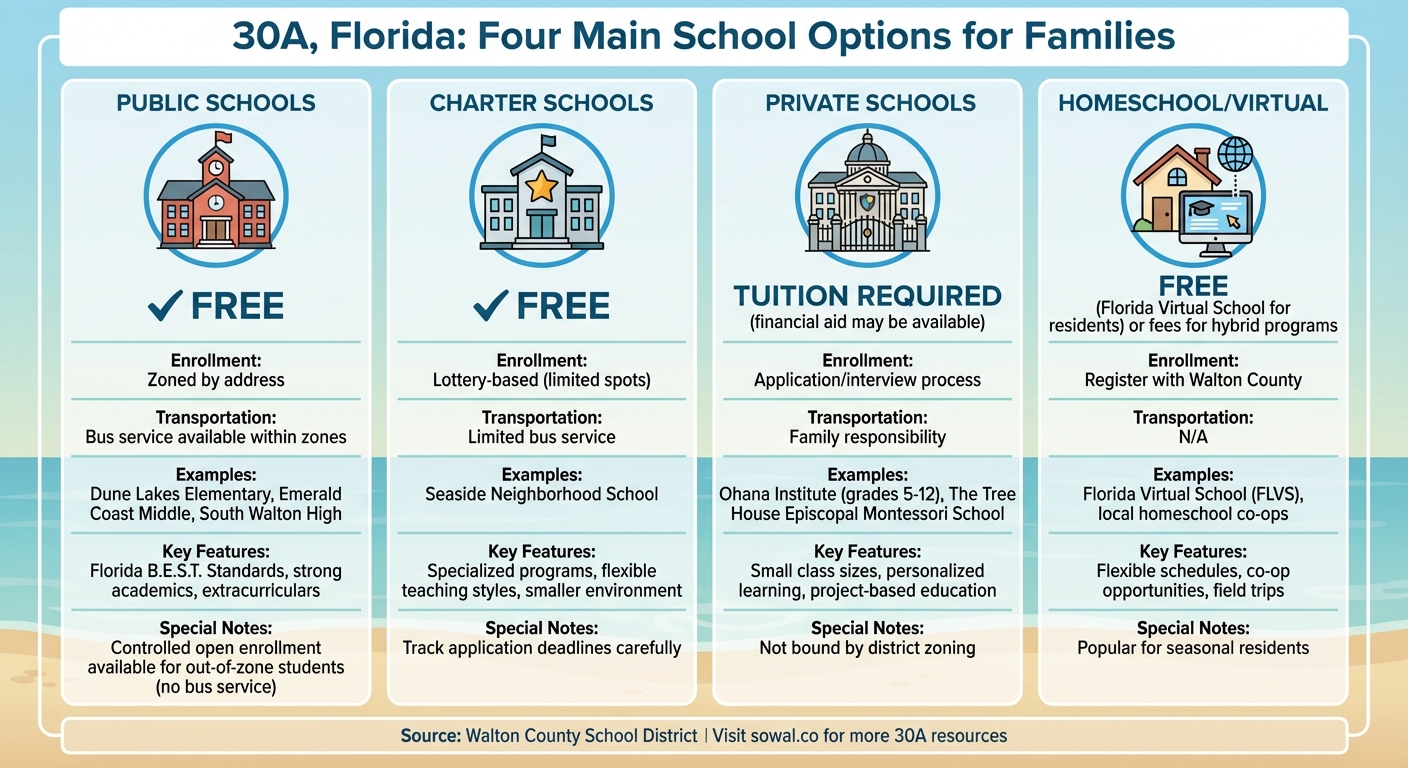
Comparison of School Options in 30A Florida: Public, Charter, Private, and Homeschool
Families moving to the 30A area have four main education choices: public schools managed by the Walton County School District, charter schools offering specialized programs, private schools with independent curricula, and homeschool or virtual learning for flexible schedules. Each option comes with its own set of rules, costs, and logistics, making it important to weigh what fits your family's needs and budget. Picking the right school is a big part of settling into life in 30A.
Public schools are free for residents and follow Florida's state standards, with bus transportation provided within the zoned areas. Charter schools, while also free, operate under agreements allowing more flexibility in teaching styles and school culture. Admission for these schools often depends on a lottery system due to limited spots. Private schools require tuition, though financial aid may be available, and typically have their own application or interview processes. Lastly, homeschool and virtual learning give parents the ability to manage education at home or online. Programs like Florida Virtual School are free for state residents, while some hybrid homeschool options may charge fees.
Public schools in Walton County are highly regarded, drawing many families. However, charter, private, and homeschool options are becoming increasingly popular, especially for those seeking smaller class sizes or alternative learning approaches. Below, we’ll break down each option in more detail.
Public Schools in 30A
Most families in 30A are zoned for three main Walton County public schools: Dune Lakes Elementary School (grades K–5), Emerald Coast Middle School (grades 6–8), and South Walton High School (grades 9–12). These schools are known for strong academic performance and offer a range of extracurricular activities, sports, and bus services within their zones.
If you're planning to move, it’s crucial to check the Walton County School District zone map to confirm which schools serve your address. School boundaries can change as new neighborhoods are developed and enrollment increases. For the most accurate zoning information, especially if you’re near county lines or in a newly built area, contact the district office directly. Families interested in enrolling in a public school outside their assigned zone can look into controlled open enrollment during specific periods. Keep in mind, though, that transportation is usually not provided for out-of-zone placements.
Private and Charter Schools
For families seeking different approaches, private and charter schools offer unique educational experiences. Seaside Neighborhood School, a public charter middle school in the Seaside community, provides a smaller, more flexible environment while remaining tuition-free for eligible Florida students. Admission is lottery-based when demand exceeds available spots, so it’s essential to keep track of deadlines. Bus services may be more limited compared to zoned public schools.
On the private school side, Ohana Institute (grades 5–12) focuses on project-based learning, small class sizes, and real-world internships, making it a popular choice for families looking for a personalized, college-preparatory experience. Another option, The Tree House Episcopal Montessori School, offers early childhood and elementary education in a multi-age classroom setting, using Montessori methods within an Episcopal framework. Both schools charge tuition, so it’s a good idea to request current fee schedules and inquire about financial aid or scholarships. Unlike public schools, private schools don’t follow district zoning, so families can choose based on the school’s programs and commute times. However, seasonal tourist traffic on US-98 is worth factoring into your decision.
Homeschool and Virtual Learning
For families interested in homeschooling or online learning, Florida Virtual School (FLVS) provides full-time and part-time online programs for K–12 students across the state. These programs follow Florida's educational standards and are tuition-free for residents when accessed through public options. Many 30A families register with Walton County and use FLVS as a core curriculum, supplementing it with additional materials.
The South Walton area also has a variety of homeschool co-ops and enrichment groups that meet weekly. These groups offer social opportunities, group classes, field trips, and electives like art and music. They often take advantage of local attractions like 30A’s beaches, state parks, and coastal dune lakes for hands-on learning in science and nature. Hybrid homeschool models, where students attend a program part-time and learn at home the rest of the week, are becoming increasingly popular. Be sure to confirm registration requirements with the Walton County School District and use local resources like sowal.co to find active co-ops and hybrid programs in the area.
Enrollment and Zoning
School Zoning and Boundaries
Where you live determines which public schools your child will attend in the Walton County School District. Most neighborhoods along 30A - like Santa Rosa Beach, Blue Mountain Beach, and Inlet Beach - are zoned for Dune Lakes Elementary, Emerald Coast Middle School, and South Walton High School. Even if another school seems closer to your home, school assignments are strictly based on WCSD zoning rules.
To confirm which schools serve your address, check WCSD's online zone map before making any housing decisions. You can also use Florida's Know Your Schools tool, provided by the Florida Department of Education, to search for schools near your address and compare options. Since zoning boundaries can change due to new developments or rising enrollment, double-check your assigned schools right before finalizing a lease or home purchase.
If you're interested in a school outside your designated zone, explore Controlled Open Enrollment during the specific application period. Keep in mind that space is limited, and bus service is usually unavailable for out-of-zone students.
Once you've confirmed your zoned school, you're ready to move on to the enrollment process.
How to Enroll Your Child
To enroll your child in a Walton County public school, you'll need to gather several key documents. These include proof of residency (such as a lease, deed, or utility bill), a photo ID for the parent or guardian, your child's birth certificate, Florida immunization and health forms, and any previous school records or transcripts. If you're relocating from another state, make sure your child's immunizations meet Florida's requirements - your pediatrician can help with this before your move.
Timing your registration is important. Plan your move around major school dates, such as the end of grading periods, winter break, or after state testing, to make the transition smoother. Families aiming for the start of the school year in August should try to complete the enrollment process between April and July. This is especially important if you're considering lottery-based charter schools like Seaside Neighborhood School or private schools with their own application timelines.
If you're looking at charter or private schools, be prepared for additional steps like recommendations, interviews, or separate application forms. Check directly with the school's admissions office to understand their specific deadlines and requirements.
School Calendar Overview
Once your child is enrolled, take some time to review the school calendar to coordinate your plans. The Walton County School District follows a standard Florida school schedule, with classes starting in early to mid-August and wrapping up in late May. The academic year includes a week-long Thanksgiving break, a two-week winter break in December, and a spring break in March, along with teacher workdays and holidays. You can download WCSD's Academic Calendar to confirm important dates, including testing windows and breaks.
Since 30A is a popular vacation destination, school breaks often coincide with peak tourist seasons. Spring break, in particular, brings increased traffic, higher lodging demand, and busy beaches. Local roads, including Scenic Highway 30A, can get crowded during these times. Plan your travel and childcare arrangements accordingly. For a better sense of peak visitor weeks and community events that might affect your daily routine during school holidays, check resources like sowal.co to stay ahead.
Transportation and Daily Schedules
Planning your daily schedule is crucial when it comes to navigating school commutes and managing extended care in the 30A area.
School Bus Services
The Walton County School District offers yellow bus services for students who meet specific criteria - usually those living more than 0.5 miles from school or along unsafe routes. Detailed information about stops and routes is available on the WCSD website, or you can contact the Transportation Department directly. Keep in mind that bus routes and pick-up/drop-off times often change during the first two weeks of school.
In some neighborhoods, families use golf carts to get to bus stops, though these vehicles are prohibited on major roads. For families with children attending private or charter schools, transportation options are more limited. These schools often lack bus routes, leaving families to rely on personal vehicles or carpools.
Understanding bus schedules is just one piece of the puzzle. Traffic patterns in the area also play a big role in planning your daily commute.
Traffic and Commute Times
Traffic congestion along U.S. Highway 98 and key points on 30A can significantly impact your schedule. The busiest times are usually in the mornings from 7:15 to 8:15 a.m. and in the afternoons from 2:30 to 3:30 p.m., especially near school entrances, major intersections, and shopping areas. During peak tourist seasons - like spring break, summer, or holidays - expect even heavier traffic, which can add time to your morning and afternoon routines.
To get a realistic sense of your commute, test your route during school-zone hours. Many parents find it helpful to add an extra 10–20 minutes to their travel time during tourist-heavy periods, especially if their drive involves crossing Highway 98 or navigating longer stretches of 30A. For updates on traffic and events that might affect your route, check local resources like sowal.co, which focuses on South Walton and the 30A area.
Traffic challenges tie directly into how school hours and extended care options are structured to accommodate families.
School Hours and Extended Care
Walton County schools operate on staggered schedules. High schools typically start early, around 7:15–7:30 a.m., middle schools follow shortly after, and elementary schools usually begin between 8:00 and 8:30 a.m. Dismissal times range from 2:15 to 3:15 p.m., which may require families to arrange additional childcare.
To help working parents, many elementary schools offer before- and after-school programs, either on-site or through third-party providers. These programs often start as early as 6:30–7:00 a.m. and run until 5:30–6:00 p.m. Middle and high schools, however, usually have fewer structured care options, leaving families to plan alternative arrangements for the time between dismissal and pick-up. Be sure to check with individual schools about the availability of extended care, as well as details on costs, hours, and registration deadlines.
sbb-itb-d06eda6
Programs and Extracurricular Activities
After understanding enrollment and daily schedules, it's equally important to explore the programs and extracurricular activities that contribute to a well-rounded education in 30A.
Schools in the 30A area are known for their strong academic offerings and extracurricular programs, often shaped by the region's coastal setting.
Academic Programs and Standards
The Walton County School District adheres to Florida's B.E.S.T. Standards, earning an impressive "A" rating and ranking third among the state's 67 counties. It also places in the top 10 for 20 out of 21 assessed areas. South Walton High School stands out for its Advanced Placement (AP) courses in English, math, science, and history, alongside robust visual and performing arts programs. During the 2023–2024 school year, students across the district earned 2,573 Career & Technical Education (CTE) certifications. These certifications spanned fields like information technology, health sciences, and engineering.
Seaside Neighborhood School, a public charter school for grades 5–8, focuses on project-based learning that weaves coastal themes into core subjects. Meanwhile, Dune Lakes Elementary and Emerald Coast Middle School integrate art, music, and technology into their daily schedules. Private institutions like the Ohana Institute emphasize creative, student-led projects, often tied to the unique 30A environment.
These academic strengths lay the foundation for a variety of extracurricular opportunities.
Sports, Clubs, and Activities
Beyond academics, 30A schools offer an array of extracurricular options designed to enrich student life.
Athletics programs in middle and high schools include football, basketball, soccer, baseball, softball, volleyball, track and field, cross-country, golf, and cheerleading. Some schools even feature activities like beach volleyball or surf clubs, reflecting the area's coastal influence. Tryouts for fall sports typically take place in late summer, with winter and spring sports having separate tryout periods. Families should consult each school's athletics page for information on tryout dates, physical exam requirements, consent forms, and eligibility rules.
Students can also participate in academic and leadership-focused clubs, such as the National Honor Society, math team, science club, student government, Key Club, and Interact. South Walton High's emphasis on the arts extends to extracurricular programs like band, chorus, theater productions, and visual art showcases. Charter schools like Seaside Neighborhood School often organize community-based projects and exhibitions that address local coastal concerns. Many schools collaborate with local nonprofits on initiatives like beach cleanups and habitat restoration. These activities not only benefit the environment but also allow students to earn community service hours, which are essential for Florida Bright Futures scholarship eligibility.
Special Education and Gifted Programs
Walton County schools offer Exceptional Student Education (ESE) services for students with disabilities, including those with learning disabilities, autism spectrum disorder, and speech or language impairments. Services are determined through a formal process involving referrals, multi-disciplinary assessments, and the creation of an Individualized Education Program (IEP). Support may include resource classes, in-class assistance, and related services like speech or occupational therapy. Families are encouraged to bring previous IEPs or evaluation reports to help streamline the process.
For gifted students, the district provides services based on cognitive testing and academic performance. Elementary and middle schools may offer pull-out enrichment programs, cluster grouping, or differentiated instruction. High schools like South Walton High expand on these opportunities with AP courses, honors classes, and dual enrollment options through nearby colleges. Charter and private schools, including Seaside Neighborhood School and the Ohana Institute, cater to advanced learners with small class sizes, personalized curricula, and independent study options.
What Families Should Know Before Moving
Before making the move, it’s essential to get familiar with the academic and community atmosphere that defines schools along 30A. Knowing how local schools operate and how seasonal tourism plays a role can make your transition smoother.
School Community and Culture
Relocating to 30A places your family in a coastal setting where academics meet a laid-back, beach-inspired vibe. Schools here are known for their small class sizes and a tight-knit community where parents, teachers, and administrators collaborate to help students thrive. The Walton County School District, which serves the 30A area, boasts impressive rankings, holding the #2 spot in Florida for high school graduation rates and #3 statewide for overall education and child well-being.
Education here blends rigorous academics with unique outdoor experiences. Students participate in activities like beach ecology projects, nature-focused field trips, and outdoor learning days, using the Gulf Coast’s natural beauty - like state parks and coastal dune lakes - as an extension of their classrooms.
Families coming from larger suburban districts often notice a more intimate campus atmosphere and a slower pace at public schools such as Dune Lakes Elementary, Emerald Coast Middle School, and South Walton High School[2,4]. For those looking for alternative options, private and charter schools like Seaside Neighborhood School and The Ohana Institute focus on project-based, student-driven learning in smaller, more personalized settings. High parental involvement is a hallmark of the area, with families contributing to carpools, learning pods, and active participation in school committees.
Seasonal vs. Full-Time Residency
As a popular tourist destination, 30A sees a mix of seasonal and full-time residents. Families visiting for just a few weeks or a single season typically do not enroll their children in local public schools, as enrollment requires proof of residency, such as a lease agreement, utility bill, and updated immunization records. Instead, many short-term families turn to homeschooling, Florida Virtual School, or private online programs, which provide the flexibility needed for temporary stays. This often influences decisions about when and how long to relocate.
For full-time residents, it’s important to plan around the area’s tourism-driven ebb and flow. Spring break and summer bring increased traffic and crowds, which can impact school-day routines, commutes, and after-school plans. Many families adjust their schedules to avoid congestion near busy town centers and beach access points. On the flip side, late fall and winter offer quieter periods, making it easier to enjoy local resources and plan activities like field trips or sports events without the added hassle of crowds.
Where to Find More Information
To prepare for your move, start by exploring official school resources. The Walton County School District website is a great place to find school calendars, zoning maps, enrollment details, and performance reports. The site includes an annual calendar outlining start dates, holidays, and breaks, along with interactive maps showing which schools serve specific 30A neighborhoods.
You can also reach out directly to schools like Dune Lakes Elementary, Emerald Coast Middle School, or South Walton High School to learn more about their programs, extracurricular offerings, and campus culture.
For additional insights into the 30A lifestyle, check out sowal.co, a digital guide dedicated to South Walton and the 30A area. It provides practical advice on relocating, neighborhood highlights, and community resources. Combining this with official district information will give you a well-rounded understanding of what it’s like to live, learn, and raise a family along Scenic Highway 30A.
Conclusion
Finding the right school for your family along 30A starts with knowing that public schools in the area operate under the Walton County School District. This district is highly regarded, ranking #3 in Florida for state testing and #2 among counties for high school graduation rates. With 23 public schools, including well-known campuses like Dune Lakes Elementary and Emerald Coast Middle School, families in the area also have the flexibility to explore private, charter, and virtual learning options.
A good first step is getting familiar with the local school system. Use district zoning maps to confirm which schools align with your potential new home before making a final decision. Keep in mind that zoning boundaries can shift as the area continues to grow, so it’s worth double-checking - even for new construction. Have your residency documents ready and review the district calendar to plan your move around enrollment deadlines.
Practical considerations like daily logistics are just as important as academics. Test your commute during school drop-off and pick-up times to see how traffic flows, especially in peak tourist seasons when 30A can get busier. If your schedule requires it, check for bus service eligibility and after-school care options.
For more information, head to the Walton County School District website or Florida's Know Your Schools tool. These resources provide enrollment details, academic calendars, bus routes, and performance data. To dive deeper into local insights, such as neighborhood vibes, commute tips, and lifestyle considerations, visit sowal.co - a digital guide dedicated to South Walton and the 30A area. Whether you decide on public, charter, private, or virtual schooling, these steps will help make your family's transition to 30A as seamless as possible.
FAQs
What are the differences between public, charter, and private schools in the 30A area?
Public schools in the 30A area are supported by local taxes and overseen by the school district. They offer free education with a standardized curriculum and are available to all students living within their assigned zones.
Charter schools, while also publicly funded, operate independently from the school district. They often emphasize specialized programs or unique teaching methods. These schools are tuition-free but may have limited spots available due to capacity constraints.
Private schools, in contrast, rely on tuition payments and private donations for funding. They typically feature smaller class sizes, tailored curricula, and may focus on religious teachings or specific educational philosophies. Tuition fees and admission criteria differ from school to school.
How can I find out which public school my child will attend in the 30A area?
If you're trying to figure out which public school your child is zoned for in the 30A area, your best bet is to contact the Walton County School District directly or check out their official website. They’ll help you determine the right school based on your home address. For families new to the area, local resources often offer useful relocation tips and insights about the community to make the transition smoother.
What homeschooling and virtual learning options are available in the 30A area?
Families in the 30A area have a range of options when it comes to homeschooling and virtual learning. These include local homeschooling networks, online educational programs, and virtual charter schools specifically available to Florida residents.
To further support homeschooling families, several community groups in the area offer guidance and resources tailored to their needs. Virtual learning platforms also bring flexibility, offering curricula designed to accommodate various learning styles and schedules. This makes it easier for families to choose an approach that aligns with their educational goals.