Flying a drone on 30A offers stunning views but comes with strict rules. You must follow federal, state, and local regulations to avoid fines or legal issues. Here's a quick overview:
- Federal Rules (FAA): Register drones over 0.55 lbs ($5 for 3 years), complete TRUST or Part 107 certification, and comply with Remote ID requirements. Stay below 400 feet, maintain visual line of sight, and avoid restricted airspace without authorization.
- Florida Laws: No flying in state parks without a permit. Respect privacy - recording private property without consent is prohibited. Avoid critical infrastructure (500 ft horizontal, 400 ft vertical) and emergency scenes (1,000 ft distance).
- Local Ordinances (Walton County): Permits are often needed for beach takeoffs/landings. Private communities like Alys Beach may restrict drone use. Military airspace near 30A requires coordination with Eglin Air Force Base.
Key restricted areas include state parks, private neighborhoods, and military zones. Violations can result in fines up to $75,000 (federal) or criminal charges (state/local). Use apps like B4UFLY to check airspace and ensure compliance. Always follow safety guidelines to protect public spaces and wildlife.
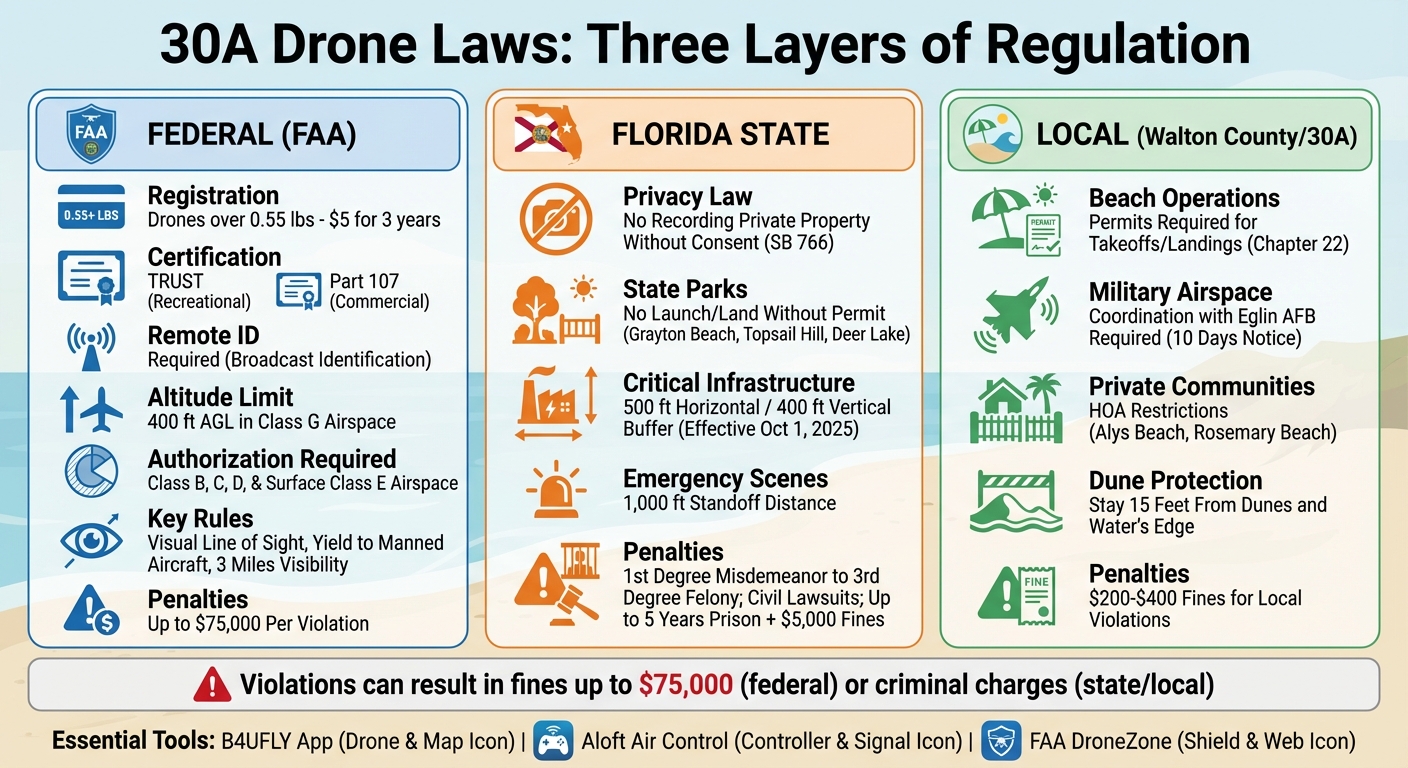
30A Drone Regulations: Federal, State, and Local Requirements Comparison
Common Problems When Flying Drones on 30A
Flying drones along 30A can be more complicated than it seems. The area’s mix of military airspace, protected parks, and private communities creates a maze of rules and restrictions. If you’re not prepared, you could face fines, confiscation of your drone, or even legal trouble.
Restricted Areas and No-Fly Zones
A significant portion of 30A falls under restricted airspace, including the Eglin E MOA and the Part 93 Valparaiso Terminal Area, also known as the "East-West Corridor." To fly near spots like Seagrove or Seacrest Beach, you’ll need to coordinate with Eglin Air Force Base Airspace Management. This process requires at least 10 days’ notice, submitted via email to 96oss.oso.eglinairspacemgt@us.af.mil.
"Your operations must remain outside of DoD/Eglin AFB Property, Controlled Airspace (ex KDTS Class D), and Restricted Areas charted to the surface (ex R2914A)." - Airspace Manager, USAF
State parks on 30A, such as Grayton Beach, Topsail Hill Preserve, and Deer Lake, also have strict rules. You cannot launch or land your drone in these areas without written permission. Even if your flight path is legal, taking off or landing in these protected spaces is prohibited. Similarly, private communities like Alys Beach and Rosemary Beach often have HOA rules that limit or ban drone use entirely, particularly in town centers.
Florida’s critical infrastructure law, effective October 1, 2025, adds another layer of restrictions. Drones are banned within 500 feet horizontally and 400 feet vertically of facilities like power plants, water treatment plants, and military installations. Violating this law could result in felony charges, with penalties including up to five years in prison and $5,000 in fines. Additionally, you must maintain a 1,000-foot distance from emergency scenes like accidents or fires.
Here’s a quick breakdown of restricted areas on 30A:
| Restricted Area Type | Specific 30A Examples | Restriction Level |
|---|---|---|
| State Parks | Grayton Beach, Topsail Hill, Deer Lake | No launch/land without permit |
| Military Airspace | Seagrove, Seacrest, Watersound | Coordination with Eglin AFB required |
| Private Communities | Alys Beach, Rosemary Beach | Local HOA/Town restrictions |
| Critical Infrastructure | Power stations, water plants, towers | 500 ft horizontal / 400 ft vertical buffer |
| Emergency Scenes | Active accidents, fire response | 1,000 ft standoff distance |
These geographical restrictions are just the beginning - privacy concerns and altitude rules add further challenges.
Privacy and Safety Issues
Flying over private property comes with its own set of problems, especially when it comes to privacy. Florida’s "Freedom from Unwarranted Surveillance Act" (SB 766) makes it illegal to record private property or individuals without their consent if there’s a reasonable expectation of privacy. Violating this law could lead to misdemeanor charges and fines of up to $500 for first-time offenders.
"It is the burden of drone pilots to lay to rest any concerns with privacy." - Pilot Institute
On 30A, hovering over backyards, pools, or balconies can quickly raise privacy concerns. While it’s not always legally required, getting written consent from property owners before capturing images of private spaces is a smart move. Wearing a safety vest and being ready to explain your flight’s purpose can also help ease tensions with concerned residents. To avoid unnecessary conflict, keep your flights short, avoid pointing cameras directly into private areas, and stick to your planned route.
Addressing privacy concerns is just as important as understanding the rules about altitude and airspace.
Confusion About Altitude and Airspace Limits
Altitude limits can be tricky to navigate on 30A, especially with overlapping airspace regulations. Many drone operators are confused by the 400-foot altitude limit. Under Part 107, drones can only exceed 400 feet when flying within 400 feet of a structure, and even then, they cannot go higher than the structure’s uppermost limit.
"The altitude of the small unmanned aircraft cannot be higher than 400 feet above ground level, unless the small unmanned aircraft: Is flown within a 400-foot radius of a structure; and Does not fly higher than 400 feet above the structure's immediate uppermost limit." - 14 CFR Part 107.51
Another common misconception is that flying at a low altitude means you’re free from airspace restrictions. That’s not the case. Flying in Class B, C, D, or surface Class E airspace on 30A requires prior authorization from Air Traffic Control, even at lower altitudes. For recreational pilots, the 400-foot Above Ground Level (AGL) limit applies in Class G (uncontrolled) airspace, but controlled airspace always needs specific clearance.
To avoid accidental violations, make sure your drone is calibrated for "Above Ground Level" (AGL) rather than "Mean Sea Level" (MSL). This small step can save you a lot of headaches when flying in areas with complex airspace rules.
Federal, State, and Local Drone Laws That Apply to 30A
Flying a drone along 30A means navigating three layers of regulations: federal rules set by the FAA, state laws from Florida, and local ordinances specific to Walton County. Each layer addresses different aspects of drone use, from airspace safety to privacy concerns.
FAA Federal Regulations
The FAA establishes the core rules for drone operations across the United States. If your drone weighs more than 0.55 lbs (250 g), it must be registered. Recreational users can register all their drones with a single fee, while commercial operators must pay $5 per drone.
Certification requirements depend on how you plan to use your drone. Recreational flyers need to complete the FAA’s TRUST test, while commercial pilots must obtain a Part 107 Remote Pilot Certificate. For example, if you're using a drone to capture real estate footage, volunteer for a nonprofit, or offer professional services, that qualifies as commercial use and requires a Part 107 certificate.
"The remote pilot in command is directly responsible for and is the final authority as to the operation of the small unmanned aircraft system."
– Federal Aviation Administration
Drones must comply with Remote ID requirements, which involve broadcasting identification unless you're flying in an FAA-Recognized Identification Area (FRIA). Once registered, your FAA registration number must be clearly marked on the drone.
Key rules for flying include staying below 400 feet in uncontrolled (Class G) airspace. If you're in controlled airspace - like Class B, C, D, or surface Class E - you'll need prior FAA authorization, which can be obtained through LAANC or the FAADroneZone. Always maintain a visual line of sight, either directly or with the help of a visual observer. Night flights are allowed if your drone has anti-collision lights visible from at least 3 statute miles.
Other safety rules include yielding to manned aircraft, keeping at least 500 feet below clouds, and maintaining a 2,000-foot horizontal distance from them. Drones cannot exceed 87 knots (100 mph) ground speed, and you must have at least 3 statute miles of visibility from your control station. If your flight results in serious injury or damages exceeding $500, you must report the incident to the FAA within 10 days.
With federal rules covered, let’s move on to the state-level laws that apply to 30A.
Florida State Drone Laws
Florida’s drone laws focus heavily on privacy, infrastructure protection, and preserving natural areas. The "Freedom from Unwarranted Surveillance Act" prohibits using drones to capture images of private property or individuals without consent when there’s a reasonable expectation of privacy.
"The Federal Aviation Administration (FAA) focuses primarily on safety while the State of Florida statutes focus on the appropriate use of UAS and the protection of privacy."
– Florida Department of Transportation
State law also restricts drone flights near sensitive facilities like power plants, prisons, and water treatment plants. Weaponized drones are strictly prohibited. Additionally, Florida State Parks - such as Grayton Beach, Deer Lake State Park, and Topsail Hill Preserve along 30A - ban drone takeoffs and landings without prior authorization. To fly in these parks, you’ll need to secure a permit from park officials.
While Florida law preempts most local drone regulations, it does allow local governments to address specific issues like harassment, nuisances, reckless flying, and property damage.
State laws lay the groundwork, but local ordinances bring in additional rules tailored to Walton County and the 30A area.
Local 30A Rules and Ordinances
Walton County and the 30A area have their own regulations to address local concerns. For instance, drone takeoffs and landings on beaches often require permits from the Tourist Development Council. Chapter 22 of the Walton County Code of Ordinances (Waterways and Beach Activities) outlines these requirements.
Much of 30A lies within military airspace, so coordination with Eglin Airspace Management is mandatory for drone operations near areas like Seagrove or other beach access points.
Private communities along 30A, such as Alys Beach and Rosemary Beach, frequently have their own HOA rules that may restrict or ban drone usage, especially in busy areas like town centers. Always check with property management before flying in these neighborhoods.
Additionally, SB 1622, signed into law on June 24, 2025, restored Walton County's authority to recognize the "customary use" of dry sand beaches. This law clarifies the distinction between public and private beach areas, which is crucial when considering privacy laws. To avoid potential issues, you can use the "Shoreline Defender" app to determine whether you're flying over publicly accessible wet sand or private dry sand.
These local rules complement federal and state laws, ensuring drone operations align with both legal requirements and community expectations.
| Regulation Level | Primary Authority | Key Restrictions on 30A |
|---|---|---|
| Federal | FAA | 400 ft altitude limit, Remote ID requirements, registration for drones over 0.55 lbs, TRUST/Part 107 certification |
| State | Florida Legislature | Prohibits unwarranted surveillance, restricts flights over critical infrastructure, state park launch/landing permits required |
| Local | Walton County / Eglin AFB | Requires notification for military airspace operations and permits for beach takeoffs/landings |
How to Fly Drones Legally and Safely on 30A
To fly a drone legally on 30A, you’ll need to follow three key steps: register your drone and complete the TRUST certification, check airspace restrictions before each flight, and secure any necessary permits. These steps ensure you’re operating within federal, state, and local guidelines.
Register Your Drone and Complete the TRUST Test
Start by registering your drone through the FAA DroneZone. Registration costs $5 and covers all drones in your inventory as a recreational flyer for three years. Once registered, make sure your FAA registration number is clearly visible on your drone.
Next, take the free TRUST test, a one-time certification that ensures you understand basic drone safety rules. Always carry proof of completion when flying. As of September 16, 2023, registered drones must broadcast Remote ID information unless flown in an FAA-Recognized Identification Area (FRIA). If you’re under 13, someone older must handle the registration process for you.
Check Airspace Restrictions with the B4UFLY App
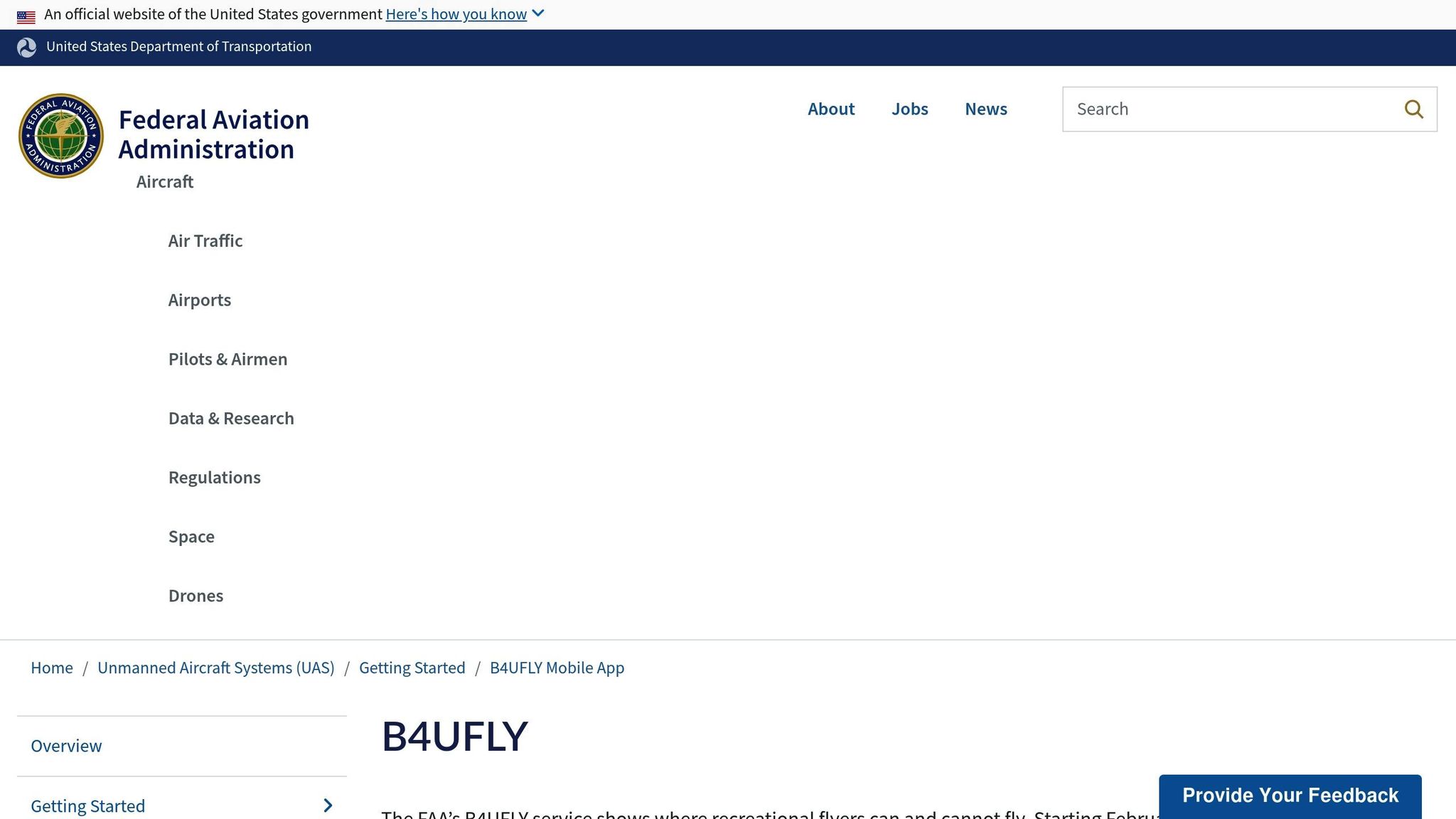
After registering, it’s crucial to confirm you’re flying in the right airspace. Airspace restrictions can change frequently, so use apps like B4UFLY or Aloft Air Control before every flight. These tools help you identify controlled airspace (Class B, C, D, and surface Class E), which requires FAA authorization, and uncontrolled airspace (Class G), where you can typically fly at or below 400 feet without prior approval.
They also flag "No Drone Zones" and Temporary Flight Restrictions (TFRs). If you’re near an airport, a LAANC-enabled app can provide near-real-time flight authorization. Additionally, use the map feature to locate Florida State Parks along 30A, such as Grayton Beach or Topsail Hill Preserve, where launching and landing drones is prohibited without special permission.
"In South Walton, be sure to review an up-to-date sectional chart or reliable app like Aloft Air Control to learn about any current flight restrictions before flying your sUAS." – Visit South Walton
Get Required Permits and Follow Local Rules
Once your drone is registered and airspace is checked, make sure you have the proper permits for flying in specific areas. Walton County’s Chapter 22 ordinance regulates waterways and beach activities, including drone use. While flying over many beach areas is permitted, launching or landing drones within Florida State Parks is prohibited unless you’ve obtained explicit permission from park officials.
When flying, maintain visual contact with your drone and avoid flying within 15 feet of dunes or the water’s edge to avoid interfering with emergency operations.
Best Drone-Friendly Locations on 30A
Finding great spots to fly on 30A means balancing scenic views with compliance. FAA-Recognized Identification Areas (FRIAs) are special zones where drones can fly without Remote ID equipment. Check the FAA’s online FRIA map to see if any are available near 30A.
Open beach areas in uncontrolled airspace (Class G) are ideal for drone photography, as long as you’re not launching from state park property. Public beach access points outside of state parks are excellent spots to stand while capturing coastal footage. Before heading out, double-check your chosen location with the B4UFLY or Aloft Air Control app to ensure there are no temporary restrictions.
While the 30A coastline offers breathtaking views, sticking to approved locations ensures you stay compliant and helps preserve the natural beauty of the area.
sbb-itb-d06eda6
Penalties for Breaking Drone Laws on 30A
Knowing the consequences of breaking drone laws on 30A is crucial for operating drones safely and responsibly.
Federal Penalties from the FAA
The FAA enforces strict penalties for unsafe or unauthorized drone operations, with civil fines reaching up to $75,000 per violation. Between October 2022 and June 2024, the FAA proposed $341,413 in penalties against 27 drone operators. Common violations include flying unregistered drones, ignoring Remote ID requirements, entering restricted airspace, and failing to report damages. Additionally, the FAA can suspend or revoke a remote pilot certificate for offenses like falsifying records, cheating on knowledge tests, or drug and alcohol violations.
"Violating the drone regulations puts lives at risk in the air and on the ground. Flying a small drone means you are flying an aircraft, and unsafe behavior will cost you." – Mike Whitaker, FAA Administrator
Recent cases in Florida highlight the seriousness of these violations, with fines ranging from $18,200 to $32,700 for actions like flying unregistered drones at night, exceeding altitude limits, and entering restricted airspace during major events.
Florida State and Local Penalties
Florida law adds further penalties, especially for privacy violations and restricted area breaches. Property owners can sue drone operators for compensatory and punitive damages if drones capture images where individuals have a reasonable expectation of privacy. In Florida, privacy is assumed for areas not visible from the ground.
Criminal charges vary based on the offense:
- Second-degree misdemeanor: Flying over private property with intent to harass.
- First-degree misdemeanor: Recording video during such harassment.
- Third-degree felony: Distributing illegally captured surveillance images or flying over critical infrastructure.
On 30A, operating drones in Florida State Parks, such as Grayton Beach or Topsail Hill Preserve, is prohibited without permission. Violating local ordinances can lead to fines ranging from $200 to $400.
Penalty Comparison Table
Here’s a quick breakdown of penalties by jurisdiction:
| Violation Type | Federal (FAA) Penalty | Florida State/Local Penalty |
|---|---|---|
| Flying without registration/Remote ID | Fines up to $75,000; certificate revocation | N/A |
| Unauthorized flight in restricted airspace | Fines up to $75,000 per violation | N/A |
| Privacy/surveillance violations | N/A | 1st degree misdemeanor; civil lawsuit for damages |
| Distributing illegal surveillance images | N/A | 3rd degree felony |
| Flying over critical infrastructure | Civil penalties up to $75,000 | 3rd degree felony |
| Launching/landing in Florida State Parks | N/A | State park violation; fines vary |
| Harassment on private property (recording) | N/A | 1st degree misdemeanor |
Fly Your Drone Responsibly on 30A
Flying a drone on 30A isn’t just about following the rules - it’s about being mindful of safety, respecting privacy, and protecting the area’s delicate environment. Whether you're flying for fun or as part of a business, make sure your drone is registered, your Remote ID is up to date, and you understand the guidelines for your type of flight.
Before taking off, check the airspace conditions using tools like B4UFLY or Aloft Air Control. Always keep your drone within your line of sight and give way to manned aircraft, such as helicopters and small planes, which often fly low along the coast.
"Anyone flying a drone is responsible for flying within FAA guidelines and regulations. That means it is up to you as a drone pilot to know the Rules of the Sky, and where it is and is not safe to fly." – Federal Aviation Administration
Beyond simply following the law, it’s important to fly with care to preserve the unique character and natural beauty of 30A. This includes respecting the area’s 15 rare coastal dune lakes, which are considered critically imperiled. Keep your drone away from sensitive ecosystems and wildlife habitats, especially during sea turtle nesting season (May through November) when the beach environment is particularly fragile.
"Whether you're relaxing on the white sand, swimming along the shoreline, or exploring the neighborhoods, remember to leave only footprints and take only memories." – Visit South Walton
FAQs
What do I need to legally fly a drone on 30A beaches?
To fly a drone legally on 30A beaches, you’ll need to make sure your drone is registered with the FAA and that you’ve successfully completed the TRUST (The Recreational UAS Safety Test). While there aren’t any extra permits specifically required for the 30A area at this time, it’s wise to double-check local regulations to ensure you’re following the rules.
Stick to FAA guidelines for recreational drone use, like staying below 400 feet, steering clear of crowded spots, and avoiding no-fly zones. Flying responsibly allows you to enjoy the stunning scenery of 30A while keeping safety a priority.
How can I fly my drone legally and respect privacy on 30A?
When flying your drone along 30A in Florida, it's crucial to respect private property to comply with the state’s privacy laws. Florida law prohibits using drones to photograph or record private property - like homes or backyards - without written consent from the property owner. This applies to any area where people have a reasonable expectation of privacy.
Here are some tips to help you stay within the law:
- Stick to public spaces such as beaches, parks, or parking lots, and steer clear of flying over private homes or fenced-off areas unless you have explicit permission.
- Keep your drone in sight and avoid aiming the camera at homes, windows, or pools unless you have the owner’s consent.
- Get written permission if granted - whether it’s a signed note or an email - so you have proof in case it’s needed.
By following these guidelines and adhering to FAA safety rules, like staying under 400 feet and avoiding crowded areas, you can enjoy capturing the stunning scenery of 30A responsibly and within the law.
What happens if I break drone laws on 30A?
If you break drone regulations on 30A, you might be hit with civil penalties reaching up to $75,000 per violation. On top of that, the FAA could suspend or even revoke your drone pilot certificate. To steer clear of these hefty penalties, make sure you understand and follow all FAA rules and any local guidelines before taking your drone to the skies.