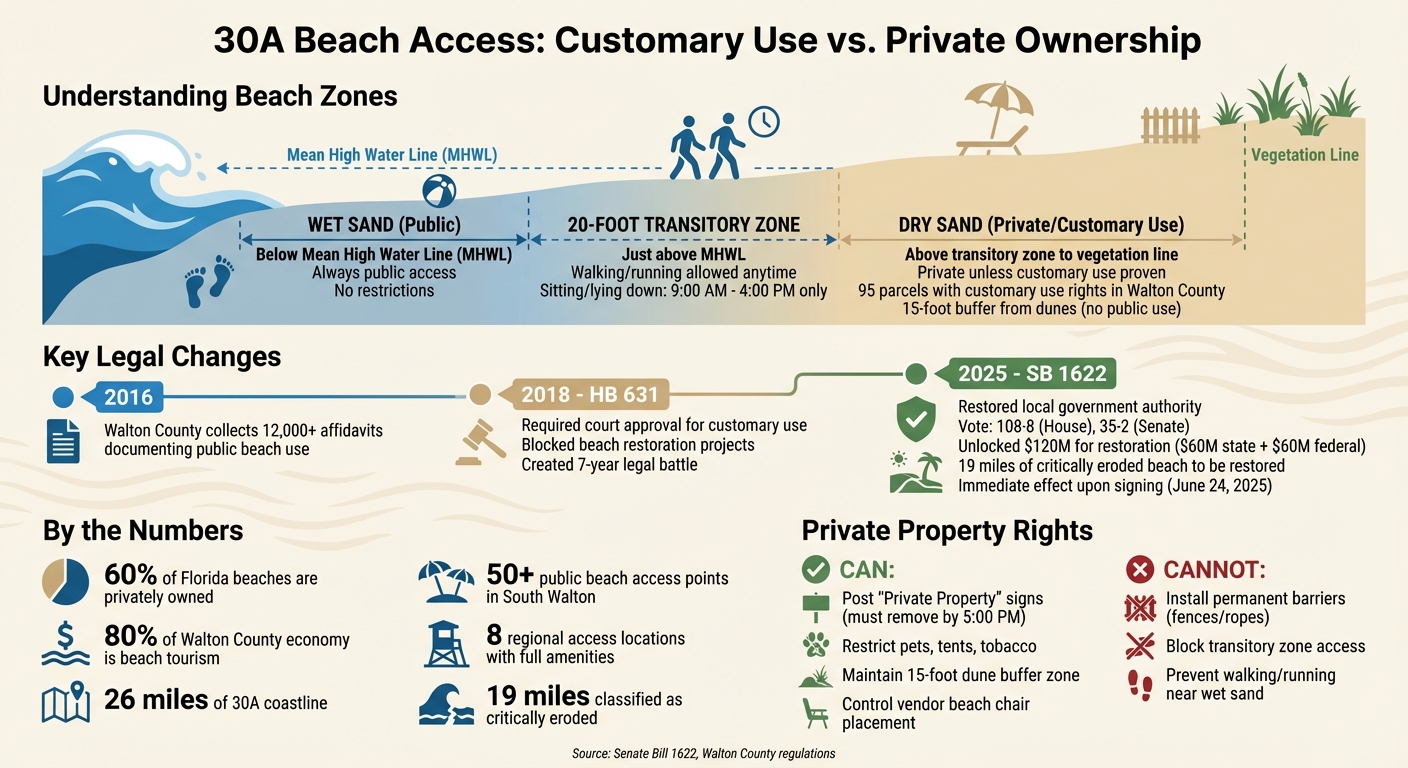
The debate over beach access along South Walton's 30A coastline revolves around customary use rights and private beach ownership. Florida law divides beaches into public wet sand (below the high tide line) and potentially private dry sand (above it). The 2018 House Bill 631 restricted public access to private beaches unless proven in court. However, the 2025 Senate Bill 1622 restored local governments' ability to recognize customary use, simplifying beach access rules and enabling critical restoration projects.
Key points:
- Customary use allows public recreational access to private dry sand if historically used without objection.
- Private owners control dry sand areas but must adhere to specific regulations, like permitting limited public access in some zones.
- A 20-foot transitory zone near the wet sand is open for walking or running, with time limits for sitting activities.
- Senate Bill 1622 unlocked $120M for restoration, streamlining processes and expanding public beach access.
Visitors should check local maps, follow posted signs, and confirm access rights when renting beachfront properties. Both public and private interests must coexist to preserve 30A’s beaches as a shared destination.
30A Beach Access Guide: Public vs Private Zones and Key Rules
Florida Public Beaches are Private Now? WATCH THIS
What Is Customary Use?
Customary use is a legal principle from common law that allows the public to use the dry sand areas of a beach for recreational purposes, even if those areas are privately owned. It creates a public easement based on the demonstration that the public has consistently and openly used the area without dispute. This concept is validated through evidence of long-term community use for leisure activities.
Historical Background and Legal Foundation
The idea of customary use has its origins in English common law from the post-colonial period and has since been adopted in states like Florida. A significant case establishing this doctrine in Florida was City of Daytona Beach v. Tona-Rama, Inc., where the Florida Supreme Court formally recognized the principle. In 2016, Walton County took steps to protect public access to its 26-mile stretch of beach by collecting over 12,000 affidavits that documented long-standing public use of the area. However, the legal landscape shifted in 2018 with the passage of HB 631, which requires courts, rather than local governments, to affirm customary use rights. These legal precedents shape how and where the doctrine is applied along the coastline.
Where Customary Use Applies
Customary use specifically pertains to the dry sand zone, which lies between the Mean High Water Line (MHWL) and the base of the dunes or vegetation line. The MHWL, calculated as the average high tide level over a 19-year period, serves as the dividing line between public wet sand and privately owned dry sand. In Walton County, customary use rights have been confirmed for 95 parcels. A 2023 settlement established a 20-foot "transitory zone" just inland from the wet/dry sand line, where the public is allowed to walk, run, or sit between 9:00 AM and 4:00 PM. This ensures that, in areas where customary use applies, people can continue to enjoy recreational activities on privately owned sand as long as their use aligns with the area's historical patterns.
Understanding Private Beach Ownership
In Walton County, beachfront property ownership extends to the Mean High Water Line (MHWL). This grants property owners control over the dry sand area between the vegetation line and the tide. Essentially, these owners have the authority to decide who can use their portion of the beach and what activities are allowed there.
Legal Rights of Beachfront Property Owners
Beachfront property owners hold specific rights that allow them to manage access to their dry sand. They can post legally compliant "Private Property" signs, which must be removed by 5:00 PM if left on the beach, and maintain a 15-foot buffer zone from the dunes where public use is prohibited. Additionally, they can restrict pets, tents, and tobacco use on their property. However, they are not permitted to install permanent barriers like fences or ropes to block access.
Following a June 2023 settlement, many property owners agreed to limited public use of a 20-foot "transitory zone" near the wet/dry sand line. This zone allows activities like walking, running, and swimming, but stationary activities - such as sitting or lying on towels - are only permitted between 9:00 AM and 4:00 PM. Furthermore, some owners prohibit vendor-provided beach chairs on their private sections of the beach altogether.
While these legal rights are clear, they often spark disagreements over what constitutes fair use of the beach.
Challenges for Public Access
Private beach ownership complicates public enjoyment of Florida's coastlines. With 60% of Florida's beaches privately owned, many residents and visitors find their access limited. Along the 30A coastline, beachgoers frequently encounter "Private Beach" signs, which create confusion and tension between property owners and the public.
This issue has sparked frustration among locals.
"The beach belongs to the people, all the people, not just the privileged few." - Thomas Knighten, 24-year South Walton resident
Tourists renting beachfront homes face unique challenges. Renting a home near the beach does not guarantee access to the dry sand. Visitors must verify their access rights with their rental manager or the local Tourist Development Council. This distinction between having a path to the beach (access) and being allowed to use the dry sand (use) often surprises vacationers.
Walton County does provide over 50 public beach access points, including 8 regional spots with full amenities. However, determining which areas are open for public use requires careful attention to posted signs and property boundaries, making it essential for visitors to stay informed.
Legislative Changes and Their Impact
The tug-of-war over beach access in Walton County took a dramatic turn in 2018, only to shift again seven years later. These legal changes highlight the ongoing tensions along the 30A coastline. Let’s dive into how the journey from House Bill 631 to Senate Bill 1622 reshaped the landscape.
The 2018 Law and Its Consequences
In 2018, House Bill 631 fundamentally altered how Florida counties could safeguard public beach access. Once signed into law, HB 631 required counties to obtain judicial approval for customary use ordinances. This effectively nullified Walton County’s 2017 ordinance and forced the county into an arduous seven-year legal process to prove customary use along its 26-mile coastline. Notably, Walton County stood alone in Florida in pursuing this full judicial route.
This legal standoff created significant hurdles for beach renourishment projects. With nearly 19 miles of Walton County’s coastline classified as "critically eroded", the need for restoration was urgent. However, the 2018 law added a layer of complexity by requiring public easements from private property owners before any restoration work could proceed.
"I cannot in good faith instruct deputy sheriffs to make an arrest for trespassing after warning when I know they cannot be prosecuted. As such, I am directing my deputies not to make arrests for trespass after warning for routine activities such as walking, sitting or transversing the beach."
- Walton County Sheriff Michael A. Adkinson, Jr.
This law not only complicated restoration efforts but also intensified debates over public versus private rights.
Senate Bill 1622 and Restoring Local Authority
Fast forward to June 24, 2025, when Governor Ron DeSantis signed Senate Bill 1622, effectively undoing the 2018 restrictions and returning control over beach access to local governments. The bill passed with overwhelming bipartisan support - 108–8 in the Florida House and 35–2 in the Senate.
This legislation tackled two major issues. First, it eliminated the need for counties to complete a lengthy judicial process before passing customary use ordinances. While judicial approval remains necessary to safeguard property owner rights, the removal of redundant legal steps significantly simplified the process. Second, it addressed beach renourishment challenges by streamlining the establishment of erosion control lines and removing the requirement for individual public easements from private property owners.
"This bill is about restoring local control, cutting legal red tape, and putting our residents first."
- Governor Ron DeSantis
"This bill is much more than policy. It’s about families, it’s about tradition, and it’s about restoring something that never should have been taken away in the first place."
- State Senator Jay Trumbull
In addition to these reforms, the bill unlocked $60 million in state funding, matched by another $60 million in federal funds, to support beach renourishment efforts. The law took effect immediately upon signing, but further action from the Walton County Board of County Commissioners is needed to implement these changes locally. These updates mark a renewed effort to balance private property rights with public access to Florida’s cherished coastlines.
sbb-itb-d06eda6
What This Means for Residents and Visitors
Senate Bill 1622 brings important updates to beach access that both residents and visitors should understand. While the law clarifies some rules about beach use, navigating the coastline still requires being mindful of boundaries and regulations. Here's a closer look at what the changes mean and how to make the most of your beach experience.
Public Access and Beach Restoration Efforts
One of the major outcomes of Senate Bill 1622 is the allocation of $120 million in state and federal funds to restore nearly 19 miles of critically eroded beaches. When public funds are used for beach restoration, the newly added sand becomes public property, creating more space for everyone to enjoy.
The law also simplifies the restoration process. Previously, counties had to secure individual public easements from private beachfront property owners before starting any work - a time-consuming hurdle. Now, local authorities can proceed without these negotiations, making it easier to combat erosion and expand public beach access.
Navigating Beach Boundaries
As restoration efforts progress, understanding where you can and cannot go becomes increasingly important. The Mean High Water Line (MHWL) designates the public wet sand area. Beyond this, a 20-foot transitory zone allows for walking, running, or water access. Sitting or lying down in this zone is permitted only between 9:00 AM and 4:00 PM. Some areas may also have judicially affirmed customary use rights.
To make things easier, digital tools like the Shoreline Defender app and the Visit South Walton Beach & Bay Access Map can help identify public areas. South Walton itself boasts over 50 public beach access points, including eight regional access locations complete with amenities and lifeguards.
If you're staying at a rental property, keep in mind that access to the dry sand isn't always guaranteed. It's a good idea to check with your property manager to confirm whether deeded beach rights are included.
For more detailed information and local updates, visit sowal.co.
Balancing Property Rights with Public Interest
Recent legislative updates are reshaping how private property rights and public interest are balanced, blending legal reforms with modern tools. One key development is Senate Bill 1622, signed by Governor Ron DeSantis in June 2025. This law restores local authority to recognize customary use but requires judicial oversight to ensure property owners are protected from government overreach.
The stakes are high, especially in Walton County, where beach-related tourism accounts for 80% of the local economy. Public access to beaches is vital for the region's prosperity, but beachfront property owners also have rights that must be respected. Land use attorney Will Dunaway highlighted this balance, stating:
"Every single private property owner who was represented by counsel and objected to the establishment of Customary Use on their beach obtained a dismissal with prejudice... or a settlement agreement that allows the public a 20-foot transitory area".
A significant component of SB 1622 is the allocation of $60 million in state funding, matched by federal contributions, to restore 19 miles of critically eroded coastline. Governor DeSantis emphasized the importance of efficiency in these projects:
"This will ensure the restoration projects can begin very quickly, and that every dollar we invest in rebuilding the beach goes towards actual sand and vegetation, not needless litigation".
Technology is also playing a role in maintaining this delicate balance. The Shoreline Defender app, launched in 2025, uses real-time GPS and tide data to clearly mark the boundary between public and private areas. This tool helps visitors stay within legal limits while offering property owners reassurance about their rights. Achieving harmony requires mutual respect between property owners and beachgoers, fostering a community spirit that benefits everyone.
The current legal framework uses the Mean High Water Line as the dividing point: the wet sand seaward is public, while the dry sand landward may be private unless a court establishes it as customary use. In Walton County, approximately 95 parcels have judicial findings confirming customary use. This system not only provides clarity for property owners but also ensures public beach access, which is essential for the local economy and the community's character.
Conclusion
The ongoing discussion about customary use versus private beach ownership in South Walton highlights the delicate balance between protecting property rights and embracing the coastal lifestyle that defines the 30A area. Since June 2025, Senate Bill 1622 has restored Walton County's ability to recognize customary use through judicial oversight, offering clarity on an issue that impacts both residents and the local tourism-driven economy.
To break it down, the Mean High Water Line determines public access: the wet sand below this line is public, while the dry sand above it is private - unless it qualifies under customary use. Many private properties have agreements in place that permit a designated public walking zone.
If you're planning a visit, knowledge is key to enjoying the beach responsibly. Use the Visit South Walton interactive map, pay attention to posted signs, and follow time restrictions like the 9:00 AM to 4:00 PM stationary use window on some private properties. Renting a vacation home? Always confirm beach access details with your host in advance, as staying in a beachside community doesn’t automatically give you access to private stretches of sand.
Sheriff Michael A. Adkinson, Jr. summed it up perfectly:
"We have to learn to be good neighbors."
This mindset of mutual respect between visitors and property owners is crucial for preserving the charm and character of South Walton's beaches for future generations. By understanding the rules, taking advantage of available resources, and practicing good beach etiquette, you can fully enjoy the beauty of 30A's sugar-white sands while respecting private property. With clear laws and modern tools, South Walton's beaches can remain a shared treasure for everyone.
For the latest tips on navigating South Walton's beaches and finding the best access points, check out sowal.co for real-time updates and community insights.
FAQs
What’s the difference between customary use and private beach ownership in South Walton?
The distinction between customary use and private beach ownership comes down to how people can access and enjoy the beach. Customary use allows the public to engage in activities like walking, sunbathing, or fishing on certain beach areas, even if they’re privately owned. This is based on a long history of uninterrupted public use. In South Walton, for example, this principle has been acknowledged to permit public access to the dry sand portions of beaches under specific circumstances.
In contrast, private beach ownership grants property owners control over the beach area landward of the mean high water line. While these owners have the right to manage access to their property, Florida law safeguards the public’s customary use rights if the beach has been historically and reasonably enjoyed by the community. Ongoing legal discussions continue to shape how these rights coexist, aiming to balance public beach access with private property boundaries.
What does Senate Bill 1622 mean for public beach access in Walton County?
In June 2025, Governor Ron DeSantis signed Senate Bill 1622 into law, introducing changes to how public access to beaches is handled in Walton County. The new law streamlines the process for recognizing customary use rights, enabling local governments to establish public access through ordinances without the need for drawn-out court battles.
One key update shifts the burden of proof to beachfront property owners. If they want to restrict public access, they now have to demonstrate that their land hasn’t been historically used by the public. This adjustment aims to protect the public’s ability to enjoy the beaches, which play a vital role in supporting tourism and the local economy. By reducing legal hurdles, SB 1622 makes it easier for residents and visitors to experience Walton County’s stunning coastline.
What should I know about beach access before renting a property on 30A?
Before booking a beachfront rental on 30A, it's crucial to get familiar with Walton County's beach access rules and customary use laws. These regulations can determine whether you'll have open access to the beach or face restrictions due to private property boundaries.
Find out if the property sits on a public or private beach and check for any specific limitations, like buffer zones or designated entry points. Since legal decisions and ongoing cases can sometimes alter access rights, it's smart to verify the most up-to-date information before committing to your rental. This way, you can avoid unexpected issues and make the most of your time by the water.