Coastal dune lakes are rare water bodies found in only a few places globally, including Florida, Oregon, Madagascar, Australia, and New Zealand. These lakes form behind coastal dunes and are influenced by rainfall, groundwater, and occasional connections to the ocean. Their rarity stems from the unique combination of sandy terrain, steady freshwater inflow, and dynamic coastal conditions required for their formation.
Key Takeaways:
- Formation: Created over thousands of years as dunes trapped water, with intermittent breaches connecting them to the ocean.
- Locations: Found in South Walton, Florida (15 lakes along 30A), Oregon, and select parts of the Southern Hemisphere.
- Ecology: Support diverse species due to fluctuating salinity and nutrient levels.
- Threats: Development, pollution, and climate change are major concerns.
- Protection: Local programs and state parks work to conserve these fragile ecosystems.
These lakes are not only scientifically important but also offer recreational opportunities like kayaking and wildlife observation. Conservation efforts are essential to maintain their balance and prevent long-term damage.
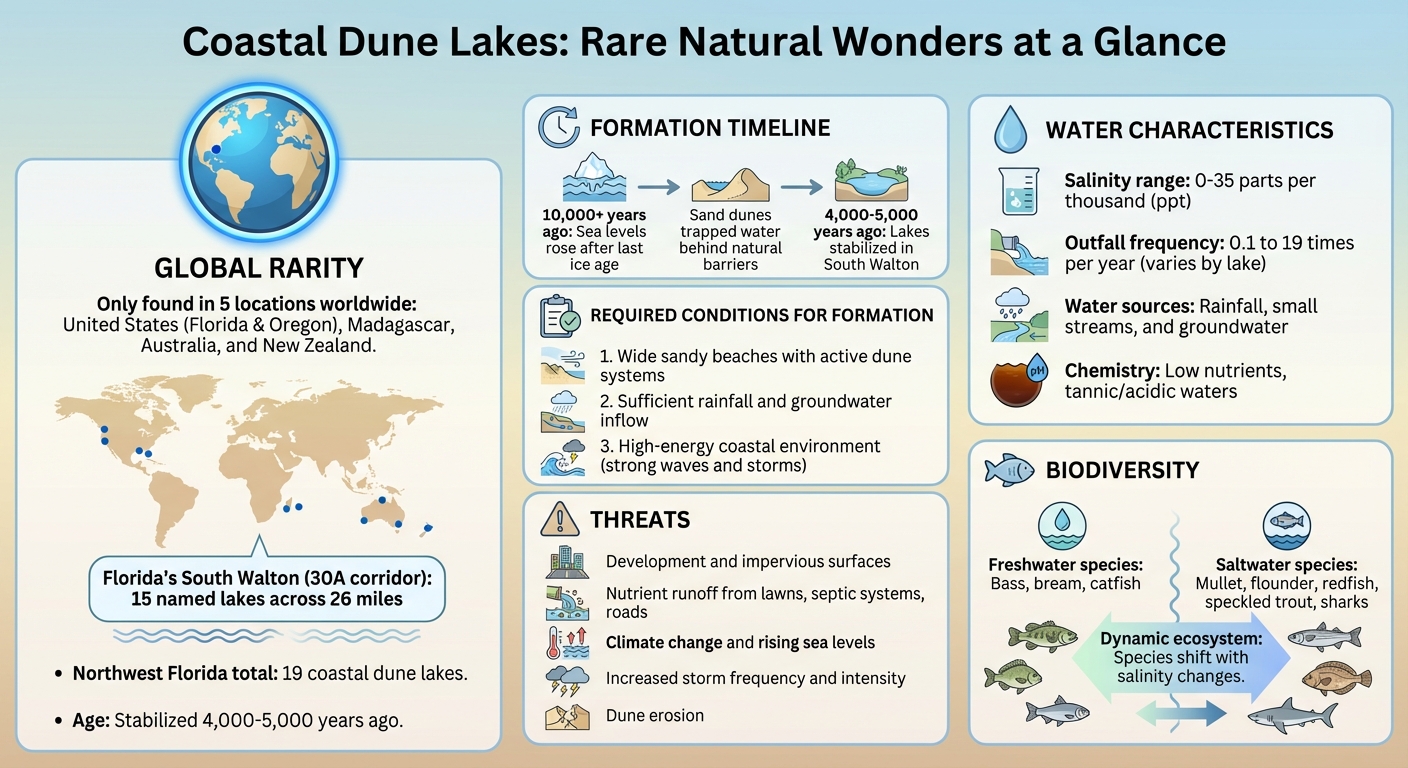
Global Distribution and Key Facts About Coastal Dune Lakes
How Coastal Dune Lakes Form and Function
Formation Process
More than 10,000 years ago, as sea levels rose following the last ice age, low-lying coastal areas and former river mouths were flooded. At the same time, winds carried sand from the Gulf, creating dune ridges that trapped water behind natural barriers. This process led to the formation of coastal dune lakes. Sediment core studies from Florida's Panhandle indicate that South Walton’s coastal dune lakes likely stabilized around 4,000–5,000 years ago, making them relatively young in geological terms.
Strong winds blowing inland transported sand, which was then trapped by vegetation and the landscape, forming foredunes over time. Over thousands of years, these dunes covered old drainage pathways, creating enclosed basins that eventually filled with water. Periodically, storms and hurricanes broke through these dune ridges, carving temporary channels that reconnected the lakes to the Gulf. However, wave action and sand movement would naturally seal these breaches again. This ongoing cycle of openings and closures shaped the irregular outlines and varying isolation levels of the lakes we see today.
This unique formation process laid the groundwork for the dynamic water movements that define each lake.
Water Flow and Outfalls
Coastal dune lakes are fed by a combination of rainfall, small streams, and groundwater, which seeps through the sandy, porous soils of the area. Rainwater infiltrates quickly, making these lakes natural collection points for their surrounding watersheds. When water levels rise significantly - often after heavy or extended rainfall - pressure builds and forces water through the lowest point in the dune, creating a narrow channel through the beach known as an outfall.
When an outfall opens, water flows out rapidly due to gravity, lowering the lake’s level. At the same time, tides, waves, and wind can push saltwater into the lake. Each lake along the 30A corridor has its own unique outfall behavior, influenced by factors like the size of its watershed, the height of its dunes, and local storm patterns. Once the lake drains and reaches a balanced level, sand and wind naturally rebuild the dune, closing the outfall until the next significant rain event.
Water Chemistry
The water chemistry in these lakes shifts in response to their flow dynamics. Rain and groundwater bring tannins from nearby organic soils, which darken the water and limit light penetration. Salinity levels fluctuate depending on freshwater inflows and occasional saltwater intrusion, creating a distinct chemical profile for each lake. When a lake remains closed and receives steady freshwater input, its salinity can drop to nearly fresh levels. However, frequent or prolonged connections to the Gulf can result in brackish or even hypersaline conditions, especially in hot weather when evaporation increases and saltwater seeps through the sandy substrate.
Most coastal dune lakes are naturally low in nutrients due to their sandy, well-drained watersheds. However, seasonal rainfall and warm temperatures can occasionally alter nutrient levels and dissolved oxygen concentrations.
Where Coastal Dune Lakes Exist Worldwide
Global Locations
Coastal dune lakes are incredibly rare, found only in a handful of places worldwide: the United States, Madagascar, Australia, and New Zealand. Within the U.S., these unique features are confined to Florida and Oregon. Their scarcity makes them one of Earth's rarest coastal formations.
In Florida, South Walton's 30A corridor is home to one of the largest concentrations of these lakes globally. This stretch of coastline hosts about 15 named coastal dune lakes spread across 26 miles. Including nearby Bay County, northwest Florida boasts a total of 19 coastal dune lakes.
Oregon's Pacific coast is the only other U.S. region with these lakes. Here, a small number of dune-impounded lakes form behind expansive coastal dune fields. In the Southern Hemisphere, Australia features these lakes along its eastern coastline, particularly in New South Wales and Queensland, including Fraser Island. Western Australia's Indian Ocean coastline also supports some examples. Meanwhile, New Zealand and Madagascar have a limited number of coastal dune lakes along sandy beaches and barrier coasts.
These scattered locations highlight the rarity of the conditions needed to form these lakes and set the stage for understanding their ecological importance.
Required Environmental Conditions
Coastal dune lakes form only when specific environmental factors align. First, the coastline must have wide sandy beaches and active dune systems capable of trapping water landward while being reshaped by waves and wind. Second, sufficient rainfall and groundwater inflow are essential to maintain a permanent or semi-permanent water body close to the coast. Lastly, a high-energy coastal environment - characterized by strong waves and storms - builds sand berms and periodically breaches them, creating natural outfalls that connect the lakes to the ocean.
On coasts that are rocky, dry, or have low wave energy, these lakes are unlikely to form. The combination of sandy terrain, consistent rainfall, and dynamic shorelines is exceptionally rare, explaining why coastal dune lakes are scattered across only a few locations globally. South Walton's 30A coastline exemplifies these unique conditions, emphasizing its global importance.
Ecological Value and Wildlife
Habitats and Species
Coastal dune lakes sit at the crossroads of freshwater, saltwater, and land-based ecosystems, creating an environment that supports a rich variety of habitats. These lakes are surrounded by areas where freshwater mingles with saltwater, forests meet open water, and scrubby dunes transition into marshlands. This unique setup fosters a wide range of plant and animal species.
The lakes’ tannic, acidic waters are home to plants adapted to low-nutrient conditions. When lake outfalls open, saltwater-tolerant species from the Gulf mix with freshwater plants, leading to shifts in species distribution based on changing salinity levels. These fluctuations create dynamic ecological niches. Fish populations, for example, adapt to these changes - freshwater species like bass, bream, and catfish thrive in low-salinity conditions, while saltwater species such as mullet, flounder, redfish, speckled trout, and even sharks appear when salinity reaches higher levels (up to 35 parts per thousand). Amphibians thrive in the acidic waters, and migratory birds benefit from the feeding opportunities that arise when Gulf waters periodically flow into the lakes. This intricate mix of habitats forms the backbone of interconnected and ever-changing food webs.
Food Webs and Species Relationships
The periodic opening of lake outfalls creates temporary estuarine conditions, which significantly influence food web dynamics. These brief estuarine environments become feeding hotspots and nurseries for species like redfish and trout. The food web shifts along salinity gradients, where freshwater species like bass coexist with saltwater species like mullet during these transitions. This, in turn, attracts migratory birds to these rich feeding grounds. Additionally, the naturally low-nutrient conditions of the lakes help prevent excessive algal growth, keeping the waters clear and supporting a unique, low-biomass ecosystem.
Natural Services
Coastal dune lakes do more than sustain wildlife - they play a crucial role in protecting the coastline. These lakes help regulate floodwaters during heavy rains, stabilize Walton County’s 26-mile shoreline, and recharge local aquifers, which helps prevent erosion and filter nutrients. Acting as natural flood control systems, the lakes release excess water into the Gulf during periods of heavy rainfall, reducing the impact of storm surges on inland areas. In South Walton, careful management of these lakes not only maintains their biodiversity but also strengthens their ability to mitigate flooding. The 15 named lakes along 30A contribute to aquifer recharge, while the adjacent marshes help control erosion in response to the ever-changing salinity levels of these ecosystems.
COASTAL DUNE LAKES JEWELS OF FLORIDA'S EMERALD COAST
sbb-itb-d06eda6
30A's Coastal Dune Lakes for Science and Recreation
30A's coastal dune lakes are more than just scenic spots - they're hubs for scientific study and outdoor adventure.
Notable Lakes Along 30A
Stretching across South Walton's 26-mile coastline, these 15 coastal dune lakes each have their own unique characteristics. Western Lake, one of the largest and most researched, is nestled between Grayton Beach State Park and neighborhoods like WaterColor. It’s a prime location for studying salinity changes and the interactions between people and nature. Eastern Lake, near Seagrove, stands out for its dynamic outfall, which frequently opens and closes, creating a living lab for observing shifts in water levels, fish movement, and salinity. Deer Lake and Alligator Lake, both located within protected areas, offer relatively untouched environments to compare the effects of development on these ecosystems. Meanwhile, Campbell Lake in Topsail Hill Preserve, accessible only by trail, serves as a pristine example of natural dune lake ecology.
These lakes aren’t just for scientists - they’re also perfect for those looking to explore and enjoy nature firsthand.
Paddling and Nature Exploration
Thanks to their shallow waters, these lakes are ideal for kayaking, paddleboarding, and canoeing. Public access points at Grayton Beach, Deer Lake, and other state parks make it easy to set off and discover winding shorelines, hidden coves, and marshy channels surrounded by forests. Conditions can vary depending on weather: after heavy rains or when the outfalls connect to the Gulf, the water becomes cloudier and currents pick up. During drier periods, the water calms, and sand flats may shift access points. Before heading out, it’s a good idea to check current conditions at sowal.co.
Local Protection and Research Programs
While these lakes are great for recreation, protecting them is a top priority. Walton County's Coastal Dune Lakes program oversees the health of all 15 lakes, focusing on their natural role as flood-control systems and their intermittent connections to the Gulf. The program monitors water levels, outfalls, and key water quality factors like salinity, nutrients, and dissolved oxygen throughout the year. Partnerships with groups like the Choctawhatchee Basin Alliance and local state parks help manage public access while preserving the delicate ecosystems. Educational efforts, including guided walks, interpretive signs, and citizen science projects like Lake Watch, help raise awareness about the importance of these lakes. Together, these initiatives balance recreational use with conservation, ensuring these rare ecosystems remain thriving and accessible for generations to come.
Threats and Future Research Needs
Current Threats
South Walton's coastal dune lakes are under mounting pressure. Development along the popular 30A area is encroaching on the very dunes and forests that act as natural filters for runoff. As homes and roads replace these protective barriers, impervious surfaces like asphalt and concrete allow more pollutants to seep into these fragile ecosystems. Nutrient runoff from lawns, septic systems, and roads poses a serious risk, potentially triggering algal blooms in these naturally low-nutrient, acidic lakes. Even small amounts of phosphorus and nitrogen can upset the delicate balance, jeopardizing the brackish species that rely on it.
Adding to these challenges is climate change. Rising sea levels threaten to permanently breach the sand berms that define these lakes, turning them from dynamic freshwater-brackish systems - where salinity ranges between 0 and 35 ppt - into consistently salty environments. Stronger and more frequent storms exacerbate this issue, leading to more frequent outfalls (which can range from 0.1 to 19 times per year, depending on the lake) and increased saltwater intrusion. Both storms and human activity contribute to the erosion of the sand berms, further altering the lakes' unique ecosystems. These changes have ripple effects not only on the lakes' biodiversity but also on the recreational experiences that draw visitors to the 30A area.
Protection Efforts
Walton County has implemented zoning regulations and protective buffers around all 15 coastal dune lakes to help safeguard these ecosystems. State parks also play a critical role in preservation. For instance, Grayton Beach State Park protects Western Lake, Alligator Lake, and Little Redfish Lake by limiting access and actively preserving their habitats. Additionally, state laws regulate outfall management and prohibit unauthorized alterations to dunes, ensuring that natural water flow patterns remain intact.
Community involvement is another key piece of the puzzle. The Choctawhatchee Basin Alliance monitors water quality and educates residents about the health of local watersheds. Local initiatives encourage practices like establishing no-discharge zones and planting native vegetation to curb runoff. Community-driven dune restoration events bring people together to reinforce natural defenses against erosion and storm damage. Resources like sowal.co actively promote these efforts, keeping the community engaged in conservation activities along the 30A corridor.
While these protective measures are crucial, future resilience depends on continued research and proactive adaptation.
Research Priorities
Scientists are focusing on three main areas to protect these unique ecosystems. First, studies on water dynamics aim to understand how factors like rainfall, wind, and lake levels influence outfall timing and overall ecosystem stability. This knowledge is critical for predicting flood control capacity and preparing for future challenges.
Second, biodiversity research is examining the intricate food webs that blend freshwater species like bass and bream with saltwater arrivals such as mullet, redfish, and even sharks. Researchers are particularly interested in how changing salinity levels affect these species and the potential risks posed by invasive species.
Finally, climate adaptation research is exploring ways to strengthen these ecosystems against rising sea levels. This includes developing improved dune restoration techniques, creating elevation models to predict and mitigate flooding, and recommending low-impact designs for nearby properties. Visitors are also encouraged to paddle responsibly and participate in monitoring programs, blending scientific research with community action.
Through a combination of rigorous research and active community involvement, these efforts aim to preserve the coastal dune lakes for future generations to enjoy and explore.
Conclusion
Coastal dune lakes are some of the rarest natural formations on the planet, found in only a few locations worldwide. The South Walton area, with its cluster of these extraordinary lakes along the 30A coastline, is a true natural gem. Here, freshwater and saltwater meet, forested edges give way to open water, and ecosystems constantly adapt to the ebb and flow of outfall events - all contributing to the lakes' global importance and underscoring the need for active conservation efforts.
The 30A region offers visitors a chance to connect with these lakes in remarkable ways. Imagine paddling across the serene waters of Western Lake in the morning, then strolling just a short distance to enjoy a refreshing swim in the Gulf. Grayton Beach State Park, a celebrated destination, protects several of these lakes while offering hiking trails and opportunities for wildlife observation. It’s the perfect gateway for anyone looking to explore these one-of-a-kind ecosystems. However, enjoying these lakes comes with a responsibility to preserve their delicate balance.
Protecting these fragile environments starts with mindful exploration. Stick to marked trails and boardwalks to avoid damaging dune vegetation, opt for non-motorized crafts like kayaks or paddleboards, and always carry out your trash. Resources like sowal.co provide excellent guidance on low-impact activities and connect visitors with local conservation programs, ensuring that these lakes remain pristine for future generations.
These coastal dune lakes are more than just beautiful - they're a testament to the intersection of nature's artistry and ecological importance. Their future depends on a collective effort to balance enjoyment with stewardship. By appreciating their rarity, supporting conservation initiatives, and exploring responsibly, you contribute to protecting one of South Walton's most extraordinary natural wonders - a living reminder of the incredible ecosystems that thrive along the 30A coastline.
FAQs
What makes coastal dune lakes such rare natural wonders?
Coastal dune lakes are a natural rarity, forming only under precise conditions where sand dunes, freshwater sources, and the ocean come together in perfect harmony. This delicate interaction creates an ecosystem so unique that you’ll only find these lakes in a handful of spots worldwide. One such place is the picturesque 30A area of South Walton, Florida.
These lakes aren’t just rare; they’re also vital. They provide habitats for a variety of wildlife and showcase breathtaking landscapes that invite exploration and admiration.
What makes coastal dune lakes so rare and how do they form?
Coastal dune lakes are a natural rarity, forming only under a specific set of conditions. These lakes emerge in regions where sand dunes act as a natural barrier, separating freshwater from the ocean. On occasion, the barrier gives way, letting saltwater mix with freshwater - a process crucial to preserving the lakes' fragile ecosystems.
For these lakes to thrive, several factors must align: an abundance of sand dunes, high groundwater levels, and regular rainfall to replenish the freshwater. This delicate balance explains why coastal dune lakes are so uncommon, with one of the few examples found along the picturesque 30A area in Florida.
What makes coastal dune lakes vital for biodiversity and the environment?
Coastal dune lakes are vital for biodiversity, offering rare and specialized habitats that support an array of plants and animals. Particularly in regions like 30A, these unique ecosystems sustain species adapted to the delicate balance of freshwater and saltwater environments.
Beyond their role as habitats, these lakes are key players in maintaining ecological harmony. They naturally filter water, recycle nutrients, and serve as crucial breeding grounds for various wildlife. Their scarcity and ecological significance make them invaluable natural wonders that deserve protection.