Camp Helen State Park is a standout destination along Florida's 30A coastline, blending a deep historical background with rare natural features. Here’s what makes it special:
- Historical Roots: Dating back 4,000 years, Camp Helen's history begins with the Deptford culture (500 B.C.). Later, it became a private estate in 1928, a corporate retreat for textile workers (1945–1987), and finally a state park in 1997.
- Preserved Structures: The park features the 1932 Lodge, colorful Rainbow Cottages, and a 40-foot water tower - remnants of its days as a resort.
- Natural Highlights: Home to Lake Powell, one of the largest coastal dune lakes in Florida, the park protects rare ecosystems found in only five places worldwide.
- Grassroots Preservation: Saved from private development in the 1990s by local activists, it now offers a mix of history and conservation.
Compared to other 30A landmarks like Eden Gardens, Grayton Beach, and Topsail Hill Preserve, Camp Helen offers a unique blend of historical significance and natural beauty.
Quick Comparison
| Feature | Camp Helen State Park | Eden Gardens State Park | Grayton Beach State Park | Topsail Hill Preserve State Park |
|---|---|---|---|---|
| Established as State Park | 1997 | 1968 | 1968 | 1992 |
| Key Theme | 20th-Century Retreat / Textile Era | 19th-Century Lumber Industry | Fishing Village / Coastal History | Logging History / Nature Preserve |
| Acreage | 180 acres | 163 acres | 1,133 acres | 1,640 acres |
| Dune Lakes | Lake Powell | None | Western Lake | Five Dune Lakes |
| Notable Structures | Lodge, Rainbow Cottages, Tower | Wesley House, Ornamental Gardens | "Wash-A-Way" House | Modern Cabins, Tram System |
| Entrance Fee | $4.00/vehicle | $4.00/vehicle | Standard State Park Fee | $6.00/vehicle |
Camp Helen’s layered history, rare ecosystems, and grassroots preservation efforts set it apart, making it a must-visit for anyone exploring 30A.
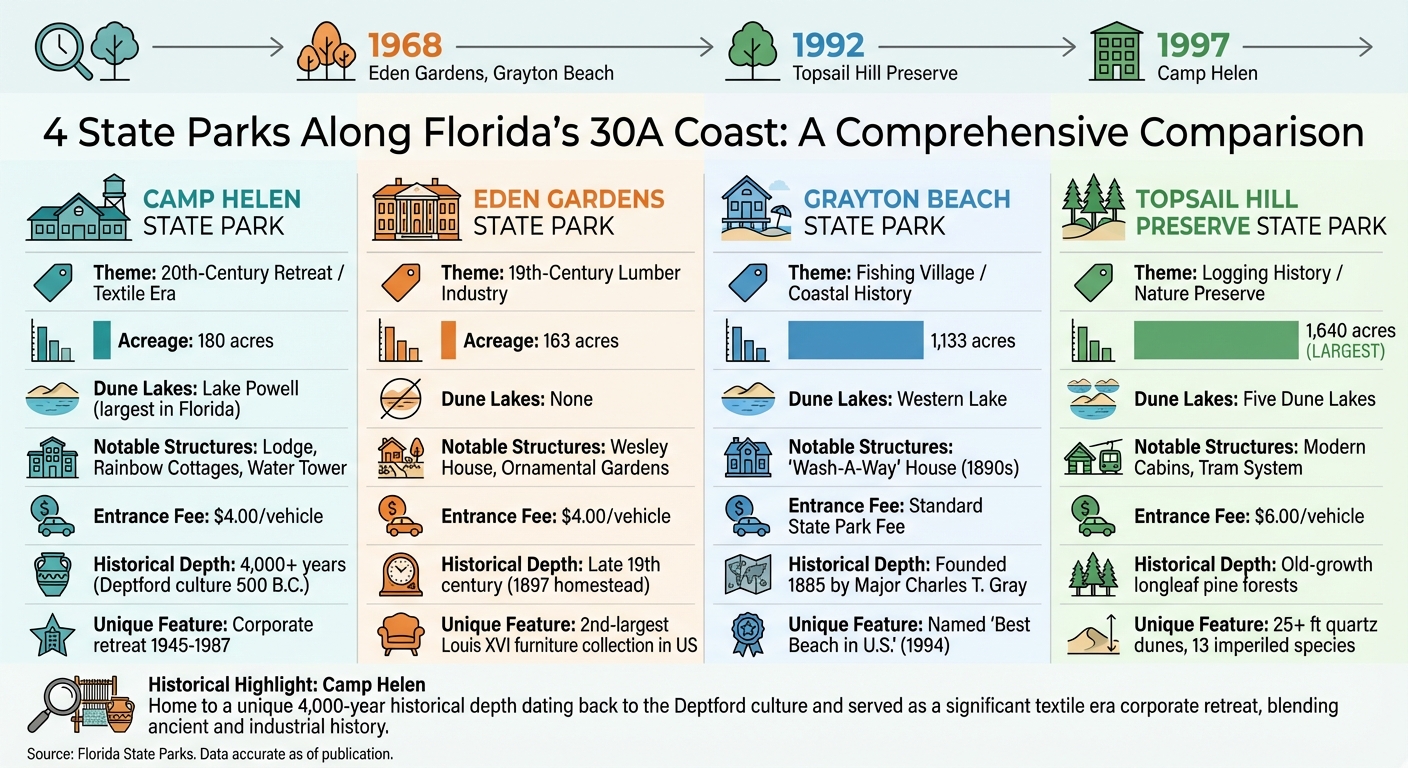
Camp Helen vs Other 30A State Parks Comparison Chart
Camp Helen vs. Eden Gardens State Park
Historical Background
Camp Helen has an intriguing past, starting as a private estate in the 1930s before becoming a retreat for textile employees. On the other hand, Eden Gardens has its roots in the late 19th century, tied to the lumber industry. The Wesley family established their homestead in 1897 and ran a lumber company on the property from 1890 until shortly after World War I. The Wesley House served as the heart of their timber operations, symbolizing this industrial heritage.
In 1963, Lois Maxon purchased the Eden Gardens estate for $12,500. Upon seeing it, she famously proclaimed, "I have found my Eden". Maxon transformed the mansion, filling it with her antique collection and creating ornamental gardens before donating the property to the state in 1968.
These unique beginnings have shaped the architectural styles and visitor experiences offered at each park.
Buildings and What Visitors Can See
The history of these parks is reflected in their architecture and attractions, offering visitors a glimpse into their distinct pasts.
At Camp Helen, you'll find rustic log-style buildings, including the 1932 Lodge and the vibrant Rainbow Cottages. These cottages are charmingly small, with the tiniest one measuring just 291 square feet. A standout feature is the 40-foot water tower, built in the 1930s to supply water pressure for the cottages. Visitors can relax in rocking chairs overlooking Lake Powell or explore the historic Rainbow Cottages.
Eden Gardens, by contrast, is centered around the stately two-story Wesley House, complete with white columns and a wrap-around porch. Inside, the house showcases the second-largest collection of Louis XVI furniture in the United States. The grounds are equally impressive, featuring ornamental gardens shaded by moss-covered live oaks, a 600-year-old "Wedding Tree", a secret garden, and a reflection pond filled with Koi. Guided tours of the mansion are available Thursday through Monday, from 10:00 a.m. to 3:00 p.m., with admission priced at $4.00 for adults and $2.00 for children.
Comparison Table
| Feature | Camp Helen State Park | Eden Gardens State Park |
|---|---|---|
| Established as State Park | 1997 | 1968 |
| Theme | 20th-Century Corporate Resort / Textile Industry | 19th-Century Lumber Industry / Antebellum-style Estate |
| Key Preserved Structures | The Lodge, Rainbow Cottages, Water Tower | Wesley House, remnants of lumber mill |
| Notable Natural Features | Lake Powell (Coastal Dune Lake), Gulf beaches | Tucker Bayou, 600-year-old "Wedding Tree", ornamental gardens |
| Acreage | 180 acres | 163 acres |
| Entrance Fee | $4.00 per vehicle | $4.00 per vehicle |
| Visitor Activities | Beachcombing, hiking, fishing, viewing historic exteriors | Guided mansion tours, garden walks, fishing off the dock |
Camp Helen vs. Grayton Beach State Park
Historical Background and Origins
Camp Helen and Grayton Beach each tell their own unique story, deeply rooted in the history of the 30A region. Camp Helen's origins trace back thousands of years, with evidence of the Deptford culture dating to around 500 B.C.. Fast forward to the 20th century, the area transformed into a retreat when the Hicks family built their "Loch Lomond" estate in the 1930s. Later, from 1945 to 1987, the site served as a corporate getaway for Avondale Mills textile workers.
Grayton Beach, on the other hand, has a different timeline. Founded in 1885 by Army Major Charles T. Gray, it holds the distinction of being one of Walton County's oldest townships. Officially mapped in 1890 by General William Miller and William Wilson, this village was established as a public fishing community. Its historic charm is encapsulated in the "Wash-A-Way" house, a two-story structure from 1890 that survived the 1926 hurricane that washed away its foundation. Meanwhile, Camp Helen’s 1932 Lodge stands as a testament to a more modern era of coastal development.
Now, let’s dive into the natural features that make these parks stand out.
Natural Features and Conservation
Beyond their rich histories, the natural landscapes of these parks set them apart. Both are home to coastal dune lakes, a rare natural phenomenon found in only five places worldwide. Camp Helen boasts Lake Powell, one of Florida's largest coastal dune lakes, which connects to the Gulf of Mexico through Phillips Inlet. This unique connection allows fresh and saltwater to mix, creating a diverse and dynamic ecosystem.
Grayton Beach State Park is centered around Western Lake, surrounded by expansive salt marshes and covering an impressive 1,133 acres. The park gained national attention when Dr. Stephen Leatherman named it the "Best Beach in the U.S." in 1994. Its striking "wind-pruned" landscape is another defining feature, where trees like slash pines and southern magnolias are partially buried by shifting dunes, making them appear as low bushes.
Comparison Table
| Feature | Camp Helen State Park | Grayton Beach State Park |
|---|---|---|
| Historical Depth | Prehistoric (4,000+ years); 20th-century retreat | 19th-century fishing village; founded 1885 |
| Key Dune Lake | Lake Powell (largest in Florida) | Western Lake |
| Acreage | 180 acres | 1,133 acres |
| Cultural Identity | "Soldiers Beach" / Industrial retreat | "Old Florida" fishing village |
| Notable Structures | The Lodge, Rainbow Cottages, Water Tower | The "Wash-A-Way" House (1890s) |
| Visitor Facilities | Day-use with historic tours | 37 campsites; 10 modern cabins |
| Entrance Fee | $4.00 per vehicle | Standard state park fee |
Camp Helen vs. Topsail Hill Preserve State Park
Industrial History and Natural Environment
Camp Helen and Topsail Hill Preserve State Park each tell a unique story shaped by their industrial pasts. Camp Helen began as the Hicks family's estate before becoming a textile mill retreat from 1945 to 1987. During this time, it served as a getaway for Alabama workers who enjoyed activities like boating, water skiing, and fishing on Lake Powell. A centerpiece of this retreat was The Lodge, constructed between 1931 and 1932 at a cost of $75,000 - equivalent to over $1.1 million today.
In contrast, Topsail Hill Preserve reflects Florida’s logging history. Spanning 1,640 acres, it safeguards old-growth longleaf pine forests and sand pine scrub - landscapes that have withstood the widespread logging that once dominated the region. The park gets its name from its towering quartz dunes, which rise over 25 feet and reminded Gulf sailors of ship sails. Unlike Camp Helen’s history as a resort, Topsail Hill has always been about preserving nature.
Both parks are home to rare coastal dune lakes. Camp Helen boasts Lake Powell, one of the largest of its kind in Florida. Topsail Hill, on the other hand, features five distinct dune lakes, including Campbell Lake, which is almost entirely freshwater and rarely connects to the Gulf. Topsail Hill’s expansive 1,640 acres dwarf Camp Helen’s more modest 180-185 acres.
These natural and historical elements set the stage for the parks’ contrasting approaches to architectural preservation.
Preserved Buildings and Structures
The architectural features of Camp Helen and Topsail Hill Preserve reflect their differing priorities. Camp Helen preserves its resort-era charm, with structures like The Lodge and the colorful Rainbow Cottages. These cottages, named for their vibrant hues, were once the most desirable accommodations for textile mill employees.
Topsail Hill, however, focuses on modern amenities that align with its ecological mission. The park offers 16 contemporary cabins and bungalows nestled near its natural dunes. It also works to protect 13 imperiled species, including the Choctawhatchee beach mouse and pitcher plants, emphasizing conservation over historical preservation.
Comparison Table
| Feature | Camp Helen State Park | Topsail Hill Preserve State Park |
|---|---|---|
| Historical Theme | Textile mill retreat (1945–1987) | Logging history & nature preserve |
| Preserved Structures | The Lodge, Rainbow Cottages, Water Tower | Modern cabins, bungalows, tram system |
| Natural Features | Lake Powell, salt marshes, 4,000-year-old middens | 25+ ft dunes, 5 dune lakes, old-growth pines |
| Size | 180–185 acres | 1,640 acres |
| Entrance Fee | $4.00 per vehicle | $6.00 per vehicle |
| Rare Species | Shorebirds, bald eagles, sea turtles | Choctawhatchee beach mouse, pitcher plants |
sbb-itb-d06eda6
Tour of the Historic Lodge at Camp Helen State Park in Panama City Beach
What Makes Camp Helen Different from Other 30A Landmarks
Camp Helen packs 4,000 years of human history into its 180-acre site, making it a standout among 30A landmarks. While many parks in the area focus solely on preserving nature or catering to modern tourism, Camp Helen tells a story that spans from prehistoric times to the mid-20th century. Archaeologists have discovered that the Deptford culture lived here as early as 500 B.C., leaving behind ceremonial mounds and pottery middens - artifacts you can still see today. This rich history sets the stage for the park's later industrial significance.
The park’s ties to the textile industry play a key role in its story. From 1945 to 1987, Avondale Mills used Camp Helen as a private vacation retreat for its Alabama textile workers, giving the site a unique identity as a corporate getaway. Meanwhile, nearby Inlet Beach, known as "Soldiers Beach", was being developed through a post–World War II veteran land lottery, but Camp Helen remained an exclusive retreat during that era.
What makes Camp Helen even more special are its historic buildings. Nine structures, including the 1931 Lodge and the brightly painted Rainbow Cottages from the "Loch Lomond" period, are listed on the National Register of Historic Places. Together, they tell the story of the park’s transformation from private estate to corporate retreat to public conservation site.
The park’s location adds another layer to its story. Surrounded by water on three sides - the Gulf of Mexico, Phillips Inlet, and Lake Powell (one of the largest coastal dune lakes in the world, covering about 800 acres) - Camp Helen is home to a mix of salt marshes, freshwater wetlands, and scrub oak habitats. This combination creates a stunningly diverse ecosystem.
In 1996, grassroots efforts ensured Camp Helen’s preservation as a state park. A petition signed by 10,000 people helped block private development. Today, the park offers visitors a glimpse into the layered history of the 30A area, from ancient indigenous cultures and industrial use to its current role in conservation.
FAQs
What makes Camp Helen State Park's history special compared to other landmarks on 30A?
Camp Helen State Park is a gem along 30A, steeped in history that stretches back thousands of years. Archaeological evidence shows that this area was home to Indigenous peoples as early as 500 BC, marking it as one of the most historically rich spots in the region. Adding to its charm is Lake Powell, the largest coastal dune lake in Florida, celebrated for its striking natural beauty and ties to local legends.
The park's story doesn't stop with its ancient past. It also boasts unique historic structures like the 1932 Lodge and a cluster of quaint cottages, remnants of its time as a corporate retreat for Avondale Mills employees. The preservation of Camp Helen is a direct result of passionate community efforts in the 1990s, ensuring that its cultural and natural treasures remain protected for future generations. With its mix of history, nature, and local heritage, Camp Helen stands as a truly special destination along the 30A coastline.
What makes Camp Helen State Park's natural environment unique compared to other parks along 30A?
Camp Helen State Park stands out as a gem along the 30A coastline, largely because of its centerpiece - Lake Powell. This lake isn't just any body of water; it’s the largest coastal dune lake in the Northern Hemisphere. What makes it so special? It’s a rare brackish ecosystem where freshwater and saltwater meet, creating a vibrant habitat packed into the park’s compact 180 acres. Here, wetlands, salt marshes, sand pine scrub, and stunning white-sand beaches come together in a way that feels almost magical.
Lake Powell occasionally flows into the Gulf, which helps sustain a wide variety of wildlife. You’ll find fish like redfish and mangrove snapper thriving here, and it also serves as an important pathway for local wildlife. Unlike many other parks along 30A that focus on traditional barrier island scenery, Camp Helen offers an exciting mix of dune lakes, marshes, and forested areas. It’s a haven for both nature enthusiasts and history buffs, making it a destination that truly has something for everyone.
How did the community help preserve Camp Helen as a state park?
The story of Camp Helen becoming a state park is a shining example of how a community can come together to make a difference. Back in April 1995, Helen Schroeder, a local resident, sounded the alarm about plans to develop the 185-acre site. Her efforts sparked a grassroots movement, uniting neighbors, students, and conservationists with one goal: to save the land. The community quickly mobilized, gathering thousands of signatures and flooding state officials with letters to show just how much people cared about preserving this natural and historic gem.
Their determination paid off. The Florida Department of Environmental Protection stepped in, purchasing the property, and by 1997, Camp Helen was officially designated as a state park. But the work didn’t stop there. Local supporters also took on the task of restoring historic buildings like the lodge and Rainbow Cottages, ensuring the park’s history was preserved alongside its breathtaking natural beauty. This incredible achievement shows the power of collective action to protect places that matter for future generations.