The 30A coastline in South Walton, Florida, offers prime locations for wildlife photography, especially for those using kayaks or paddleboards. From rare coastal dune lakes to the vibrant Choctawhatchee Bay, this area is rich with opportunities to photograph ospreys, dolphins, and shorebirds in their natural habitats. Here’s a snapshot of the top spots:
- Western Lake: Best for sunrise shots of ospreys fishing.
- Deer Lake State Park: Ideal for shorebirds during golden hour.
- Topsail Hill Preserve: Great for wading birds and tortoises in soft afternoon light.
- Choctawhatchee Bay: Perfect for dolphin photography throughout the day.
- Coastal Dune Lakes or Gulf Shores: Stunning sunset silhouettes of dunes and birds.
Quick Tips:
- Use kayaks or paddleboards for quiet, low-angle shots.
- Early mornings and late afternoons provide the best light and wildlife activity.
- Respect wildlife by maintaining safe distances and following local guidelines.
For a detailed breakdown of each location, including launch points, camera settings, and safety tips, keep reading.
Kayak Photography Secrets: Capture Stunning Nature Shots on the Water! 🛶📸
How To Use This Guide
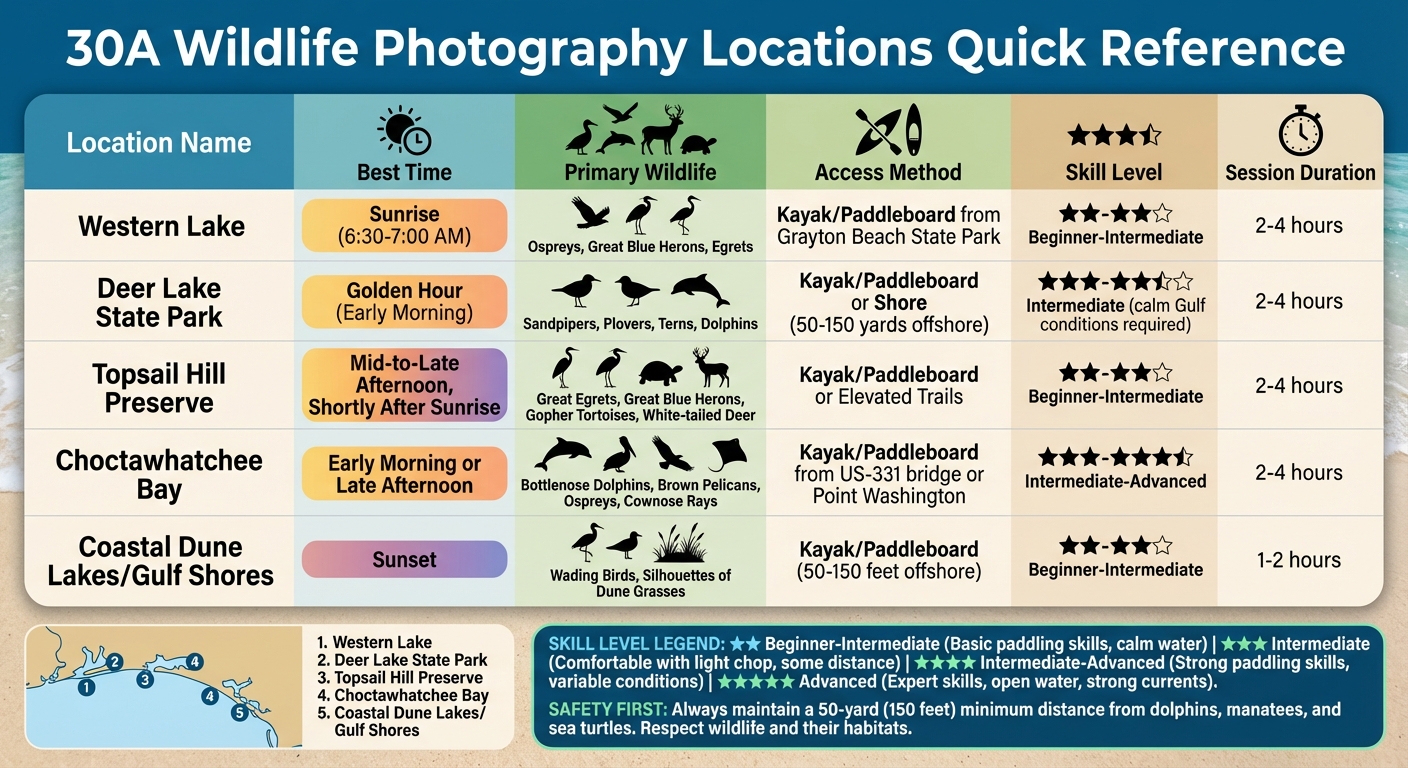
30A Wildlife Photography Locations Comparison Guide
What To Expect
This guide spotlights five incredible wildlife photography locations along 30A, each offering unique scenery and ideal times for capturing stunning shots. Here’s a quick rundown:
- Western Lake: Perfect for catching dramatic osprey fishing sequences at sunrise.
- Deer Lake State Park: Ideal for close-up shots of shorebirds along the dunes during golden hour.
- Topsail Hill Preserve State Park: A great spot for photographing wading birds and tortoises in the soft light of mid-to-late afternoon.
- Choctawhatchee Bay: Offers opportunities for responsible dolphin photography throughout the day.
- Coastal dune lakes or Gulf shores: Excellent for capturing backlit silhouettes at sunset.
The best way to access these spots is by kayak or paddleboard, which allows for a quiet approach and low-angle shots without disturbing the wildlife. Basic paddling skills for calm to moderate waters are sufficient, and most sessions last between two to four hours, including launch and on-water shooting time. Before heading out, browse through the featured shots in this guide and select one or two locations that align with your schedule and experience level. While on the water, you can refer back to this guide on your phone for launch points, suggested routes, and camera settings.
Be sure to read the safety tips and environmental guidelines below to make your adventure both enjoyable and responsible.
Safety and Environmental Awareness
Your safety comes first. Always wear a U.S. Coast Guard–approved personal flotation device, and check the weather, wind, tide, and storm forecasts before heading out. Carry a whistle and a waterproof light if you plan to stay out near dusk. Let someone know your route and expected return time. For your camera gear, use leashes or dry bags to keep it secure. If you’re paddling in areas like Choctawhatchee Bay, where boat traffic is common, wear bright clothing or attach a small flag to stay visible, and avoid navigating through main channels. North Florida summers can be intense, with high heat and sudden thunderstorms, so pack water, wear sun protection, and be ready to head back to shore if the weather takes a turn.
When it comes to wildlife, respect is key. Maintain a distance of at least 50 yards from dolphins, as required by the Marine Mammal Protection Act, and avoid disturbing birds by flushing them from nests or roosting areas. Follow Florida State Parks rules by staying off dunes and using designated access routes. Coastal dune lakes are rare and fragile ecosystems - treat them with care to help preserve their natural beauty for future visitors.
Quick-Planning Comparison Table
To make your planning easier, look for the summary table later in the article. It compares all five photography locations side by side, highlighting the best spots for sunrise versus sunset, which require a kayak or paddleboard versus shore access, and which are better suited for beginners or experienced paddlers. The table can also help you map out a full day of photography - like starting at Western Lake for sunrise, heading to Topsail Hill for midday shots, and wrapping up with sunset at the Gulf. Pair this guide with local resources like sowal.co to check current conditions, access updates, and seasonal wildlife activity before you head out.
Western Lake Osprey at Sunrise
Where to Launch
If you're planning to explore Western Lake, Grayton Beach State Park is your ideal starting point. It offers convenient parking, restrooms, and easy access to the water. Arrive early - sunrise typically falls between 6:30 and 7:00 a.m., depending on the season - for the calmest waters and the soft, golden light perfect for photography. On the WaterColor side of the lake, you can also use public launch points or community docks to enjoy an alternate perspective of the sunrise. Once you're on the water, the lively bird activity will quickly draw your attention.
Wildlife and Scenic Highlights
Western Lake is one of the rare coastal dune lakes, an ecosystem found in only a few places around the globe. This unique setting attracts an abundance of birdlife. The osprey are the true stars here, often seen hunting confidently over the open water. Watching them circle, dive, and emerge with a fish is nothing short of breathtaking. Along the lake's shallows, you'll find Great Blue Herons and egrets feeding actively at first light, often unbothered by a quiet, slow-moving paddler. The still surface of the lake at dawn creates mirror-like reflections, doubling the beauty of every bird and scene. Keep an eye on the dune line and the Gulf outfall for shorebirds like sandpipers and plovers, which become more active as the sun rises higher.
Photography Tips
To make the most of your time on Western Lake, take advantage of your low position on a kayak or paddleboard. Shooting from deck level allows you to frame ospreys and wading birds against the vibrant sunrise sky and their reflections on the water. For action shots, such as an osprey diving or an egret landing, switch to continuous autofocus (AI Servo/AF-C) and use high-speed burst mode. Set your shutter speed between 1/2000 and 1/4000 seconds with an aperture of f/5.6 to f/8 to freeze the motion of wings and water spray. Auto ISO set between 3200 and 6400 will help you adapt to the changing light during dawn. To add drama, shoot with side or backlighting during the golden hour, highlighting feathers and capturing the glowing mist above the water. Adjust your kayak or paddleboard's angle carefully to avoid disturbing the birds. Finally, protect your gear with a dry bag during transit and use a rain cover or splash cover to shield your camera while shooting.
Deer Lake Shorebirds Along the Dune Line
Paddling the Shoreline
At Deer Lake State Park, a protected boardwalk stretches over the dunes, leading directly to the beach. This stable platform is a lifesaver on windy days. If the Gulf waters are calm, you can launch your kayak or paddleboard right from the beach access point. Aim to paddle about 50–150 yards offshore, staying safely outside the swim zone. One of the standout features here is the dune lake outflow, where Deer Lake connects with the Gulf. This creates a slightly deeper channel that acts as a natural feeding ground for shorebirds. To get the best shots, position your kayak or paddleboard near the edges of the current - close enough to observe the action but far enough to avoid the stronger currents or breaking waves.
Before heading out, always check the conditions. Waves should be under 2–3 feet, and onshore winds should stay below 10–15 mph. Double-red flags? That’s your signal to stay off the water. Early mornings, with light offshore winds, are perfect for paddling. The water is stable, and the reflections are pristine, giving you the ideal setup for capturing those serene wildlife moments.
Key Wildlife Subjects
Once you’re out on the water, the real magic begins. The shoreline at Deer Lake is a hotspot for shorebirds, offering a year-round opportunity to observe their behaviors. Sandpipers, like Western and Least Sandpipers, are particularly active in the swash zone. They dart in as waves recede, only to retreat as the water advances. Slightly farther up the beach, plovers can be spotted hunting for prey, pausing between their quick sprints.
Keep an eye out for terns, such as Royal and Sandwich Terns. These birds often gather in loose groups on the sand, facing into the wind, and can be seen diving dramatically offshore. And don’t forget to scan beyond the breakers - you might spot bottlenose dolphins cruising parallel to the beach. On clear, calm days, you can capture stunning shots of dolphins with the dune line as a backdrop, creating a truly coastal scene.
Photography Strategies
To photograph wildlife here without disturbing the natural flow, a telephoto lens in the 300 to 600 mm range (full-frame equivalent) is your best friend. This allows you to maintain a respectful distance while still filling your frame with detail. Shooting parallel to the surf line is a smart move - it keeps your lens closer to the birds' eye level, creates a dynamic diagonal along the shoreline, and minimizes distractions from choppy surf in the background. Whether you’re shooting from the shore or the water, stick to low angles and align your movements with the birds’ direction. This approach reduces disturbance and helps capture their natural behavior.
For settings, adjust your shutter speed to match the action: 1/1600 to 1/4000 seconds works well, depending on whether the birds are walking, running, or flying. Pair this with apertures between f/4 and f/8, based on the light conditions, and use Auto ISO with an upper limit to balance noise and detail. Continuous autofocus (AI Servo/AF-C) and high-speed burst mode are essential for sharp, action-packed shots. If you’re working in bright sunlight, don’t forget to dial in +1/3 to +2/3 stop exposure compensation to avoid underexposing white birds against the bright sand and water.
Take a few minutes - 5 to 10 is ideal - to observe the birds before you start shooting. You’ll notice patterns, like sandpipers following retreating waves or terns taking off in coordinated bursts. Stick to designated access points and stay in the wet-sand zones below the dune line. Avoid placing tripods or gear in vegetated areas, as these are often nesting sites. And if the birds seem agitated or take flight as you approach, back off and let your telephoto lens do the work. Respecting their space is key to capturing those authentic, undisturbed moments.
Topsail Hill Egrets and Tortoises
Exploring the Lakes
Topsail Hill Preserve State Park spans an impressive 1,600 acres and boasts 3 miles of pristine, untouched beachfront. If you're looking to get up close to the action, launch a kayak or paddleboard from one of the interior access points. Staying about 20–30 feet from the shoreline allows you to capture detailed shots of the wildlife without disturbing their natural behavior.
For a broader perspective, head to elevated vantage points like the Coastal Dune Lakes Overlook or the first half-mile of the Pine Flatwoods Trail. These spots provide calm, wind-shielded views of egrets and herons framed by the dunes and coastal scrub. This mix of close-up and wide-angle opportunities ensures you’ll leave with a variety of stunning images.
Wildlife Highlights
The park is a haven for wildlife photographers. Great egrets and great blue herons are often seen wading in the shallows, making them perfect subjects for both detailed portraits and dynamic action shots. Keep an ear out for the distinct calls of red-shouldered hawks perched in the pines - they'll often give away their location.
As you explore the trails near the lake margins, you might spot gopher tortoises moving leisurely between sandy scrub and flatwoods. Be mindful to keep a respectful distance to avoid disrupting their burrows. White-tailed deer are another highlight, frequently visiting water access points during the quiet hours of dawn and dusk. Staying downwind and low to the ground can help you capture intimate, natural moments. Don’t miss the butterfly garden nearby, which attracts not only pollinators but also smaller bird species, adding even more variety to your shots.
Best Light and Seasonal Tips
For the best photos, plan to arrive shortly after sunrise. The soft, golden light enhances both the landscape and wildlife activity during these early hours. Plus, the park’s amenities, including Coastal Coffee & Cafe 30A, open around 6:30 a.m., so you can grab a quick breakfast before heading out. Morning light filtering through the pine flatwoods creates beautiful dappled patterns and highlights the delicate plumage of egrets.
Seasonal changes also bring unique opportunities. During spring (March–May) and fall (September–November), migratory birds like warblers, flycatchers, and raptors pass through, adding to the diversity of subjects. In the summer, it’s best to schedule your sessions early to avoid the afternoon heat and potential thunderstorms. Winter, on the other hand, offers cooler weather and a chance to photograph resident wildlife, which tends to be less skittish - perfect for capturing those up-close, detailed portraits.
sbb-itb-d06eda6
Choctawhatchee Bay Dolphins
Launching Suggestions
If you're eager to explore dolphin hotspots in Choctawhatchee Bay, the public bay access points in South Walton are your best bet. Launching from areas near the US‑331 bridge, Point Washington, or neighborhood bay accesses will cut down your paddling distance to the main channels where dolphins are often seen hunting for fish. These locations are ideal for getting close to the action without a long trek.
For calmer conditions, especially when the wind kicks up, head to protected bayous like Hogtown Bayou. Launching near bridges, channels, and dock clusters is another smart move. These spots attract baitfish due to currents and structures, which, in turn, draw in dolphins. If you can, aim for early morning or late afternoon outings - these times not only offer the calmest waters but also coincide with peak feeding activity, making them perfect for paddling and snapping photos.
Wildlife Encounters
As you paddle out from the calm launch areas into the open bay, you'll find yourself in the middle of a lively ecosystem. The star of the show here is the bottlenose dolphin, which can be spotted in Choctawhatchee Bay all year long. Keep an eye out for small groups gliding along sandbar edges or channel drop-offs. If you notice dolphins surfacing repeatedly in one spot, they're likely feeding on schooling fish.
But dolphins aren't the only wildlife to admire. You'll see brown pelicans diving dramatically from the sky, ospreys hovering before plunging into the water talons-first, and cownose rays gracefully gliding just below the surface in the shallows. These encounters not only enhance your experience but also provide a more complete story of the bay's vibrant ecosystem.
Dolphin Photography Tips
Capturing the perfect dolphin shot takes some planning and quick reflexes. When you spot a dolphin surfacing, try to track its direction and aim your lens just ahead of where it’s heading. Dolphins tend to surface in quick, predictable intervals, so anticipating their next move gives you a split-second advantage. Using burst mode on your camera is a great way to capture the moment when their dorsal fin arcs above the water.
To make your photos more engaging, include elements like shorelines, bridges, or boats in your frame. A simple dolphin fin can feel disconnected, but adding landmarks like the US‑331 bridge or a weathered dock helps ground your image in the unique setting of Choctawhatchee Bay. If dolphins happen to approach your paddleboard or kayak, remember to keep a safe distance and avoid altering their path. Not only does this comply with Marine Mammal Protection Act guidelines, but it also ensures you capture their natural behavior - making for more authentic and compelling photos.
Coastal Dune Sunset Silhouettes
Ideal Paddling Position
Start your adventure at Grayton Beach State Park and paddle about 50–150 feet offshore. This distance offers calm waters and an uninterrupted view of the horizon, making it perfect for capturing the layered silhouettes of dunes and boardwalks. Staying within this range keeps the tallest dunes and nearby boardwalks close enough to frame as striking dark shapes against the vibrant sunset sky. The central stretch of the park boasts the highest dune line, making it an ideal spot for creating layered compositions.
For the best results, position your kayak or paddleboard parallel to the beach. This alignment lets you frame the rolling dune ridges perfectly. If the water is calm, try angling slightly diagonally to overlap multiple dune crests, adding depth and dimension to your shot. Stay low and centered on your board to minimize rocking, and time your shots between gentle swells for sharper images. This positioning lays the groundwork for capturing breathtaking silhouettes.
Subjects for Silhouettes
Dune boardwalks, fencing, and stairways stand out as bold, graphic shapes against the colorful evening sky. When combined with people walking or fishing nearby, they create instantly recognizable scenes that reflect the charm of the 30A coastline. Enhance your composition by including dune grasses and sea oats on the ridge, which add texture and layers, giving your photos a sense of place.
Keep an eye out for wading birds perched on posts or pilings, surf fishermen casting their lines, or beach walkers strolling along the shore. These elements - whether human or wildlife - add both scale and a narrative to your frame. One of the perks of shooting at Grayton Beach State Park is its lack of visible buildings from the shoreline, ensuring your silhouettes remain clean and free of distractions. With the vibrant sunset as your backdrop, you’re ready to refine your technique as the light fades.
Low-Light Photography Tips
As daylight wanes, these tips will help you capture sharp silhouettes and low-light wildlife shots. Brace your elbows against your body or rest your camera on the kayak deck for extra stability. Using a short monopod or mini-tripod wedged securely against your kayak can further reduce motion blur. Alternatively, wrapping your camera strap tightly around your arm provides added steadiness. Shooting in short bursts of 2–4 frames increases your chances of getting at least one sharp image, even on a moving platform.
During golden hour, set your ISO between 400 and 800, gradually increasing to 1,600–3,200 as the light dims - especially if you’re photographing moving birds. For static subjects like dunes and grasses, you can lower your shutter speed to 1/125 to 1/250 sec, but for action shots, keep it at 1/500 sec or faster. Meter for the bright sky and adjust exposure to –1 to –2 EV to deepen the silhouettes and enhance the sunset’s colors. And, as always, prioritize safety when making your way back to shore.
Gear and Settings for Wildlife Photography
Water-Safe Photography Gear
When it comes to photographing wildlife on or near water, having the right gear is non-negotiable. Start with a weather-sealed camera body and lens - these can handle light splashes but aren't fully waterproof. To safeguard your equipment from paddle drips or wake, add a fitted rain cover. For capturing birds and dolphins, a telephoto zoom lens in the 70–300mm or 100–400mm range hits the sweet spot. These lenses provide enough reach to photograph from a respectful distance while staying light enough to manage on a moving kayak or paddleboard.
To keep your gear safe and dry, store it in a roll-top dry bag (10–20 liters), and include silica gel packs to combat Florida's humidity. Attach floating straps to your camera, binoculars, and phone - these inexpensive accessories could save you thousands if something takes an unexpected dive. Keep small dry pouches handy for essentials like batteries, memory cards, and a microfiber cloth to wipe off salt spray. For dealing with glare on the water or enhancing sky colors, a circular polarizing filter can be a game-changer, though it will reduce light by 1–2 stops.
Camera Settings by Scenario
Tailoring your camera settings to the situation is key to capturing sharp, vibrant wildlife photos. For osprey and egrets in flight, start with a shutter speed of 1/1000–1/2000 sec, an aperture around f/4–f/5.6, and ISO 800–1600 during sunrise. If the light is dim, bump the ISO up to 3200. Use continuous autofocus with burst mode to track and freeze fast-moving subjects. For shorebirds walking or foraging, adjust to 1/1000 sec, with an aperture of f/5.6–f/8 and ISO 400–800 under bright beach lighting.
Capturing dolphin breaches demands even faster settings: aim for 1/1600–1/2500 sec with f/5.6 (or your lens's widest aperture) and ISO 400–1600, depending on the cloud cover. Using Shutter Priority or Manual mode with Auto-ISO ensures you can lock in the high shutter speed needed for these quick movements. For slower subjects, like gopher tortoises, you can relax the settings to 1/320–1/500 sec, f/8, and ISO 400–800, allowing for steadier handheld shots even on the water.
Once you’ve set your camera for the scenario, remember to stay mindful of your surroundings and prioritize safety while you shoot.
Safety and Considerations
Before heading out, take a moment to prepare for both your safety and the protection of your gear. Bring 1–2 liters of water per person for shorter sunrise or sunset paddles, and pack extra during hotter months. Protect yourself from the Gulf’s intense sun and glare with broad-spectrum SPF 30+ sunscreen, a wide-brim hat, and polarized sunglasses. To maintain stability, pack your gear low and centered in your kayak or near the middle of your paddleboard. Only take your camera out of its dry bag when you’re in calm water and feel balanced.
Follow Leave No Trace principles: pack out all trash, avoid damaging dune vegetation, and steer clear of protected sea turtle nesting areas. Keep a respectful 50-yard distance from dolphins and other marine mammals, relying on your telephoto lens instead of paddling closer. After your outing, back up your photos in at least two places - such as a laptop and portable SSD, or your phone and cloud storage - to ensure your hard work is safe.
Conclusion
From the diving ospreys at Western Lake to the playful dolphins in Choctawhatchee Bay, every spot along 30A offers its own unique charm for photographers. Early mornings at Western Lake and Deer Lake bring tranquil waters and bustling shorebirds, while Topsail Hill provides a mix of graceful egrets and wandering tortoises. The bay adds a touch of excitement with its lively dolphins, and the sunsets over coastal dunes create striking silhouettes that perfectly capture the spirit of 30A. This guide encourages you to seize these moments with creativity and care.
The region's rare coastal dune lakes, protected parks, and thriving bay ecosystems are treasures worth preserving. By maintaining a respectful distance from wildlife, packing out your trash, and steering clear of sensitive nesting areas, you play a part in safeguarding these beautiful locations for generations to come.
If you're new to wildlife photography, consider starting at Deer Lake or Western Lake, where the calm waters and slower-moving subjects make for a great introduction. A telephoto lens paired with the soft light of early morning can work wonders for your shots.
For a truly immersive 30A experience, plan your adventure with sowal.co. From hidden beach access points to insider tips, it’s your go-to resource for making the most of your trip - whether you’re capturing the perfect photo or piecing together a multi-day itinerary. Every outing along 30A can be unforgettable with the right preparation and perspective.
FAQs
When is the best time to capture wildlife photos along 30A waters?
The prime moments to capture wildlife along the 30A waters are early mornings and late afternoons. These periods not only align with heightened animal activity but also provide soft, natural light that can elevate the quality of your photographs.
For the best results, head out during sunrise or the golden hour just before sunset. These times not only showcase stunning scenery but also ensure a quieter, more serene environment, free from the distractions of larger crowds.
What’s the best way to safely observe wildlife while kayaking or paddleboarding?
To enjoy wildlife responsibly while kayaking or paddleboarding, remember to approach animals gently and quietly to avoid scaring them. Keep a safe distance - if you notice any changes in their behavior, it’s a sign you’re too close. Avoid making sudden movements, and under no circumstances should you feed or touch the animals. Interfering with wildlife can disrupt their natural behavior and harm their habitat. Give them space and take in the experience from a respectful distance.
What are the best camera settings for photographing birds and dolphins in action?
To snap crisp, action-packed shots of birds or dolphins in motion, you’ll want to set a fast shutter speed - aim for at least 1/1000 of a second to freeze their movements. Combine this with a wide aperture (around f/2.8–f/5.6) to let in plenty of light and create that dreamy, blurred background. Adjust your ISO depending on the light: go higher in dim conditions and lower in bright sunlight. Switch on continuous autofocus (AI Servo or AF-C) to keep up with your moving subject, and activate burst mode to fire off a series of shots in quick succession. This way, you’ll boost your chances of nailing that perfect shot.