
How to Set Seasonal Rates for 30A Rentals
Calculate a base rate, map peak/shoulder/off seasons, and use dynamic pricing and local events to boost 30A vacation rental revenue.

Maximizing earnings from your 30A vacation rental requires smart seasonal pricing. Here's how you can optimize rates to match demand throughout the year:
- Peak Season (March, June–August): Charge premium rates (20–50% higher) to capitalize on high demand from families and vacationers. To help guests plan their stay, you can even suggest a South Walton itinerary to showcase the area's attractions.
- Shoulder Season (April–May, September–October): Adjust rates to be 10–20% above or below your base rate, depending on local events and weather-driven demand.
- Off-Season (November–February): Offer discounts (20–40% lower), but keep rates above your break-even point. Holidays and local festivals can justify temporary rate increases.
Key Steps to Get Started:
- Set Your Base Rate: Calculate fixed and variable costs, then add a profit margin to establish your minimum nightly rate.
- Create a Pricing Calendar: Divide the year into peak, shoulder, and off-season periods, and adjust rates accordingly.
- Leverage Local Demand Drivers: Use school calendars, holidays, and events like the 30A Songwriters Festival to fine-tune pricing.
- Compare dynamic pricing vs. fixed rates: Platforms like PriceLabs or Beyond can help adjust rates in real-time based on market trends.
Pro Tip: Highlight premium features like beach access, private pools, or pet-friendly policies to justify higher pricing. Regularly review competitor rates and booking trends to stay competitive.
Seasonal pricing isn't just about charging more during busy times - it's about optimizing occupancy and revenue year-round.
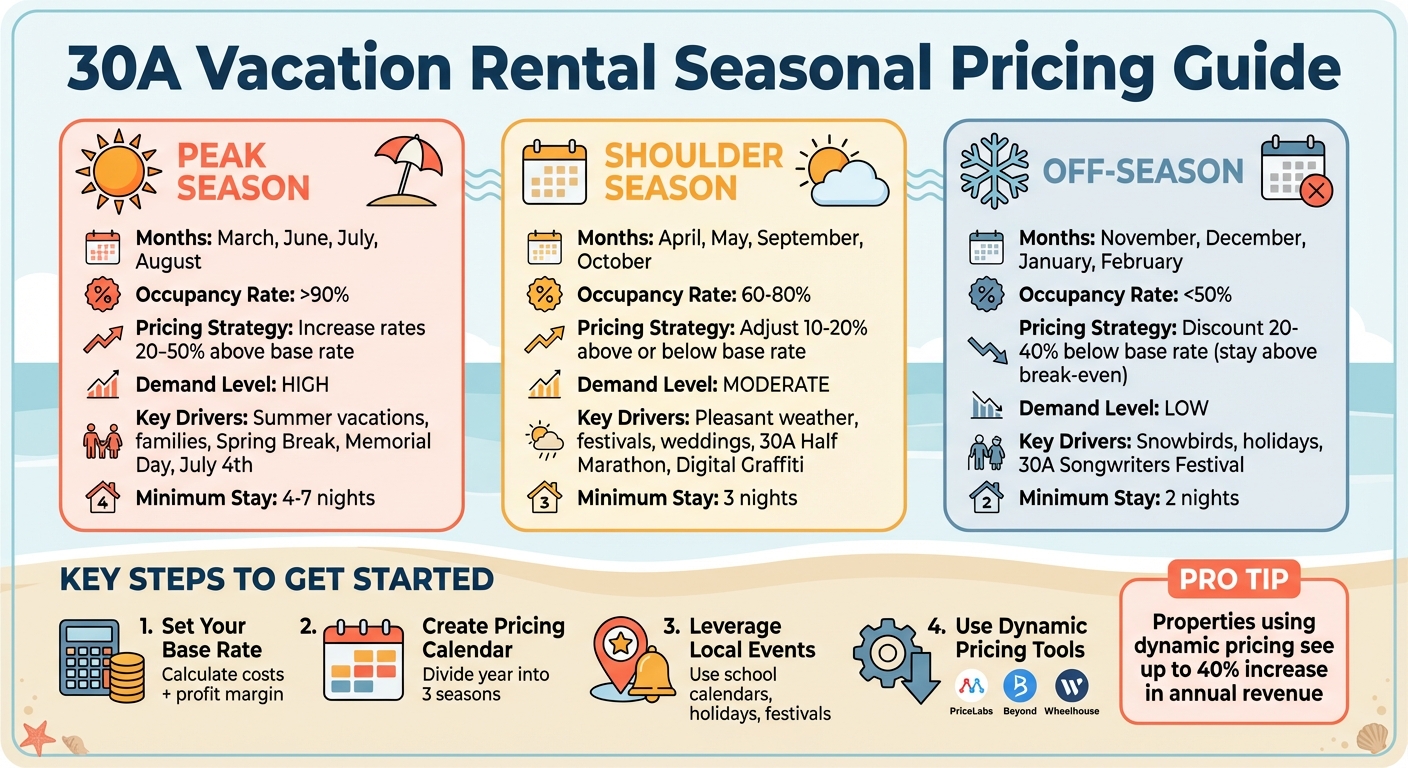
30A Vacation Rental Seasonal Pricing Guide: Peak, Shoulder & Off-Season Rates
How to Price Your Airbnb in Destin, 30A, or Panama City Beach to Maximize Revenue Year Round (10/10)
How Seasonal Demand Works on 30A
Understanding visitor trends is crucial when setting prices on 30A. Factors like school calendars, weather, local events, and the area's reputation as a drive-market destination all influence these patterns. Below, we’ll break down how seasonal demand affects guest behavior and pricing strategies.
Peak, Shoulder, and Off-Season Periods
The rental market on 30A operates in three distinct periods: peak, shoulder, and off-season. Each comes with its own occupancy trends and pricing opportunities.
Peak season typically occurs in March, June, July, and August. Families flock to the area during these months, often booking longer stays.
"The peak season on 30A generally runs from late spring through summer, with occupancy rates often exceeding ninety percent in communities like Seaside, Rosemary Beach, WaterColor, and Alys Beach." - Justin Nash, Real Estate Agent, Spears Group
Shoulder season spans late spring (April and May) and early fall (September and October), with occupancy rates ranging from 60% to 80%. This period is marked by pleasant weather, lighter crowds, and events like festivals, weddings, and golf outings. October, in particular, is a favorite for its warm Gulf waters, stunning sunsets, and peaceful vibe.
Off-season runs from November through February, with occupancy often dropping below 50%. While demand is lower during these months, holidays and events can create short bursts of activity. January and February typically offer the steepest discounts of the year.
Here’s a quick breakdown of the seasonal trends:
| Season | Months | Occupancy Rate | Demand Level |
|---|---|---|---|
| Peak | March, June, July, August | >90% | High |
| Shoulder | April, May, September, October | 60% - 80% | Moderate |
| Off-Season | November - February | <50% | Low |
Events and Holidays That Drive Bookings
Beyond seasonal patterns, specific events and holidays create demand spikes, allowing for premium pricing. July 4th is the busiest day of the year, with parades and fireworks drawing crowds to hotspots like Seaside and Grayton Beach. Memorial Day and Labor Day weekends also see strong bookings, as families take advantage of long weekends.
In March, spring break attracts families looking for a laid-back beach experience, setting 30A apart from the party vibe of nearby Destin or Panama City Beach.
Winter months, though generally slower, see short bursts of activity during key events. For example, the 30A Songwriters Festival in January brings visitors during Martin Luther King Jr. weekend, filling venues across multiple communities. Other notable events include the Digital Graffiti festival in Alys Beach (May), the 30A Wine Festival in March, and the 30A Half Marathon & BBQ Festival in October. Holidays like Thanksgiving, Christmas, and New Year’s Eve also create brief windows of elevated demand and pricing opportunities.
Typical Rates by Property Type
Nightly rates on 30A vary depending on property type, amenities, and location. The area’s average daily rate (ADR) is $598, peaking at $645 in summer and dipping to $536 in winter.
Larger properties with premium features command significantly higher rates. For example, a four-bedroom home with a private pool and beach access can earn 30–50% more than a similar property located inland. Luxury homes in the top 10% of the market achieve nightly rates of $943 or more, nearly doubling the market median of $495.
Here are some performance highlights from Walton County properties over the 12 months leading up to January 2026:
- 220 E Park Place Ave: This 7-bedroom home with a private pool generated $252,026 in annual revenue, with an ADR of $1,600.82 and a 42.9% occupancy rate.
- The Grand Pearl: An 8-bedroom luxury property earned $243,227 in revenue, achieving a 54.7% occupancy rate and an ADR of $1,845.56.
- Amberjack Beach Home: This 7-bedroom new construction brought in $200,969 annually, with a 42.1% occupancy rate and an ADR of $1,420.68.
Condos and townhomes generally fall on the lower end of the pricing scale. In contrast, single-family homes with four or more bedrooms, en-suite bathrooms, and amenities like golf carts or heated pools fetch the highest rates. The market leans heavily toward larger properties, with 83.4% of listings offering three or more bedrooms to meet the demand for family and group accommodations.
These insights can help you refine your pricing strategy to align with seasonal trends and guest preferences.
How to Set Your Base Nightly Rate
Before you dive into seasonal adjustments, you need to establish a solid base rate that reflects your property's value and its position in the 30A market. Think of this as the cornerstone of your pricing strategy. This rate should not only cover your operating costs but also leave room for profit. Nailing it requires an honest evaluation of your property, its expenses, and the demand in your market.
Understanding Your Property and the Market
Location matters - a lot on 30A. Properties with direct dune access or beachfront views can command premium rates, while inland rentals typically fetch less. A house in Rosemary Beach or Alys Beach, with their walkable village vibes, will often justify a higher rate compared to a similar-sized inland property.
The number of bedrooms and the layout also play a big role. Homes with 3 to 6 bedrooms tend to generate the highest revenue, especially if they include flexible sleeping arrangements like bunk rooms.
Amenities can significantly affect pricing. A private pool? That’s a game-changer. Add a heating option, and you can extend your rental season. Gulf Coast Property Management notes that a four-bedroom home with a pool and beach access can charge 30–50% more than a similar property without those features. Other amenities that add value include multiple parking spaces, outdoor showers, shaded seating areas, and reliable high-speed Wi-Fi - features that have become standard expectations rather than perks.
To set your base rate competitively, compare your property to similar listings. Christine Fox Realty suggests a scoring system: weight beach access at 25%, bedroom capacity at 20%, and amenities at 15%. If your property outshines the competition in these areas, your base rate should reflect that advantage.
Use this analysis to guide your next step: calculating costs and profit margins.
Calculating Costs and Setting Profit Goals
Start by identifying your fixed costs - these are your predictable monthly expenses, like your mortgage, property taxes, insurance, and HOA fees. If you’re unsure about HOA fees, a general estimate is 0–2% of your property’s value.
Then, account for variable costs - expenses that change depending on bookings. This includes utilities (electricity, water, internet), cleaning services, maintenance, and guest supplies like toiletries and linens. Keep in mind, utility bills can jump by 200% when the property is occupied. Don’t forget to include property management fees, which on 30A typically range from 15% to 35% of your gross revenue.
To calculate your break-even rate, total up your annual expenses and divide by the number of nights you expect the property to be occupied. This is the absolute minimum rate you should charge, even during slower seasons.
"I'd rather the home sit empty than give it away. Guests associate the amount paid with quality. We only want to attract quality guests to accommodate the properties we manage." – Gulf Coast Property Management
A general rule of thumb is that about 50% of your gross rental income will go toward operating costs. If you’re aiming for a 10% return on investment, make sure your base rate covers both your expenses and your profit target.
With these calculations, you’ll have the confidence to set a base rate that aligns with your financial goals.
Highlighting Special Features for Premium Pricing
Certain features can justify a higher base rate if you make them stand out in your listing. Gulf views, pet-friendly beachfront rentals, and proximity to town centers are all factors that can support a premium price if marketed effectively.
Properties with ratings of 4.7 or higher on review platforms tend to perform better and can charge 10–20% more than average listings. Investing in professional photography, which typically costs $400 to $800, can make a big difference in showcasing your property’s best features.
If your rate is significantly higher than nearby rentals - say, 20–30% more - be sure to clearly list the premium features that justify the price. Highlight extras like smart locks, ample parking, elevator access, or luxurious outdoor spaces.
Lastly, don’t forget to factor in taxes. On 30A, you’ll need to collect and remit both Florida state sales tax and short-term rental rules in Walton County.
sbb-itb-d06eda6
Creating Your Seasonal Pricing Calendar
Once you've established your base rate, the next step is crafting a pricing calendar that aligns with local demand trends. Seasonal pricing tiers will serve as the backbone of your calendar, helping you optimize revenue throughout the year.
Mapping Out Your Seasonal Tiers
Divide the year into three distinct pricing periods to match fluctuations in demand:
- Peak season: March (Spring Break), June, July, and August.
- Shoulder seasons: April through May and September through October.
- Off-peak: November through February.
Don’t forget to account for event-driven demand spikes. For example, the 30A Songwriters Festival in January, the 30A Wine Festival in March, and Digital Graffiti in May can justify premium pricing even during slower months.
| Season | Months | Typical Occupancy | Key Drivers |
|---|---|---|---|
| Peak | March (Spring Break), June–August | >90% | Summer vacations, Memorial Day, July 4th |
| Shoulder | April–May, September–October | 60–80% | Spring festivals, fall weather, 30A Half Marathon |
| Off-Peak | January–February, November–December | <50% | Snowbirds, holidays, Songwriters Festival |
Use this structure to fine-tune your base rate for each season.
Adjusting Rates for Each Season
Rates should fluctuate based on demand within each season:
- Peak season: Increase rates by 20% to 50%, depending on the week and your property’s unique features.
"High-demand periods often allow hosts to increase rates by 20 to 50 percent, but that increase must be backed by guest experience, reviews, and responsiveness." – Barcle Group
- Shoulder season: Adjust rates to fall 10% to 20% above or below your base rate, depending on demand.
- Off-peak season: Lower rates by 20% to 40%, but always ensure they remain above your break-even point. For unbooked dates within a two-week window, consider offering last-minute discounts of 10% to 15%.
If your calendar fills up months in advance, your prices may be too low. On the flip side, if you’re struggling to book during peak season two months out, your rates are likely too high.
Setting Minimum Night Requirements
Minimum stay rules are a crucial part of seasonal pricing strategies. During high-demand periods like summer and Spring Break, enforce 4 to 7-night minimums.
"Minimum stays of 3 to 7 nights are common in high season to capture weeklong vacations." – Christine Fox, Christine Fox Realty
For shoulder seasons, a 3-night minimum can help attract weekend travelers. During the off-peak months, reduce the minimum stay to 2 nights to encourage bookings.
If a peak week remains unbooked 30 days prior, consider shortening the minimum requirement to 5 or even 3 nights - a booked property at a slightly reduced rate is far better than an empty one. Holiday weekends during the off-season can also support 3 to 5-night minimums for higher nightly rates.
Using Data and Tools to Improve Your Pricing
Once you've established a seasonal pricing calendar, the next step is to fine-tune your strategy using data and dynamic adjustments. By leveraging performance metrics and making real-time changes, you can significantly boost your earnings. In fact, property owners who embrace dynamic pricing strategies can see up to a 40% increase in annual revenue compared to those sticking to static rates.
Tracking Market Data and Booking Trends
To stay competitive, keep a close eye on key metrics like Average Daily Rate (ADR), Revenue Per Available Room (RevPAR), and occupancy rate. Comparing your current booking pace to "Same Time Last Year" (STLY) data can help you identify trends early. For instance, if your bookings are filling up faster than last year, it might be time to raise your rates. On the other hand, if you're falling behind, consider lowering prices to attract more reservations.
Understanding your booking window - how far in advance guests are reserving - can also guide your strategy. Use this insight to decide when to offer early-bird pricing or apply last-minute discounts to fill gaps.
Another critical step is monitoring 3–10 comparable properties in your area, especially those with similar bedroom counts and amenities. Properties with ratings above 4.7 out of 5, for example, often command rates 10% to 20% higher. Stay informed about local happenings by checking resources like sowal.co or social media groups. Events like festivals, concerts, or sports competitions - known as compression events - can create sudden demand spikes, making premium pricing an option. Additionally, track school calendars and holidays in key feeder markets such as Atlanta, Nashville, New Orleans, and Texas, as these often influence travel patterns to 30A.
"Revenue data, of course, is the basis on which all legitimate rental projections are developed... we're not guessing when it comes to rental projections." – Alex Curry, Director of Business Development, 360 Blue
With these insights in hand, you can effectively use technology to adjust rates in real time.
Automated Pricing Adjustments
Dynamic pricing tools like PriceLabs, Beyond, Wheelhouse, and DPGO are game-changers. These platforms analyze historical booking data, market trends, and competitor rates to automatically adjust your nightly prices. They help you maximize revenue during high-demand summer weeks and maintain occupancy during slower seasons, like winter.
Most tools allow you to choose between pricing strategies - whether you want to prioritize higher occupancy or premium rates. They also integrate seamlessly with Property Management Systems, syncing rates across platforms like Airbnb, Vrbo, and your direct booking site. Features like a "Channel Rate Multiplier" let you adjust prices by platform, accounting for varying commission fees (e.g., Airbnb charges around 3%, while Vrbo ranges from 6% to 15%).
"Seasonality is probably one of the easiest things to implement as a pricing strategy. It's a really good place to start, to make more revenue." – Jordan Locke, Founder, RevPARTY Consulting
While automation simplifies daily pricing tasks, it’s important to manually adjust rates for unique features of your property. For example, certain amenities can justify rates 30% to 50% higher than what the software might suggest. Regular checks ensure these adjustments align with your revenue goals.
Monitoring and Updating Your Rates
Review your rates weekly to stay competitive as market conditions shift. If your summer calendar is still empty 30 days out, consider applying a last-minute discount. Conversely, if dates are booking months in advance, it’s a sign you could be underpricing.
Another effective tactic is to adjust your minimum stay requirements as dates approach. For peak weeks, start with a 7-night minimum, but reduce this to 2–3 nights within 30 days of arrival to fill any remaining gaps. A booked property is always better than an empty one. Additionally, consider how flexible cancellation policies impact your bookings. Data shows they can boost rental income by as much as 53%. Balancing flexibility with your risk tolerance and local demand trends will help you find the right fit for your property.
Conclusion
Steps to Get Started
To set seasonal rates for your 30A rental, begin by dividing the year into demand categories: Peak (Spring Break through Summer, especially June and July), when guests frequently check beach conditions Shoulder (late Spring and early Fall), and Off-Season (Winter). From there, revisit your base rate by factoring in fixed and variable costs to establish a profitable minimum price.
Next, fine-tune your rates by considering your property's standout features. For instance, being close to beach access, within walking distance of hotspots like Seaside or Rosemary Beach, or offering amenities like private heated pools can justify premium pricing. Finally, incorporate dynamic pricing to capitalize on demand spikes caused by local events or seasonal trends.
"More people 'flat price' than you think. So if you implement seasonal pricing, you're already doing better than half the vacation rental market".
With these steps, you'll have a solid foundation for managing your rental's pricing strategy.
Reviewing and Updating Your Strategy
Once your rate structure is in place, the key to success lies in regular updates. Pricing strategies aren’t set in stone - market conditions and guest behaviors evolve constantly. As noted in the data-tracking section, reviewing your rates weekly allows you to adjust for booking trends, local events, and competitor pricing. At the very least, conduct an annual analysis of 12–24 months' worth of data to identify patterns, such as high- and low-performing weeks.
Pay attention to booking windows, too. If your calendar fills up quickly, you might be underpricing. On the other hand, if dates remain unbooked 30 days out, consider offering last-minute discounts or relaxing minimum stay requirements. Properties that use data-driven projections with solid comparable data can achieve a 90% accuracy rate in forecasting gross annual revenue, helping you maximize profits.
FAQs
How can I use dynamic pricing tools to maximize revenue for my 30A rental?
Dynamic pricing tools are a game-changer for managing rental rates. These tools automatically adjust your prices based on real-time factors like local demand, competitor rates, and special events. For 30A rentals, look for a tool that not only analyzes historical booking data but also tracks market trends. Then, fine-tune it to account for key dates like spring break, summer vacations, and local festivals.
To get the most out of these tools, layer in local insights. Event calendars and community updates can help you spot high-demand periods, allowing you to adjust rates strategically. Keep an eye on performance metrics like occupancy rates and average daily revenue, and tweak the tool’s settings as needed. By blending automation with a local touch, you can keep your 30A rental competitive and boost revenue throughout the year.
What should I consider when setting the base nightly rate for my 30A rental?
To determine a nightly rate for your 30A vacation rental, start by calculating your minimum costs. Add up all your fixed and variable expenses - things like mortgage payments, property taxes, insurance, utilities, cleaning, and maintenance. Once you have that total, divide it by the number of nights you realistically expect to rent out your property each month. This gives you a break-even rate, ensuring your costs are covered while staying competitive.
Next, take a close look at market conditions. Compare your property’s size, location, and amenities - like private beach access or a pool - with similar rentals in the South Walton area. Homes with standout features can often justify higher rates. It’s also important to factor in seasonal trends. High-demand periods, such as holidays, festivals, and school vacations, may allow for higher pricing. However, your base rate should still account for slower, off-season periods to keep your property booked consistently.
By balancing your expenses, local competition, and seasonal demand, you can set a solid base rate that supports profitability and allows for adjustments during peak seasons or special events.
How do local events influence seasonal pricing for 30A rentals?
Local events often lead to temporary surges in demand, making them an important element to consider when adjusting seasonal pricing for 30A vacation rentals. For instance, the 30A Songwriters Festival held in January attracts a significant number of visitors, creating an opportunity for property owners to raise nightly rates while still achieving high occupancy. This approach can effectively increase revenue by syncing pricing with these demand peaks.
To make the most of event-driven demand, start by checking the local event calendar - sowal.co provides a comprehensive list of events in South Walton and along 30A. For major events, you might adjust your rates upward by 10–30% above your standard seasonal pricing. The exact increase can depend on factors like the size of the event and the anticipated number of attendees. Keep an eye on key metrics such as booking lead times, occupancy rates, and average daily rates (ADR) to fine-tune your pricing strategy for future events. By treating these occasions as mini high seasons, you can maximize revenue while keeping your property booked.