If you're new to water sports and wondering whether paddleboarding or kayaking is easier, here's the short answer: kayaking is generally simpler for beginners. It offers more stability, requires less balance, and is easier to start paddling right away. Paddleboarding, while slightly more challenging at first, provides a full-body workout and a unique standing perspective.
Key points to consider:
- Kayaking: Easier to balance, seated position, great for staying dry, and ideal for calm or slightly windy conditions.
- Paddleboarding: Requires balance, engages your core, offers flexibility (stand, kneel, sit), and provides a higher viewpoint for spotting wildlife.
Both activities are beginner-friendly along 30A's calm coastal dune lakes. Rent equipment from local shops, like YOLO Board, and try both to see what suits you best.
Quick Comparison
| Factor | Paddleboarding (SUP) | Kayaking |
|---|---|---|
| Stability | Moderate; requires balance | High; seated position is stable |
| Learning Curve | Takes about an hour to balance | Easy to paddle immediately |
| Physical Effort | Full-body workout | Works primarily upper body |
| Portability | Lightweight and easy to carry | Bulkier; may need help transporting |
| Fall Recovery | Easy to climb back on | Re-entering can be tricky |
| Best 30A Spot | Calm coastal dune lakes | Dune lakes or calm Gulf mornings |
For a relaxing start, try kayaking. For a fun challenge and workout, go paddleboarding. Both are great ways to enjoy 30A's serene waters.
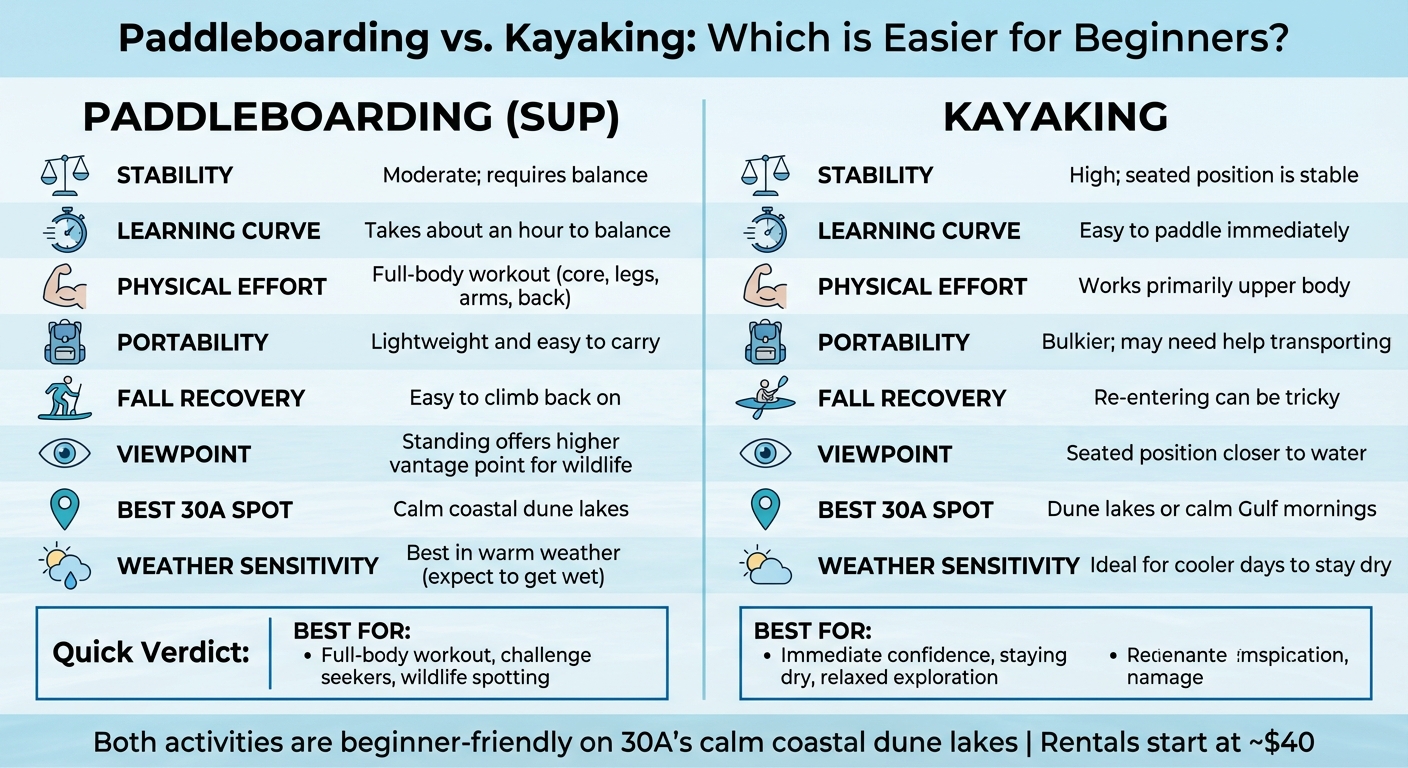
Paddleboarding vs Kayaking Comparison Chart for Beginners
Kayak vs. SUP- Pros and Cons, which one is best for you- StandUp Paddleboarding or Kayaking?
What Makes a Water Activity Easier for Beginners?
Deciding between paddleboarding and kayaking often comes down to what makes you feel more at ease and confident on the water. Things like balance, body positioning, ease of getting back on after a fall, and how manageable the gear is all play a role.
These factors are especially important along 30A, where you’ll encounter options like the calm coastal dune lakes or the open Gulf waters. Knowing what makes each activity beginner-friendly can help you choose the right one for your comfort level and the conditions you’re likely to face. Let’s break it down to see which option is better suited for beginners on 30A.
Balance and Stability
Kayaks tend to feel more stable right off the bat because of their design. When you’re seated close to the water’s surface, your center of gravity is naturally lower, making it easier to maintain balance. As Skyhook Adventure points out, "Kayaks tend to be more stable initially, as you're sitting close to the water's surface, lowering your centre of gravity." This stability is a huge plus, especially if you're paddling through wind or choppy waters.
On the other hand, paddleboards require you to stand, which raises your center of gravity and demands more active balancing. Wind can also be a challenge, as your body acts like a sail, making gusts harder to manage. For beginners, renting the widest and thickest paddleboard available can make a big difference in stability. Interestingly, while kayaks may feel more stable at first, paddleboards are much easier to climb back onto if you fall. This can be particularly helpful in the calm waters of South Walton’s coastal dune lakes.
Body Position and Comfort
Kayaking keeps you seated, often with back support, which many find more comfortable for extended trips. This position allows you to focus solely on paddling without worrying about balancing. Julian Kidd, a paddling expert at Green Water Sports, explains, "Kayaking may be more beginner-friendly because you don't need to learn how to balance and paddle simultaneously; you can focus solely on your stroke."
Paddleboarding, however, offers more flexibility. You can stand, kneel, sit, or even lie flat on the board. This versatility is great for stretching or taking breaks, but standing requires constant engagement of your core and leg muscles. While this provides a solid workout, it can also lead to leg fatigue during longer outings. If balancing on a paddleboard feels tricky, start by paddling on your knees to lower your center of gravity before attempting to stand.
Gear Transport and Setup
Portability is another key factor to consider. Kayaks are usually heavier and bulkier than paddleboards, often requiring two people to carry them from your car to the water . Transporting a hard-shell kayak typically involves roof racks or a large truck bed to get it to 30A’s beach access points.
Paddleboards, on the other hand, are designed with convenience in mind. Most come with a center grab handle, making it easy for one person to carry the board under their arm. Inflatable paddleboards take portability a step further - they can fit into a car trunk or even a backpack-sized case. Compared to inflatable kayaks, inflatable SUPs are generally lighter and easier to manage.
When setting up a paddleboard, it’s important to be cautious with the fins in shallow water. Dragging the board against sand or rocks can damage them. For a smooth start, beginners should try launching at one of South Walton’s coastal dune lakes. These calm, protected waters offer an easy and stress-free way to get started.
Paddleboarding for Beginners: Pros and Cons
Learning Curve on 30A Waters
If you’re just starting out with paddleboarding, 30A is one of the best places to learn. With its 15 coastal dune lakes and 26 miles of beachfront, this area offers a mix of calm, shallow waters and scenic beauty. Coastal dune lakes like Western Lake, Eastern Lake, and Camp Creek Lake are perfect for beginners. These spots are flat, shallow, and shielded from strong winds, making them ideal for practicing your balance before heading into the Gulf.
Most beginners can get the hang of stand-up paddleboarding within a day, especially with the help of wide, stable boards designed for first-timers. Western Lake, located in Grayton Beach State Park, is a particularly great spot for novices because the natural surroundings protect it from wind. If you’re feeling ready to try the Gulf, it’s best to go early in the morning when the water is calm and smooth, as the south winds tend to pick up later in the day. When transitioning to the Gulf, start by paddling on your knees to get through small waves before attempting to stand up.
Physical Effort Required
Paddleboarding isn’t just a fun activity - it’s also a fantastic workout. It engages your core, legs, and arms, offering a full-body exercise that improves both strength and balance. Compared to kayaking, paddleboarding demands more physical effort, but the fitness benefits are worth it.
"Paddling affects both the physical and mental well‑being of the paddler... it improves core strength and balance. It also leads to better overall cardiovascular health."
- Jeff Archer, Founder, YOLO Board
For beginners, standing for long periods can be challenging. If you start to feel fatigued, switching to a kneeling or sitting position can help. Balancing on the board is often the trickiest part, especially if you make quick or jerky movements, which can lead to falls. Common beginner mistakes include holding the paddle blade backward (it should angle forward) and looking down instead of keeping your eyes on the horizon. To avoid getting tired too quickly, focus on using your core muscles for power rather than relying solely on your arms.
Equipment and Rentals on 30A
Paddleboards are surprisingly lightweight, and inflatable models are especially easy to store and transport. If you’re visiting 30A, renting a paddleboard is affordable, with prices starting at around $40. Several local businesses cater to beginners and provide everything you need to get started.
YOLO Board + Bike in Santa Rosa Beach offers high-quality rentals and group lessons, making it a great choice for those new to the sport. For flatwater paddleboarding, the Boathouse Paddle Club on Western Lake is the only rental location specifically focused on calm-water experiences. Yellowfin Ocean Sports, with locations in Seagrove, WaterColor, and Grayton Beach, provides lightweight gear that’s easy for beginners to handle. Many other rental shops, such as The Rental Shop 30A and 30A Beach Paddle Surf, even deliver equipment directly to vacation rentals. Some of these providers include free introductory lessons, making it even easier to dive into paddleboarding.
sbb-itb-d06eda6
Kayaking for Beginners: Pros and Cons
Kayaking is a fantastic option for beginners, offering a mix of stability, ease, and accessibility that makes it a great way to enjoy the water.
Stability and Confidence
One of the biggest perks of kayaking is its stability. Thanks to a low center of gravity, kayaks make you feel secure, even when the breezes along 30A start to pick up. This feature is especially comforting for first-timers who might be worried about tipping over.
"Most people can jump in a kayak, grab a paddle, and take off immediately."
- Sarah Winfrey, Writer
Since kayaks keep you close to the water, they’re easier to control in windy conditions. Whether you’re paddling in the Gulf or exploring the coastal dune lakes, you can feel confident navigating even when the water isn’t perfectly calm.
Paddling Technique and Efficiency
Kayaking uses a double-bladed paddle, which makes for an easy, natural rhythm. Unlike paddleboarding, where you have to switch sides with a single-blade paddle, kayaking allows you to alternate strokes seamlessly - left, right, left, right - without breaking your flow. This design helps beginners quickly get the hang of steering, turning, and maintaining control.
Before you hit the water, take a moment to adjust the foot braces. Your knees should be slightly bent and in contact with the kayak’s sides. This positioning not only boosts your stability but also helps you paddle more powerfully and efficiently.
Now, let’s see how kayaking’s design makes it comfortable for people of different body types.
Comfort for Different Body Types
The seated position in a kayak is a game-changer, especially for older adults or anyone with balance concerns. Unlike paddleboarding, which requires constant core engagement to stay upright, kayaking lets you relax and focus on the scenery.
For warm weather along 30A, sit-on-top kayaks are ideal for beginners. They allow cooling breezes to reach your body, provide space to stretch your legs, and make it easy to hop in for a quick swim. When launching, try the "sidesaddle" method: walk your kayak into knee-deep water, sit down with your legs still in the water, and then swing them into the boat. This approach keeps you stable and makes getting started a breeze.
If you’re paddling in cooler months or prefer staying dry, a sit-in kayak with an enclosed cockpit might be a better fit. While it offers protection from the elements, keep in mind that it can get uncomfortably warm under Florida’s direct sun.
Which Is Easier for Beginners on 30A?
For most beginners, kayaking is the simpler choice. With a seated position and a naturally low center of gravity, it’s easier to feel stable and start paddling right away. Paddleboarding, on the other hand, often takes about an hour of practice to get the hang of balancing.
The calm and protected coastal dune lakes along 30A make both activities beginner-friendly.
Side-by-Side Comparison
Here’s a breakdown of how paddleboarding and kayaking compare for beginners on 30A:
| Factor | Paddleboarding (SUP) | Kayaking |
|---|---|---|
| Stability | Moderate; relies on core strength and board width | High; seated position ensures stability |
| Learning Curve | Balance may take about an hour to master | Easy to start paddling right away |
| Paddling Technique | Uses a single-blade paddle | Double-bladed paddle creates a natural rhythm |
| Fall Recovery | Easier to climb back onto the board from the water | Re-entering after capsizing can be tricky |
| Physical Effort | Engages core, legs, arms, and back for a full-body workout | Primarily works the upper body and arms |
| Gear Handling | Lightweight and easy to carry | Bulkier; may need help transporting |
| Best 30A Spot | Calm waters of coastal dune lakes | Coastal dune lakes or calm Gulf mornings |
| Viewpoint | Standing offers a higher vantage point for spotting wildlife | Seated position keeps you closer to the water |
| Weather Sensitivity | Best in warm weather (expect to get wet) | Ideal for cooler days to stay dry |
Matching Activities to Your Preferences
Kayaking might be your top pick if you:
– Want to feel confident on the water right away
– Prefer staying dry
– Have concerns about balancing
– Need extra storage for gear on longer outings
Kayaking’s stability and built-in storage make it a great choice for families with kids or older adults looking for a relaxing experience.
Paddleboarding could be perfect if you:
– Want a full-body workout
– Enjoy taking on the challenge of learning a new skill
– Love the idea of standing tall to spot dolphins or sea turtles
– Plan to paddle during calm morning hours on 30A’s serene coastal dune lakes
"If you're new to paddle boarding, the coastal dune lakes are for you. These lakes are mostly protected from the winds, which results in flat, smooth waters perfect for those first-timers."
- Lindsey Rogers, The 30A Company
Conclusion
If you're new to 30A's waters, both paddleboarding and kayaking offer fantastic ways to explore, each with its own set of perks. Kayaking tends to be easier for beginners, thanks to the seated position and added stability. On the other hand, paddleboarding delivers a full-body workout and a higher perspective for spotting wildlife - and once you get the hang of balancing, many find it surprisingly intuitive.
The best part? You don’t have to choose right away. You can try both activities without committing to one. Local rental shops like YOLO Board + Bike, Gulf Wind Paddle & Surf, and Reef Beach Services & Rentals make it easy to experiment. Paddleboard rentals in the area typically start at around $40, and many shops even offer free beginner lessons to help you get started.
For your first outing, head to one of 30A’s calm coastal dune lakes, such as Western Lake, Eastern Lake, or Camp Creek Lake. These protected waters are ideal for learning, with their flat, peaceful conditions. Once you’re more comfortable, you can venture into the Gulf of Mexico - just aim for early mornings when the water is calm and inviting.
Still undecided? Consider renting a hybrid SUP-YAK, which allows you to attach a seat to a paddleboard. This gives you the freedom to switch between sitting and standing as you figure out what suits you best. Ultimately, the goal is to get out there and enjoy the experience - with 30A’s stunning scenery, you really can’t go wrong.
FAQs
Is paddleboarding or kayaking easier for beginners?
Choosing between paddleboarding and kayaking as a beginner comes down to a mix of stability, effort, and what you enjoy most. If you're looking for something with a gentler learning curve, kayaking might be the way to go. Sitting low in the water gives you better stability, making it easier to get the hang of things. Paddleboarding, on the other hand, challenges your balance since you're standing, but wider boards can help beginners feel steady after some practice.
When it comes to physical effort, paddleboarding provides a full-body workout. It engages not just your arms but also your core and legs. Kayaking, while still a workout, is less intense and works well for those who prefer a more relaxed pace. Weather might also influence your decision - kayaks are more comfortable in cooler or windy conditions, while paddleboards are ideal for warm, calm days, like the ones often found during South Walton’s summer months.
At the end of the day, it’s all about what feels more enjoyable to you. Both activities are perfect for exploring the serene waters along 30A. Whether you're gliding along in a kayak or standing tall on a paddleboard, you're in for an amazing experience.
What’s the difference in physical effort between paddleboarding and kayaking for beginners?
Exploring the 30A coastline for the first time? Paddleboarding and kayaking are two great ways to dive in, each offering its own level of physical challenge.
Stand-up paddleboarding (SUP) is a bit more of a workout. You’re standing the whole time, balancing on the board, and using a single-blade paddle. This movement engages your core, legs, and upper body, making it a full-body exercise that burns plenty of calories.
On the other hand, kayaking is a more laid-back option. You’re seated in a stable position and use a double-bladed paddle to move across the water. It’s easier on your body, with the effort mainly targeting your arms, shoulders, and back - especially if the water is calm. So, if you’re looking for an intense workout, paddleboarding is your pick. But if you want a more relaxed, beginner-friendly experience, kayaking is the way to go.
What are the best spots and conditions on 30A for beginners to try paddleboarding or kayaking?
The best time to enjoy paddleboarding or kayaking along 30A is during the early morning or late afternoon. At these times, the water tends to be calm, the wind is gentle (typically under 10 mph), and the temperatures are more comfortable. These conditions are perfect for beginners, especially on 30A's distinctive coastal dune lakes, where the water is generally flat and shielded from Gulf waves.
Here are a few beginner-friendly spots to check out:
- Western Lake (Grayton Beach State Park): This peaceful dune lake, surrounded by gorgeous scenery, is an excellent place to practice balance and paddling skills.
- Camp Creek Lake: Known for its crystal-clear, wind-protected water, this quiet location is perfect for calm morning paddles.
- Eastern Lake: With its wide, flat waters and convenient Gulf access, this spot is ideal for learning basic paddling techniques.
Local rental services make it easy to gear up, offering paddleboards and kayaks at these locations. Choosing a calm day and one of these beginner-friendly spots ensures a relaxing and enjoyable introduction to 30A's beautiful waterways.