Choctawhatchee Bay: Estuary Highlights
A concise look at Choctawhatchee Bay’s habitats, wildlife, recreation, and local programs combating pollution through restoration and water-quality monitoring.

Choctawhatchee Bay, located along Florida’s Emerald Coast, is a 129-square-mile estuary where freshwater from the Choctawhatchee River mixes with saltwater from the Gulf of Mexico. This creates a dynamic ecosystem crucial for marine life, with 75–85% of Gulf species relying on the bay during their lifecycle. Surrounded by wetlands, marshes, and oyster beds, the bay also features rare coastal dune lakes found only in Florida within the U.S.
Key Points:
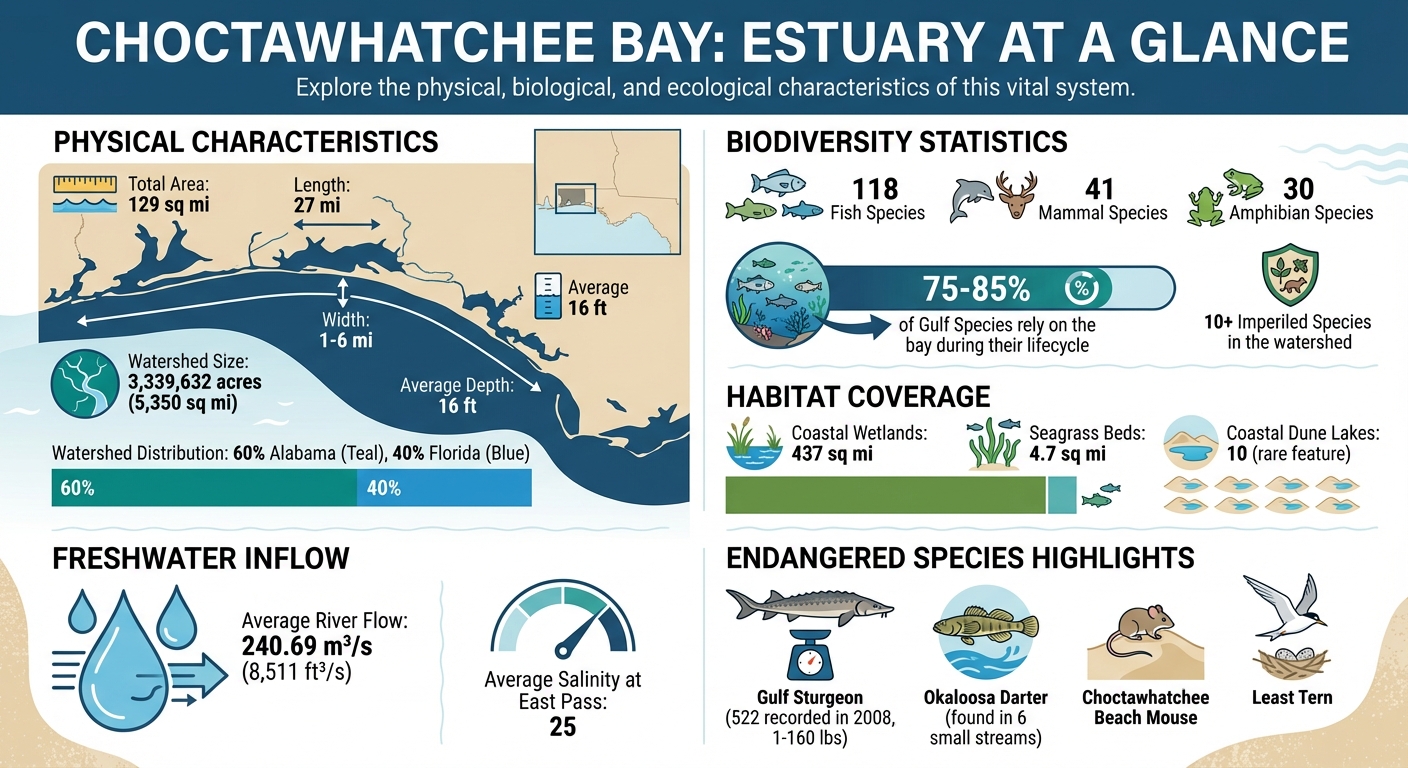
- Size & Depth: 27 miles long, 1–6 miles wide, and an average depth of 16 feet.
- Biodiversity: Home to 118 fish species, Gulf Sturgeon, and endangered species like the Okaloosa darter and Choctawhatchee beach mouse.
- Activities: Popular for fishing, birdwatching, eco-tours, kayaking, and paddleboarding.
- Conservation: Programs like SWIM and CBEP aim to improve water quality, restore habitats, and educate communities.
The bay’s health faces challenges from urban runoff and pollution, but ongoing efforts like oyster reef restoration and shoreline planting are helping to protect this vital resource. Visitors can enjoy recreational activities while contributing to its preservation.
Choctawhatchee Bay Key Facts and Biodiversity Statistics
Bay Biodiversity
Habitat Types
Choctawhatchee Bay is a thriving ecosystem shaped by a variety of habitats that work together to sustain its rich biodiversity. Spanning approximately 437 square miles, the bay's coastal wetlands play a vital role as natural barriers, stabilizing the shoreline and filtering pollutants before they reach the open water.
Seagrass beds, covering about 4.7 square miles of the bay floor, act as essential nurseries for young fish and invertebrates. These underwater meadows are critical for both juvenile and adult marine species, offering food and shelter.
Oyster reefs in the bay not only support shellfish populations but also play a key role in reducing erosion. Often used in restoration projects, these reefs double as habitats for a variety of other species. The bay is also home to 10 rare coastal dune lakes, a feature unique to Florida and found in very few places globally.
Adding to this diversity, a network of riparian zones and streams brings freshwater into the bay. These areas create habitats for specialized species like the endangered Okaloosa darter, which is restricted to six small streams flowing into the bay.
Wildlife Species
The Choctawhatchee River Basin is a haven for wildlife, supporting at least 118 fish species, 41 mammal species, and 30 amphibian species. The bay itself serves as a federally protected foraging area for the Gulf Sturgeon, a threatened species that depends on free-flowing rivers for its migration and spawning.
Visitors to the bay often spot redfish, speckled trout, and largemouth bass in the shallows, while dolphins can be seen navigating the deeper waters. Along the coastal dunes, the endangered Choctawhatchee beach mouse finds its home, and the bay's marshes provide essential breeding grounds for protected bird species like the Least Tern.
Alison McDowell, Director of the Choctawhatchee Basin Alliance, highlights the importance of the bay's ecosystem:
"75-85% of commercially and recreationally important species that are caught in the Gulf spend part of their lifecycle in the Bay".
This includes species like blue crab and shrimp, which depend on the bay's brackish waters during key developmental stages. The Nature Conservancy emphasizes the bay's significance, stating:
"The Choctawhatchee represents two of these 87 watersheds that stand out as hot spots, harboring 10 or more imperiled species".
The bay's remarkable biodiversity not only preserves its ecological integrity but also enhances its value as a destination for recreation and exploration.
Recreation in the Bay
Fishing Locations
Choctawhatchee Bay is a year-round magnet for anglers, offering a variety of habitats teeming with fish. Shallow grass flats are prime spots for catching Redfish, Speckled Trout, and Flounder, while deeper channels and reef structures are home to species like Snapper and Sharks. Anglers can also try their luck at jetties and bridges, which are great for Sheepshead, Black Drum, and Bluefish. For those sticking to inshore waters, Pompano and Ladyfish are popular targets.
Spring and fall are especially favorable for fishing, thanks to the mild water temperatures. A typical 4-hour inshore fishing charter for four adults costs about $700, with an additional $100 per person for groups of up to six. These guided trips usually depart from spots like Bluewater Bay Marina in Niceville or the beaches along 30A and Miramar Beach. Charters provide all the essentials - rods, reels, tackle, live bait, and fishing licenses. Many operators also embrace catch-and-release practices to help preserve the bay's fragile ecosystem.
Wildlife Watching and Eco-Tours
Beyond fishing, Choctawhatchee Bay offers plenty for nature enthusiasts. Its calm, protected waters make it an excellent setting for birdwatching and nature photography. The Rocky Bayou Aquatic Preserve in Niceville is a standout destination, showcasing a variety of estuarine habitats. For a more immersive experience, the Choctawhatchee Basin Alliance organizes "Summer Eco Adventures" and "Fall Eco Adventures" in Walton County, taking visitors off the beaten path.
Visitors can also get hands-on with conservation efforts. Guided tours often include activities like water quality sampling, coastal dune lake paddle cleanups, and oyster reef restoration. These excursions highlight the importance of preserving seagrass beds and other habitats critical to protected species, blending education with adventure.
Boating and Paddling
If you're looking to explore the bay from the water, its calm and shallow conditions are perfect for kayaking, paddleboarding, and recreational boating. Spanning around 129 square miles, the bay offers a range of depths suitable for paddlers of all experience levels. Public access points are easy to find, with popular launch sites near the 331 Bridge and Rocky Bayou.
Destin's East Pass, the bay's only connection to the Gulf of Mexico, is a favorite spot for boaters. Charters operate daily during the warmer months, while winter trips (December through February) depend on the weather. However, boaters should be aware that parts of the western bay are off-limits due to Eglin Air Force Base operations.
Conservation Programs
SWIM Plan
The Surface Water Improvement and Management (SWIM) Plan tackles the issue of urban stormwater runoff, which carries harmful substances like fertilizers, pesticides, and heavy metals into the bay. This runoff degrades both water and sediment quality, posing a serious threat to the ecosystem’s health. To combat this, the plan emphasizes monthly water quality monitoring, focusing on key indicators such as temperature, salinity, pH, dissolved oxygen, and nutrient levels. This data helps pinpoint problem areas and track progress over time.
One of the plan’s standout strategies involves the use of living shorelines. These include reef breakwaters made from recycled oyster shells and planting native smooth cordgrass. Together, these measures stabilize coastlines, create habitats for fish and wildlife, and act as natural filters to reduce pollutants. These efforts are crucial for maintaining the bay’s fragile ecosystem over the long term.
Choctawhatchee Bay Estuary Program
The Choctawhatchee Bay Estuary Program (CBEP) brings together government agencies, nonprofits, and local communities, following the framework of the EPA's National Estuary Program. At its core is the Comprehensive Conservation and Management Plan (CCMP) - a detailed guide for protecting the bay's vast 3,339,632-acre watershed, which spans parts of Alabama and Florida. The program is focused on addressing threats like rapid development and climate change while working to restore vital habitats and improve water quality.
"The purpose of this CCMP is to identify key resources, impacts, and strategies to protect the watershed for generations to come." - CCMP Executive Summary
Community involvement is a cornerstone of CBEP’s efforts. For example, the "Grasses in Classes" initiative educates 3rd and 5th-grade students in Okaloosa and Walton Counties about marsh ecosystems. Students grow smooth cordgrass and take part in hands-on shoreline restoration projects. In September 2024, CBEP hosted "Family Bay Day" at Fred Gannon Rocky Bayou State Park. This event featured educational activities designed to help families appreciate the ecological importance of the basin. Residents can also get involved by joining volunteer monitoring teams or participating in oyster shell recycling programs, which contribute directly to living shoreline restoration projects.
Hydrology and Watershed
Choctawhatchee River and Freshwater Inflows
Stretching 141 miles from central Alabama to the bay, the Choctawhatchee River plays a vital role in maintaining the bay's ecosystem. With an average freshwater inflow of approximately 240.69 m³/s (or 8,511 ft³/s), it creates the brackish conditions that support a wide range of species. Near East Pass in Destin, the water's salinity averages 25, an ideal environment for Gulf sturgeon and oysters.
The river's limestone bottoms serve as critical spawning grounds for Gulf sturgeon. In late 2008, researchers recorded 522 sturgeon in the area, weighing anywhere from 1 to 160 pounds. The river system is also fed by several major tributaries: Alabama’s Pea River and Little Choctawhatchee River, along with Florida’s Holmes, Wright, Sandy, and Pine Log creeks. These waterways not only support the ecosystem but also provide habitats for rare species like the endangered Okaloosa darter.
This intricate network of freshwater inputs is essential to the watershed, influencing water quality and fostering habitat diversity across the region.
Watershed
Covering a massive 3,339,632 acres (about 5,350 square miles), the Choctawhatchee watershed spans 60% in Alabama and 40% in Florida. It connects a variety of landscapes, including forested wetlands, marshes, and coastal barriers, all of which help filter water before it reaches the bay. The area also features 10 coastal dune lakes, further highlighting its ecological significance.
The health of the bay’s water is directly tied to conditions upstream. In Alabama, the river’s water quality generally ranges from good to very good. However, the Florida section faces challenges from pollution caused by wastewater and erosion. Urban stormwater runoff compounds the problem, carrying fertilizers, pesticides, and heavy metals from parking lots, lawns, and developed areas. This runoff impacts roughly 437 square miles of coastal wetlands and nearly 5 square miles of submerged aquatic vegetation.
Choctawhatchee Bay Estuary Program - Where Rivers meet the Sea in Northwest Florida
Conclusion
Choctawhatchee Bay is one of South Walton's most cherished natural gems, teeming with diverse wildlife and offering countless recreational opportunities. The bay's connection to rare coastal dune lakes adds to its ecological value, while species like the Gulf sturgeon and Okaloosa darter highlight its global ecological importance.
The bay's rich biodiversity forms the backbone of its recreational appeal. Whether you're gliding across its tranquil waters on a paddleboard or casting a fishing line at one of its public access points, the bay offers peaceful, nature-centered activities. However, these experiences hinge on the health of the estuary, which continues to face threats from urban development and stormwater runoff carrying harmful fertilizers and pesticides into its delicate ecosystems.
"Community quality of life depends upon the water quality of streams, rivers and estuaries within the Choctawhatchee River Basin." – Choctawhatchee Basin Alliance
Your involvement plays a key role in protecting this vital ecosystem. By supporting initiatives like the Estuary Program and Choctawhatchee Basin Alliance, you can help ensure the bay's health for generations to come. Simple actions - reducing lawn chemicals, recycling oyster shells, or volunteering for water quality monitoring - make a big difference. Programs such as "Grasses in Classes" demonstrate how efforts like restoring salt marshes and recycling oysters contribute to preserving this extraordinary environment.
FAQs
What makes Choctawhatchee Bay’s ecosystem so special?
Choctawhatchee Bay stands out thanks to its rare coastal dune lakes - a natural wonder that's incredibly scarce, appearing in just a few places around the globe. These lakes, blending freshwater and saltwater, are found exclusively in the United States within the Choctawhatchee Bay watershed, making this region a true gem on the world stage.
The bay is also a hub of biodiversity, supporting habitats like wetlands, marshes, seagrass meadows, and oyster beds. These ecosystems are vital for several threatened and endangered species, including the Gulf sturgeon, Least tern, Okaloosa darter, and the Choctawhatchee beach mouse.
Beyond its ecological significance, the bay is a haven for outdoor enthusiasts. Whether you're into fishing, kayaking, paddleboarding, or simply enjoying wildlife, it offers endless opportunities to connect with nature and soak in its beauty.
What role do programs like SWIM and CBEP play in preserving Choctawhatchee Bay?
Programs like the Surface Water Improvement and Management (SWIM) initiative and the Choctawhatchee Bay Estuary Program (CBEP) play a key role in preserving the health of Choctawhatchee Bay. SWIM concentrates on developing and funding detailed plans aimed at improving water quality and restoring habitats throughout the Choctawhatchee River and Bay watershed.
Meanwhile, CBEP unites government agencies, nonprofits, and community organizations to safeguard water quality, revive critical ecosystems, and promote education about the environment. Together, these efforts work to keep the bay a vibrant home for diverse wildlife and a cherished resource for generations to come.
What recreational activities can you enjoy at Choctawhatchee Bay?
Choctawhatchee Bay is a paradise for those who love the outdoors, offering countless ways to enjoy its stunning waters and surrounding scenery. Fishing stands out as a favorite activity here. Anglers can try their luck catching redfish, speckled trout, flounder, and more. Many guided fishing charters are available, and they often supply all the necessary equipment while promoting eco-friendly practices like catch-and-release to help protect the bay’s delicate ecosystem.
The bay’s calm, inviting waters make it ideal for boating, kayaking, and paddleboarding, giving visitors a chance to uncover secluded coves, glide through mangrove tunnels, and admire picturesque shorelines. Wildlife enthusiasts will delight in spotting dolphins, pelicans, and herons, while the nearby trails and parks offer opportunities for hiking, picnicking, and birdwatching. Whether you're seeking adventure or a peaceful escape, Choctawhatchee Bay offers the perfect mix of excitement and relaxation in the heart of the Florida Panhandle.