Alys Beach stands out on Florida's Scenic Highway 30A with its iconic all-white stucco homes, private courtyards, and hurricane-resistant design. Inspired by Bermuda and Antigua, the community prioritizes durability, privacy, and a clean aesthetic. Homes are built from reinforced masonry, feature white-tile roofs, and are certified to withstand Category 5 hurricanes. Unlike other 30A neighborhoods, Alys Beach trades open porches and front yards for secluded courtyards accessed through arched passageways.
Key highlights:
- Design: White stucco exteriors, Mediterranean and Bermudian influences.
- Privacy: Homes centered around private courtyards.
- Durability: Built for 160+ mph winds, meeting advanced safety standards.
- Layout: Walkable community with centralized amenities.
While Alys Beach offers privacy and resilience, other 30A communities like Seaside embrace colorful, open designs that foster neighborly interaction. Choosing between them depends on whether you value privacy and durability or a more social, traditional beach vibe.
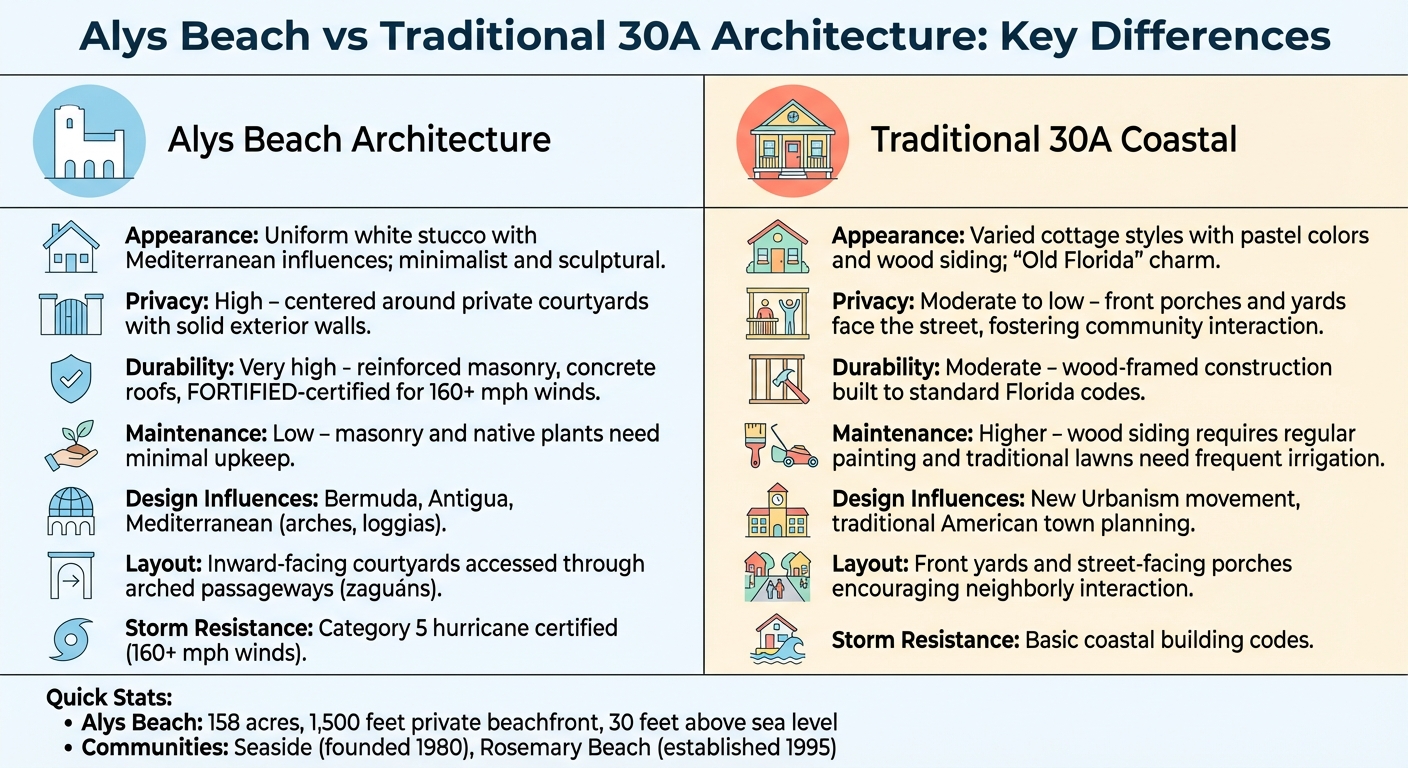
Alys Beach vs Traditional 30A Architecture Comparison
1. Alys Beach Architecture
Exterior Design
Alys Beach is instantly recognizable for its all-white aesthetic. Every building is crafted from white stucco masonry, creating a striking canvas where the natural surroundings take center stage. As town architect Marieanne Khoury-Vogt puts it:
"The homes are crafted with masonry white stucco, so the sky and landscape are the elements of color that really stand out".
The stepped, white-tiled roofs, inspired by Bermudian design, not only reflect heat but are also built to endure the challenges of tropical storms.
Adding to the charm, the streets are dotted with unique touches like Juliet balconies, intricate façade details, and custom planters contributed by homeowners. Along Scenic Highway 30A, Medjool palms and Bermudian-style "butteries" - small, decorative storage structures - act as visual landmarks, reinforcing the community's distinct identity. Together, these exterior elements create a harmonious architectural dialogue that defines Alys Beach.
Architectural Influences
Alys Beach draws inspiration from a variety of global styles, seamlessly adapted to fit the Florida coastline. The architecture combines Bermudian stepped roofs, courtyard homes reminiscent of Antigua, and Mediterranean features like arches and loggias. Galina Tachieva, an architect and town planner with Duany Plater-Zyberk, describes the design as:
"a place where urbanism, architecture, landscape, art, and green infrastructure all converged in a refined blend of design and innovation".
This fusion of styles results in a fresh take on coastal architecture, avoiding imitation of any single historical tradition.
Layout and Privacy
Breaking away from the typical 30A design, Alys Beach prioritizes courtyards over front yards. Homes are built right up to the edges of their lots, enclosing private courtyards that are accessible through zaguáns - arched passageways that enhance the sense of seclusion. Town architect Erik Vogt notes that residents have warmly embraced this departure from conventional layouts. For those moments of connection, residents can simply open their courtyard gates to engage with the pedestrian-friendly pathways.
Resilience and Sustainability
Durability is at the heart of Alys Beach's design philosophy. Every home is built to withstand winds exceeding 160 miles per hour, equivalent to a Category 5 hurricane. The community is a global pioneer, requiring all homes to meet the FORTIFIED for Safer Living certification, underscoring its dedication to safety and longevity.
Beyond structural strength, Alys Beach incorporates features like high-velocity doors and windows, permeable pavement, and an underground stormwater system that mimics natural water flow. The town's elevation - approximately 30 feet above sea level - adds another layer of protection against storm surges. Reflecting on this forward-thinking approach, Khoury-Vogt explains:
"One of the most sustainable contributions we can make is to build communities that are enduring and thus don't need to be repaired and repainted often".
This commitment to resilience and thoughtful design ensures Alys Beach is as practical as it is beautiful.
CAA's Art on Demand | An Architectural Tour of Alys Beach
2. Traditional 30A Coastal Architecture
While Alys Beach leans toward uniformity and private, enclosed spaces, traditional 30A homes embrace a more relaxed and open coastal vibe.
Exterior Design
Traditional 30A homes are known for their wood-frame construction and a variety of coastal colors that reflect a classic beach cottage style. Unlike the consistent white stucco of Alys Beach, these homes use a mix of materials and hues, giving each property a unique character. Front yards and street-facing porches are common features, creating a welcoming atmosphere. Roofing materials also differ - shingles or metal roofs replace the white-tiled roofs seen in Alys Beach. Communities like Seaside (founded in 1980) and Rosemary Beach (established in 1995) embody this aesthetic, which has become the hallmark of the area's architectural charm. These homes are rooted in a design philosophy that draws heavily from classic American town planning.
Architectural Influences
The design of traditional 30A communities is deeply tied to the New Urbanism movement, which emphasizes walkable, centralized layouts and traditional American town planning principles. Unlike Alys Beach, which takes inspiration from global locales like Bermuda or Antigua, these communities focus on creating a cohesive, local feel. Diana Lane, Director of Public Relations at Alys Beach, explains:
"New Urbanism is based on traditional town design, where everything is centralized and the residences are more densely structured, so that the overall footprint is condensed".
This philosophy extends beyond the homes themselves, influencing how outdoor spaces encourage community connections.
Layout and Privacy
Traditional 30A homes prioritize open, social layouts. Instead of enclosed courtyards like those at Alys Beach, these properties feature front yards and porches that naturally invite interaction at the street level. Standard setbacks create a sense of openness, fostering a neighborly atmosphere. Erik Vogt highlights how these layouts encourage the kind of neighborly interactions that define the 30A experience.
Resilience and Sustainability
Both architectural styles embrace the coastal lifestyle, but they approach storm resilience differently. Traditional 30A homes meet basic coastal building codes, lacking the advanced storm protections found in Alys Beach. However, the New Urbanist design inherently supports sustainability by promoting walkability and compact layouts. This reduces reliance on vehicles and helps preserve natural landscapes, aligning with the area's broader environmental goals.
sbb-itb-d06eda6
Pros and Cons
When deciding between Alys Beach and traditional 30A communities, it often comes down to choosing between privacy and durability or a more social, neighborly vibe.
Alys Beach stands out for its strength and seclusion. Every home is certified under the FORTIFIED for Safer Living® program, designed to endure winds exceeding 160 mph. As Marieanne Khoury-Vogt explains:
"You can shoot a two-by-four at 150 miles an hour and you're not going to penetrate your building envelope".
The homes, constructed with reinforced masonry and topped with concrete tile roofs, require far less maintenance compared to wood siding. The inward-facing courtyards enhance privacy but come at the expense of the front porches and yards that are hallmarks of more traditional, community-oriented neighborhoods like Seaside.
On the other hand, traditional 30A architecture offers a welcoming, communal atmosphere. The iconic beach cottage style - with its pastel hues, wood siding, and wraparound porches - creates spaces that naturally encourage neighborly interaction. These designs complement the walkable layouts of 30A communities, fostering a sense of connection. However, the wood-frame construction, while charming, demands regular upkeep, including painting and sealing, and lacks the storm resistance of Alys Beach’s fortified structures.
Here’s a side-by-side look at the key differences between these two architectural styles:
| Feature | Alys Beach Architecture | Traditional 30A Coastal Design |
|---|---|---|
| Appearance | Uniform white stucco with Mediterranean influences; minimalist and sculptural | Varied cottage styles with pastel colors and wood siding; "Old Florida" charm |
| Privacy | High; centered around private courtyards with solid exterior walls | Moderate to low; front porches and yards face the street, fostering community interaction |
| Durability | Very high; reinforced masonry, concrete roofs, FORTIFIED-certified for 160+ mph winds | Moderate; wood-framed construction built to standard Florida codes |
| Maintenance | Low; masonry and native plants need minimal upkeep | Higher; wood siding requires regular painting and traditional lawns need frequent irrigation |
Alys Beach offers unparalleled durability and privacy, while traditional 30A designs bring a sense of charm and community connection. The choice ultimately depends on whether you prioritize long-term resilience or the inviting warmth of a classic beach cottage lifestyle.
Conclusion
Alys Beach sets itself apart from other 30A communities with its focus on resilience, privacy, and cohesive design. As the first community built to meet "Fortified…for safer living" standards, its homes are crafted from reinforced masonry and concrete, designed to endure the Gulf Coast's challenging weather conditions.
Instead of the typical front-porch culture, Alys Beach features mandatory private courtyards. These secluded spaces not only offer personal retreats but also promote natural cross-ventilation. The result is a visually striking community that spans 1,500 feet of private beachfront.
The town’s design strikes a balance between consistency and individuality. The signature white-washed masonry provides a clean, unified aesthetic, while unique architectural details - like custom planters, Juliet balconies, and intricate stairwells - add personality. Town Architect Erik Vogt captures the essence of this approach:
"Ultimately, the real strength of Alys Beach is always going to be how everything comes together in a way that feels harmonious".
The layout emphasizes walkability, with all 158 acres designed to create an integrated community. Shops, restaurants, and the beach are just a short stroll away, thanks to the principles of New Urbanism. Thoughtful features like a 20-acre nature preserve and a recycled well water irrigation system show how timeless design can work hand-in-hand with practical, modern solutions.
Through its thoughtful design and practical innovations, Alys Beach offers a distinctive alternative to the typical 30A lifestyle, appealing to those who value durability, privacy, and architectural elegance.
FAQs
What makes the architecture in Alys Beach resistant to hurricanes?
Alys Beach’s architectural style is built to withstand the unpredictable and often harsh weather of the Gulf Coast, including hurricanes. The homes are characterized by their solid white stucco exteriors and gently sloping white-tile roofs, drawing inspiration from Mediterranean and Caribbean coastal designs. These choices aren’t just about aesthetics - they’re crafted to combat wind-driven rain and minimize uplift pressure during storms.
The community also follows Florida’s rigorous hurricane-resistant building codes. Features like impact-resistant windows, reinforced structural elements, and elevated foundations are standard, offering protection against storm surges. This thoughtful combination of timeless design and modern engineering ensures Alys Beach remains both resilient and visually striking.
What makes Alys Beach homes so private?
Alys Beach homes are cleverly designed to feature private, inward-facing courtyards that offer tranquil outdoor retreats for residents. These courtyards, surrounded by walls or lush greenery, provide a secluded space where homeowners can soak up the coastal sunshine and breezes without worrying about prying eyes. By positioning windows and doors to face these private areas, the homes reduce visibility from the street and neighboring properties.
Adding to this sense of seclusion, the community's Mediterranean-inspired architecture plays a key role. With white stucco exteriors, compact layouts, and thoughtfully planned sightlines, the design prioritizes natural views, like water or greenery, over neighboring homes. Quiet pedestrian pathways and generous setbacks further enhance the peaceful, resort-like atmosphere, creating a harmonious balance between personal privacy and a connection to the community.
What makes Alys Beach's architecture unique?
Alys Beach’s architecture draws from a mix of Mediterranean, Caribbean, and Greek influences, creating a visually stunning and cohesive style. The town’s signature white stucco exteriors, flat-tile roofs, and serene courtyards echo the beauty of Bermuda and the courtyard homes of Antigua, Guatemala, all thoughtfully adapted for the Gulf Coast. With narrow streets and symmetrical façades designed to invite gentle breezes, the layout captures the essence of traditional seaside villages.
This blend of old-world charm and modern coastal design gives Alys Beach an atmosphere of understated elegance. Situated along Florida’s 30A, it stands out as a destination where historic inspiration meets contemporary living, offering a distinctive experience for both visitors and residents.