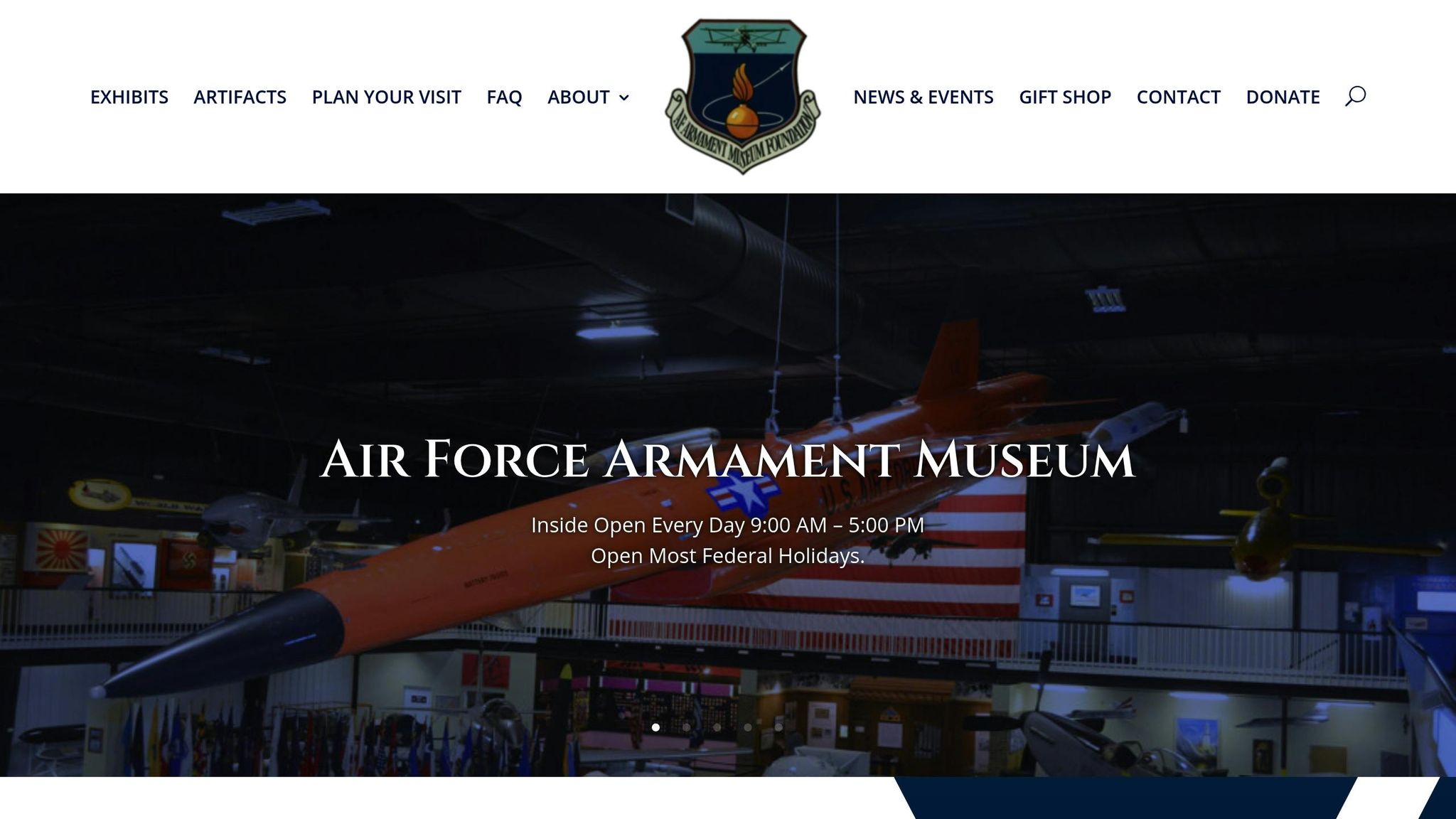
The Air Force Armament Museum in Valparaiso, Florida, is the only museum in the world dedicated solely to Air Force armament. Located near Eglin Air Force Base, it features over 29 restored aircraft, a 20,000-square-foot indoor exhibit space, and a 17-acre outdoor air park. Admission and parking are free, making it accessible for all visitors.
Key attractions include:
- SR-71 Blackbird: A reconnaissance aircraft capable of speeds over Mach 3.2.
- B-52 Stratofortress: A long-range bomber with a storied history.
- AC-130 Gunship: Known for its close air support missions.
- GBU-43 MOAB: The world’s largest conventional explosive weapon.
Inside, visitors can explore over 1,500 artifacts, interactive cockpit simulators, and themed galleries covering conflicts like the Korean and Vietnam Wars. The museum also offers educational programs like "Engineers for America" for younger audiences. Open daily, it’s a must-visit destination for aviation and military history enthusiasts.
Air Force Armament Museum Virtual Tour | Eglin Air Force Base | Florida
Museum History and Mission
Air Force Armament Museum History Timeline 1972-1995
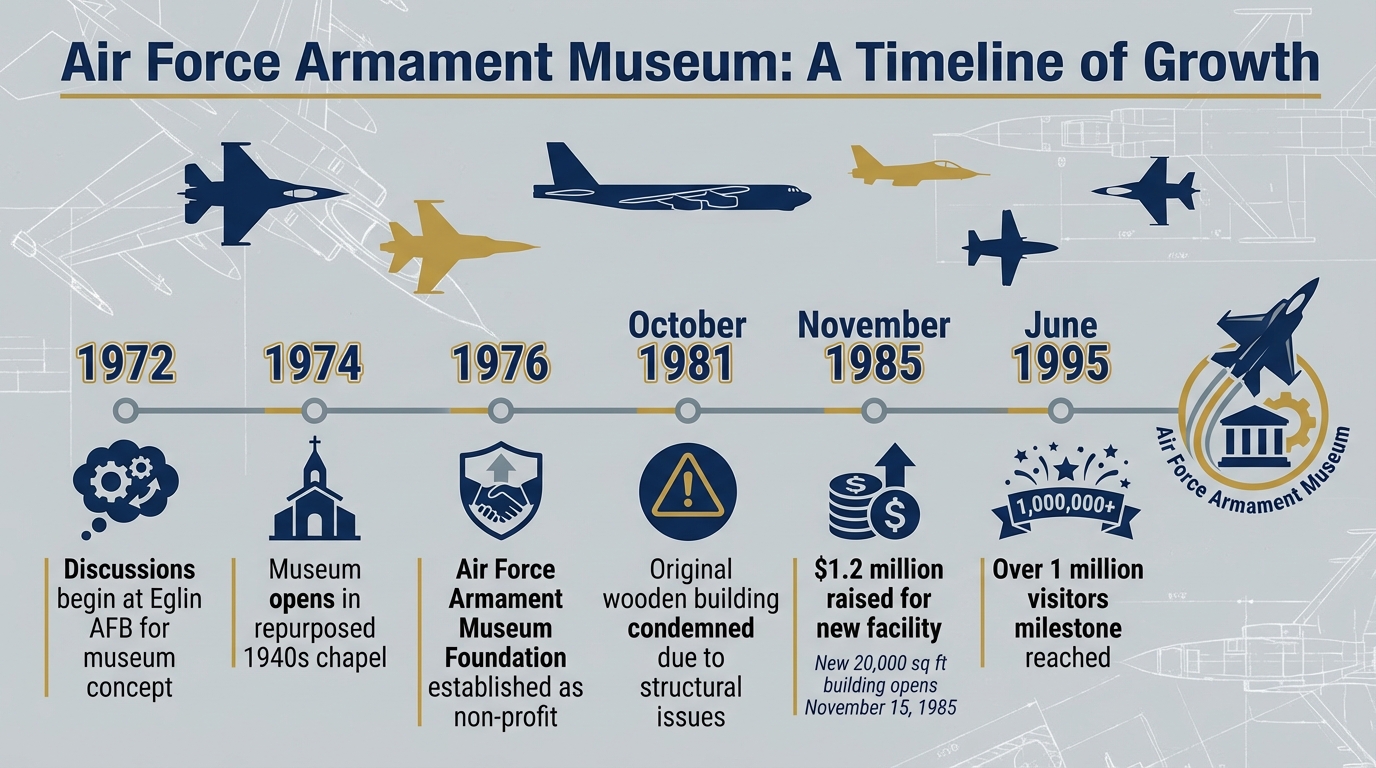
Back in 1972, discussions at Eglin Air Force Base laid the groundwork for what would become the Air Force Armament Museum. By 1974, the museum officially opened its doors in a repurposed 1940s chapel. Just two years later, in 1976, the Air Force Armament Museum Foundation was established as a non-profit organization, aimed at raising funds for a permanent, modern space. This early history provides the foundation for the museum's ongoing mission.
Structural issues with the original wooden building led to its condemnation in October 1981. However, a successful fundraising effort brought in $1.2 million by November 1985, paving the way for a new 20,000-square-foot facility. This new building, deeded to the Air Force, reopened on November 15, 1985, and by June 1995, had already welcomed over one million visitors.
"We aim to educate and inspire through our meticulously curated exhibits, showcasing the evolution of military aviation technology and the valor of those who served." - Air Force Armament Museum
The museum is dedicated to two key goals: preserving history and educating the public. Its extensive collection includes more than 1,500 artifacts, covering military aviation from World War I to the present day. These artifacts tell the story of air armament's evolution, offering a glimpse into both technological advancements and the bravery of those who served. On top of that, the museum hosts over 280 events annually, ranging from military Change of Command ceremonies to workshops and commemorations honoring veterans.
Visitors can also engage with interactive displays, try out cockpit simulators, and watch a 32-minute film that highlights Eglin Air Force Base's critical role in armament development. For younger audiences, the "Engineers for America" program offers classroom tours and hands-on engineering experiments, ensuring students gain an appreciation for this vital aspect of military heritage.
Outdoor Aircraft Collection: Historic Planes on Display
Step outside and explore a fascinating lineup of 25–29 aircraft that span from World War II to modern military operations. This outdoor air park offers a unique opportunity to delve into the history of the U.S. Air Force, with detailed plaques at each aircraft explaining their service stories. Every plane on display represents a distinct chapter of U.S. Air Force history.
"The fastest plane ever built, the SR-71 Blackbird is the centerpiece." - Air Force Armament Museum Official Website
The air park, open daily from sunrise to sunset, features informational plaques and guided walking tours available at the front desk. Beyond the aircraft, visitors can also view large-scale munitions, such as the massive T-12 Cloudmaker, a 38,600-pound earthquake bomb. Highlights of the collection include record-breaking aircraft that reshaped the future of aerial warfare.
SR-71 Blackbird
At the heart of the collection is the SR-71 Blackbird. This reconnaissance marvel could fly at speeds exceeding Mach 3.2 and soar to altitudes of 85,000 feet, allowing it to survey 100,000 square miles in just one hour.
With only 32 ever built, the Blackbird played a crucial role in strategic reconnaissance missions from 1966 to 1998. Its unmatched ability to evade enemy missiles and operate at extreme altitudes made it a key player during the Cold War.
B-52 Stratofortress
The B-52G Stratofortress on display, known as "El Lobo II", showcases the Air Force's long-range bombing capabilities. This aircraft was designed to carry a 10,000-pound payload over a range of 3,000 miles at speeds of 300 mph.
Nearly 750 B-52s were built before production ended in 1962, yet the platform remains in active service, with plans to continue operations through 2040. A defining moment in its history occurred on May 21, 1956, when a B-52 dropped the first airborne hydrogen bomb over Bikini Atoll, solidifying its place in military history.
AC-130 Gunship
The AC-130A Spectre stands as a testament to advanced close air support. Originally a C-130 Hercules transport, this aircraft was modified into a heavily armed gunship designed for ground attack missions. Visitors can even step inside the AC-130 for an interior tour, offering a rare glimpse into this powerful aircraft.
"Spectre was operationally tested at Eglin Air Force Base, Fla., from June to September 1967. It initially deployed to Nha Trang, Republic of Vietnam Sept. 20, 1967, and flew its first combat mission Sept. 27." - Air Force Armament Museum Official Website
The AC-130's roots at Eglin Air Force Base tie directly to the museum's location, adding a special connection to the exhibit. During the Vietnam War, this gunship became indispensable, providing crucial air support to ground forces.
Indoor Exhibits: Artifacts and Interactive Displays
Step inside the museum's 20,000-square-foot gallery, where history meets hands-on exploration. The indoor exhibits showcase hundreds of pieces of military armament, tracing the evolution of technology from World War I to today. Alongside these artifacts, you'll find four aircraft displayed with an array of bombs, missiles, and rockets. Interactive features bridge the gap between historical relics and modern advancements, offering a deeper connection to the past.
"This convergence of history and 21st century influences allows the museum to educate visitors for hours each visit." - Air Force Armament Museum
The Gun Vault is a highlight, featuring weaponry from the 1903 Springfield rifle to the powerful GAU-8 Gatling gun, capable of firing 6,000 rounds per minute. Another standout is the Sikes Antique Pistol Collection, which includes over 180 handguns. From flintlocks and Civil War-era pistols to Western six-shooters, this collection provides a fascinating look at the early development of military firearms. The indoor exhibits also feature themed galleries, such as those dedicated to the Korean and Vietnam Wars, along with interactive multimedia simulations.
Korean and Vietnam War Exhibits
The museum's Korean and Vietnam War galleries spotlight the critical role of the Air Force in these conflicts. The Vietnam War exhibit brings the era to life with pilot uniforms, personal equipment, and firsthand accounts from service members. It also highlights the operational testing of the AC-130 Spectre gunship at Eglin AFB in 1967 before its deployment to Nha Trang on September 20 of that year. Meanwhile, the Korean War section recounts the North Korean invasion and the subsequent support efforts by the U.S. and United Nations. These exhibits honor the contributions of military aviation and armament while preserving the stories of those who served.
Interactive Displays and Multimedia Experiences
For a more immersive experience, visitors can try out multiple cockpit simulators, including an A-10 "Warthog" simulator. These interactive displays are designed to engage both kids and adults, offering a hands-on way to explore aviation technology. Photography is welcome throughout the indoor exhibits, so visitors can capture their favorite moments and the impressive armament on display.
sbb-itb-d06eda6
Weapons and Armament Artifacts
The museum's collection offers a fascinating journey through the evolution of air-delivered weapons, from simple gravity bombs to advanced precision-guided munitions. These exhibits showcase decades of advancements in guidance systems, explosive capabilities, and tactical applications. Below are some standout artifacts that represent key milestones in this technological progression.
GBU-43/B MOAB
The GBU-43/B Massive Ordnance Air Blast (MOAB), often called the "Mother of All Bombs", holds the title of the largest satellite-guided, air-delivered conventional weapon ever built. Developed at Eglin Air Force Base, this colossal weapon weighs an incredible 21,600 pounds, with 18,700 pounds of H6 explosive packed into its 30-foot-long frame, which has a diameter of 40.5 inches. Its KMU-593/B GPS/INS guidance system ensures pinpoint accuracy. Unlike bunker busters, which are designed to penetrate deeply before detonating, the MOAB explodes just above the ground. This creates a devastating blast radius of about 150 meters (492 feet), making it highly effective against surface targets, minefields, and cave entrances. It succeeded the unguided 15,000-pound BLU-82 "Daisy Cutter", which had been used during the Vietnam War and early Afghanistan operations. Remarkably, the MOAB was developed in just 10 months. Its first combat use occurred on April 13, 2017, when it targeted a network of caves and tunnels used by Islamic State militants in Afghanistan's Achin district .
Next, the museum delves into the transformative impact of the AIM-9 Sidewinder missile on aerial combat.
AIM-9 Sidewinder Missile
The AIM-9 Sidewinder revolutionized air combat with its heat-seeking, "fire and forget" technology. Utilizing infrared guidance, this missile allows pilots to lock onto a target and fire without needing continuous tracking. This innovation marked a dramatic shift from traditional gun-based dogfighting to the age of missile-based air dominance. The exhibit pairs the Sidewinder with earlier missile models, including the Falcon AIM-26B and GAR-1D, to illustrate the rapid evolution of air-to-air missile technology.
AGM-65 Maverick Missile
The AGM-65 Maverick represents a leap forward in precision-guided air-to-ground weaponry. Equipped with TV, laser, or infrared guidance, the Maverick is designed to hit both moving and stationary targets with exceptional accuracy. Its guidance systems can automatically identify and track targets even in difficult conditions, drastically reducing the risk of collateral damage compared to older, unguided munitions. Modern versions of the Maverick incorporate advanced microprocessors and digital electronics, enabling precise in-flight navigation and enhanced computing power. Through this artifact, the museum highlights the continuous evolution of air armament technology and its impact on modern warfare.
Planning Your Visit
Location and Directions
The Air Force Armament Museum is located at 100 Museum Drive, Eglin AFB, FL 32542, just off Highway 85 North near Eglin Air Force Base. You don’t need a military ID or base pass to visit. If you’re coming from Fort Walton Beach, head about 7 miles north on Highway 85 and follow the airport signs - they’ll lead you straight to the museum. On-site parking is free, with additional spaces for RVs and buses available at the south end when space permits.
Hours and Admission
Admission to the museum is completely free. The indoor exhibits are open daily from 9 a.m. to 5 p.m., while the outdoor airpark is accessible from sunrise to sunset. The museum only closes on Thanksgiving and Christmas Day but welcomes visitors on New Year’s Day. Groups of five or more can book a volunteer-guided tour (lasting 60–90 minutes) by contacting the museum at least one week in advance. While entry is free, donations are appreciated to support the upkeep of this national treasure.
Nearby Attractions
Make the most of your trip by exploring nearby spots like Wild Willy's Adventure Zone, Gulfarium Marine Adventure Park, the Okaloosa Island Boardwalk, and the Emerald Coast Science Center. For more travel tips and local highlights, check out sowal.co (https://sowal.co).
Why Visit the Air Force Armament Museum
The Air Force Armament Museum stands out as the only museum in the world solely dedicated to Air Force armament, offering a fascinating look into the evolution of military aviation and weaponry. Its focus on armament technology and delivery systems makes it a must-visit for those curious about the history and advancement of air power.
Visitors of all ages can enjoy an array of engaging features, from interactive cockpit simulators to dynamic mixed-media displays. Families, in particular, will appreciate programs like "Engineers for America", which introduces students to foundational engineering concepts in a fun and educational way. The museum’s hands-on exhibits and diverse collection ensure an enriching experience for everyone.
In addition to its impressive historical displays, the museum continues to grow, honoring the contributions of various groups within the military. For example, the African American Military Heritage Hall, opened in February 2022, highlights the significant roles played by African American service members at Eglin Air Force Base. Exhibits like the GBU-43 MOAB, precision-guided missiles, and other advanced weaponry connect the museum’s storied past to modern innovations.
Whether you're a history enthusiast, an aviation fan, or just looking for an educational and entertaining stop in Northwest Florida, the Air Force Armament Museum promises a day of discovery - and it’s completely free. It’s an experience not to be missed along the Emerald Coast.
FAQs
Why is the SR-71 Blackbird a must-see exhibit at the Air Force Armament Museum?
The SR-71 Blackbird is one of the most captivating exhibits at the Air Force Armament Museum, earning its place in history as the fastest and highest-flying aircraft ever built. Its sleek, jet-black exterior draws the eye, but it’s the aircraft’s extraordinary achievements that leave a lasting impression. Back in July 1976, the SR-71 set a jaw-dropping speed record of 2,193.2 mph and soared to an altitude of 85,069 feet - records that remain undefeated even today.
What makes the Blackbird even more fascinating is its vital role during the Cold War. Operating as a reconnaissance aircraft from 1966 to 1998, it undertook covert missions over enemy territories, collecting essential intelligence while cruising at an astonishing altitude of 80,000 feet. This blend of groundbreaking technology and historical importance makes the SR-71 a must-see for anyone passionate about aviation or history.
What activities does the Air Force Armament Museum offer to engage kids with military history?
The Air Force Armament Museum brings military history to life for kids with interactive exhibits and hands-on activities. Inside, children can get up close to displays of bombs, missiles, rockets, and historic aircraft. Touchscreens, simulated targeting drills, and other engaging stations turn complex topics into fun, easy-to-understand experiences tailored for younger visitors.
Families can also explore the outdoor aircraft park, home to legendary planes like the SR-71 Blackbird. Inside, exhibits like a World War II Prisoner-of-War cell, complete with hidden escape tools, offer an immersive glimpse into history. With free admission and self-guided tours, the museum provides a relaxed environment for families and school groups to spend an entire day discovering aviation and military history in an exciting, hands-on way.
What can I see in the outdoor aircraft collection at the Air Force Armament Museum?
The outdoor aircraft collection at the Air Force Armament Museum stretches across 17 acres, showcasing more than 25 historic military aircraft. Among the highlights is the legendary SR-71 Blackbird, known as the fastest aircraft ever built. Other iconic planes on display include the B-17 Flying Fortress, P-51 Mustang, B-52 Stratofortress, A-10 Warthog, and modern fighters like the F-15 and F-16. Together, these aircraft tell the story of pivotal moments in U.S. airpower history, spanning from World War II to the Gulf War.
Visitors are invited to stroll among these remarkable planes, marvel at their detailed designs up close, and capture memorable photos. The collection not only reflects the evolution of aviation technology but also pays tribute to the service and sacrifice of those who flew them. For aviation fans and history lovers, this outdoor display is an experience not to be missed.